Week 4 - Linkage, Recombination, and Eukaryotic Gene Mapping
 Call Kai
 Learn
 Practice Test
 Spaced Repetition
 Match
 Flashcards
 Knowt Play
1/23

There's no tags or description
Looks like no tags are added yet.
24 Terms
What are linked genes, and how does genetic recombination affect their inheritance?
Linked genes are genes located on the same chromosome that tend to be inherited together during meiosis.
Unlike unlinked genes, linked genes do not always assort independently because they are physically located on the same chromosome.
However, crossing over between homologous chromosomes can exchange chromosome segments, producing new combinations of alleles.
This process is called genetic recombination, and it explains why linked genes are not always inherited together.

What did Thomas Hunt Morgan and Alfred Sturtevant discover about genetic linkage and recombination?
Thomas Hunt Morgan:
Observed that some genes do not segregate independently, contrary to the pattern predicted by Mendel's law of independent assortment.
Proposed that genes located on the same chromosome are linked and tend to be inherited together.
Recognized that recombination can produce allele combinations different from the original linked combinations.
Alfred Sturtevant:
Established that the frequency of recombination reflects the distance between genes on a chromosome.
Genes that are closer together have a lower recombination frequency because crossing over is less likely to occur between them.
Genes farther apart generally have a higher recombination frequency because crossing over is more likely to occur between them.
What is Mendel's law of independent assortment, and how does it affect gamete formation?
Mendel's law of independent assortment states that the inheritance of one trait does not affect the inheritance of another trait.
Genes located on different chromosome pairs assort independently because homologous chromosome pairs orient randomly during metaphase I of meiosis.
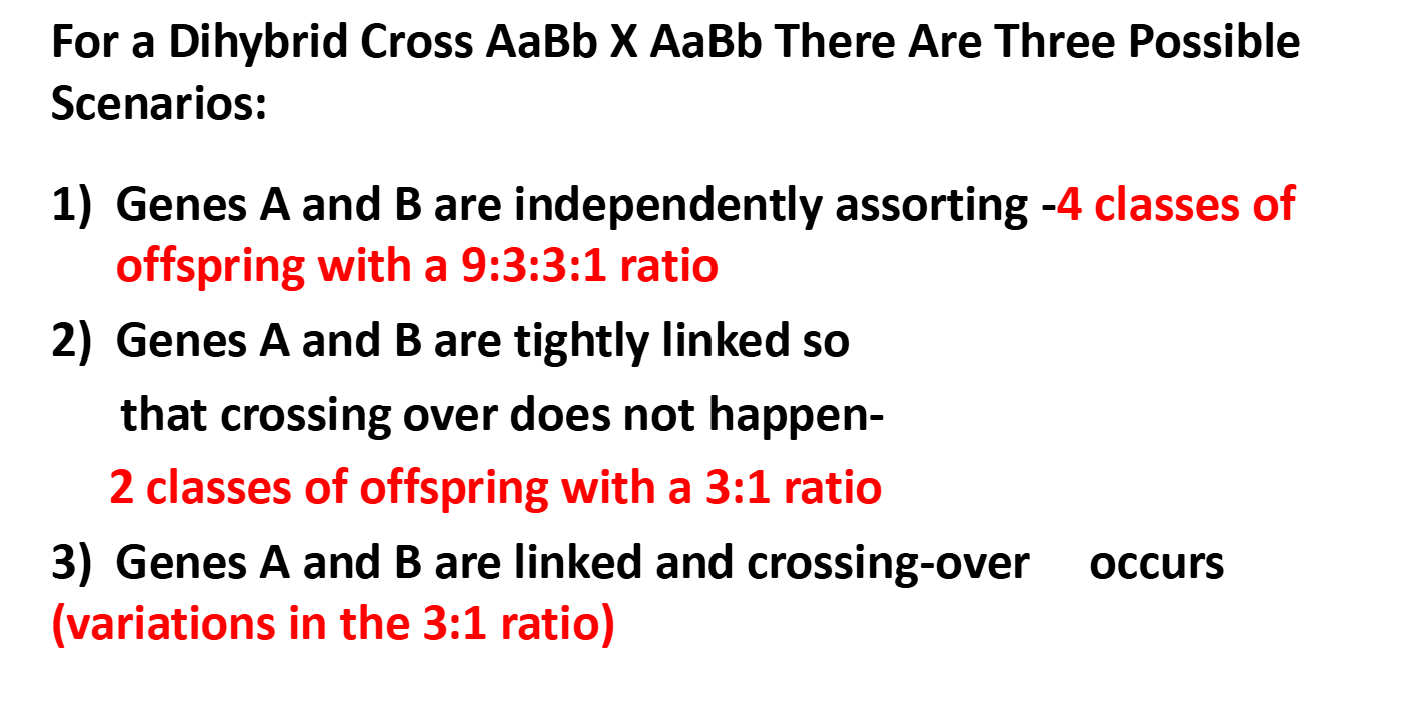
For an AaBb individual with independently assorting genes, four gamete types are produced: AB, Ab, aB, and ab.
Each gamete type has an equal probability of 25%.

How does the orientation of homologous chromosomes during meiosis explain independent assortment?
During metaphase I of meiosis, each homologous chromosome pair aligns randomly and independently of other pairs.
For an AaBb individual with genes on different chromosome pairs, two orientations are possible: A with B and a with b, or A with b and a with B.
These orientations produce four equally likely gamete combinations: AB, ab, Ab, and aB.
Therefore, the inheritance of one chromosome pair does not determine the inheritance of another.

Why does a dihybrid cross between independently assorting genes produce a 9:3:3:1 phenotypic ratio?
When two dihybrid individuals (GgWw × GgWw) are crossed, each parent produces four gamete types (GW, Gw, gW, gw) in equal proportions.
Random fertilization produces 16 equally likely genotype combinations.
This ratio is characteristic of independently assorting genes under standard Mendelian conditions.

How did Bateson and Punnett's sweet pea experiment demonstrate that some genes do not assort independently?
Bateson and Punnett studied flower colour (red/white) and pollen grain shape (long/short) in sweet pea plants.
Under independent assortment, the F2 offspring were expected to follow a 9:3:3:1 phenotypic ratio.
Instead, parental combinations (red/long and white/short) occurred much more frequently than expected.
Recombinant combinations (red/short and white/long) occurred much less frequently.
These results demonstrated that the two genes were linked and tended to be inherited together, although occasional crossing over produced recombinant offspring.

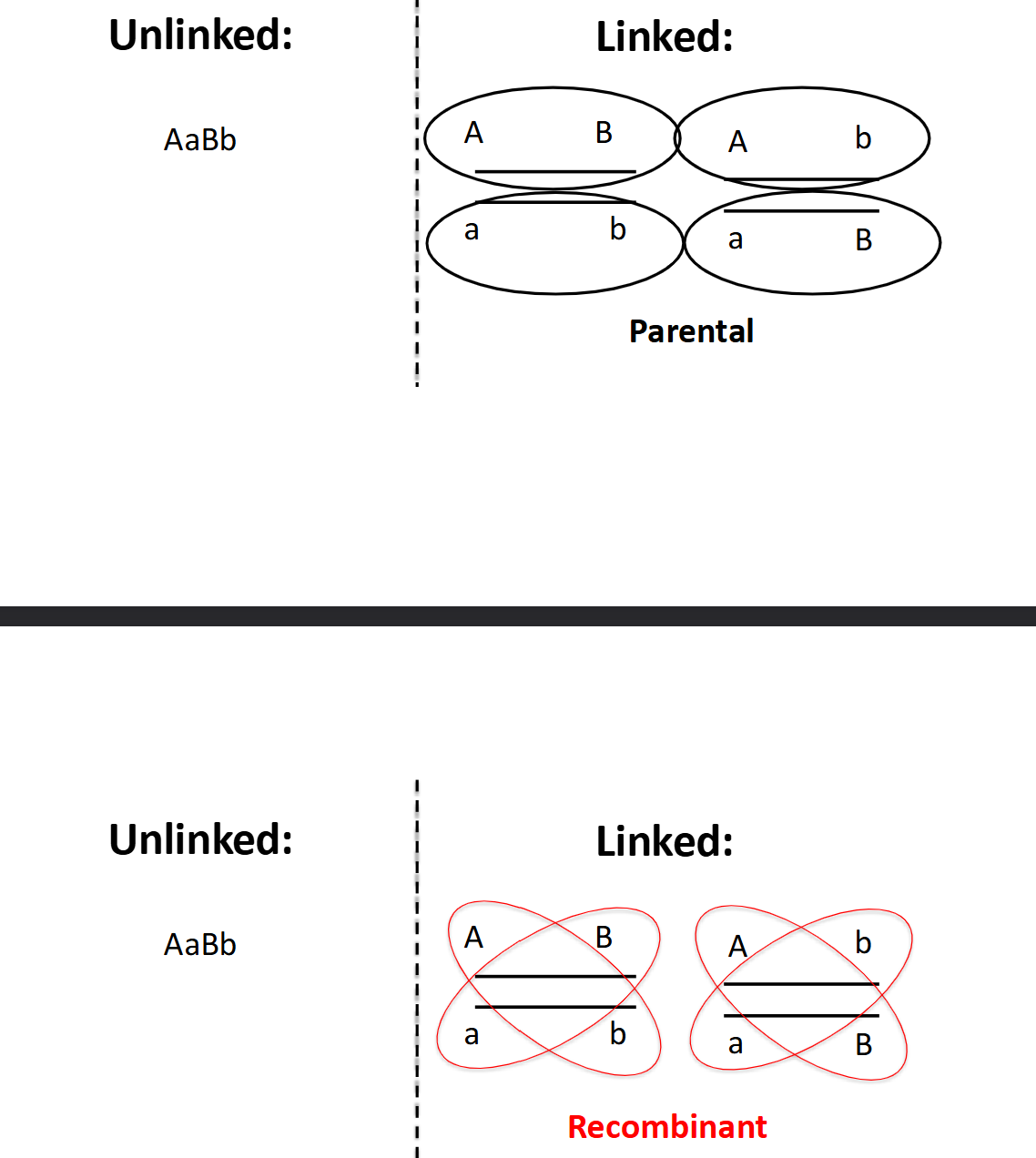
How does gamete formation differ between linked and unlinked genes?
Unlinked genes are located on different chromosomes and assort independently during meiosis.
An AaBb individual with unlinked genes produces four gamete types (AB, Ab, aB, ab), each at a frequency of 25%.
Linked genes are located on the same chromosome and tend to be inherited together.
For linked genes, parental allele combinations occur more frequently, while recombinant combinations occur less frequently due to crossing over.
The frequency of recombination between linked genes reflects their distance apart on the chromosome.

What is the difference between parental and recombinant gametes?
Parental (nonrecombinant) gametes contain the same combinations of linked alleles that were present on the original homologous chromosomes.
Recombinant gametes contain new combinations of linked alleles produced through crossing over between homologous chromosomes during meiosis.
For an individual with the linked configuration AB/ab: - Parental gametes: AB and ab - Recombinant gametes: Ab and aB
Two individuals can have the same genotype (AaBb) but different arrangements of linked alleles on their homologous chromosomes.
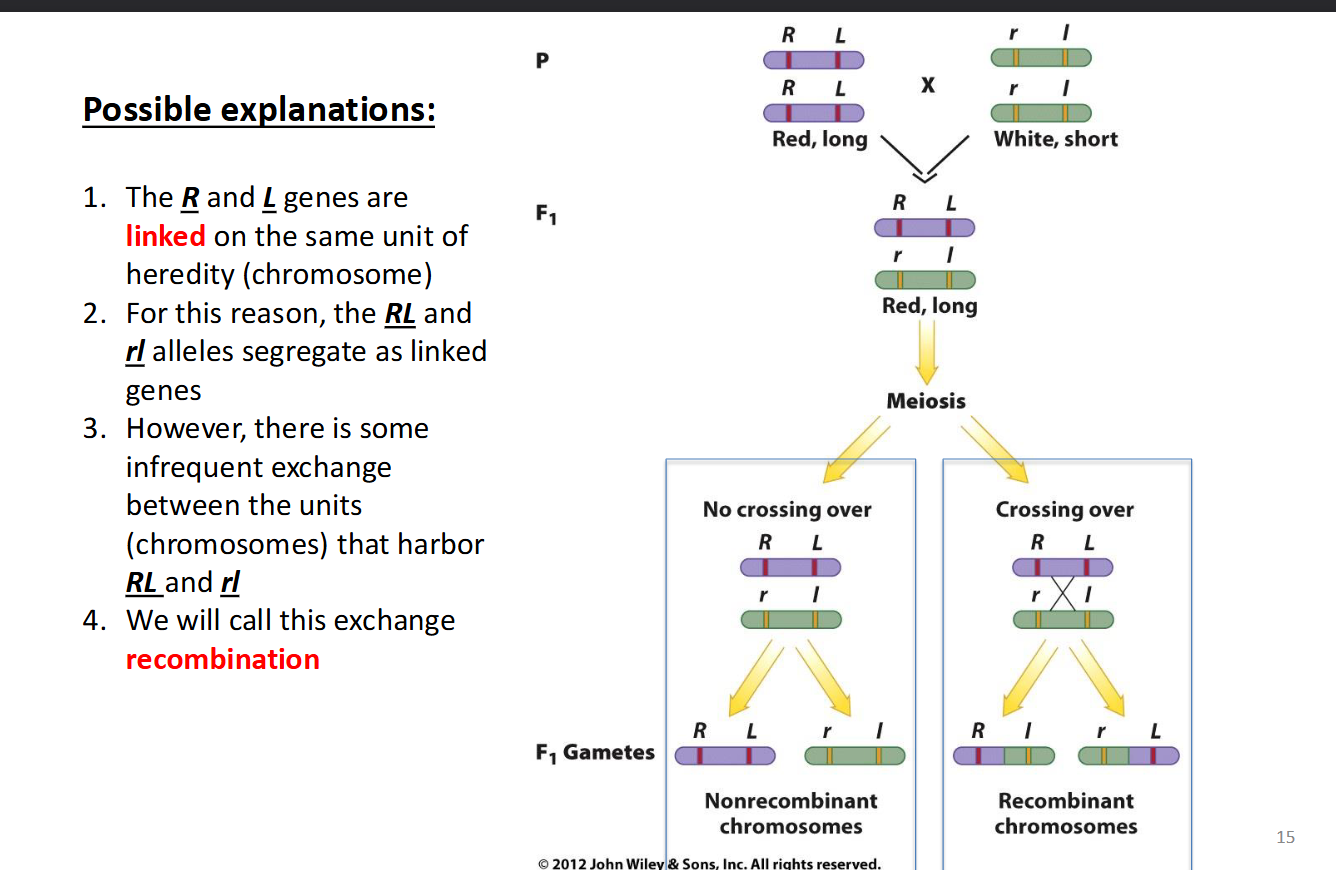
How does crossing over produce recombinant allele combinations in linked genes?
Linked genes are located on the same chromosome and tend to segregate together during meiosis.
Without crossing over between the genes, parental gametes RL and rl are produced
Crossing over exchanges corresponding chromosome segments between homologous chromosomes, generating new combinations of alleles.
This produces recombinant gametes Rl and rL
How is recombination frequency calculated, and what does it represent?
Recombination frequency measures the proportion of offspring resulting from recombinant gametes.
Formula: Recombination frequency = (Number of recombinant offspring / Total number of offspring) × 100.
Example from the lecture:
Parental offspring: 450 + 470 = 920
Recombinant offspring: 42 + 38 = 80
Total offspring: 1000
Recombination frequency = (80/1000) × 100 = 8%.
Recombination frequency varies between different pairs of genes and can be used to estimate genetic distance.

How do offspring ratios differ between testcrosses involving linked and unlinked genes?
Unlinked genes: Assort independently, producing four equally frequent offspring classes (1:1:1:1 ratio).
Linked genes: Tend to be inherited together, producing two major parental classes and two minor recombinant classes due to crossing over.
Key difference: Linked genes deviate from the expected 1:1:1:1 ratio because parental allele combinations occur more frequently.

What is crossing over, and when does it occur during meiosis?
Crossing over is the physical exchange of corresponding chromosome segments between non-sister chromatids of homologous chromosomes.
It occurs during prophase I of meiosis, after chromosomes have replicated.
This exchange can produce new combinations of existing alleles, called recombinant chromosomes.
Crossing over explains how linked genes can be separated into new allele combinations.
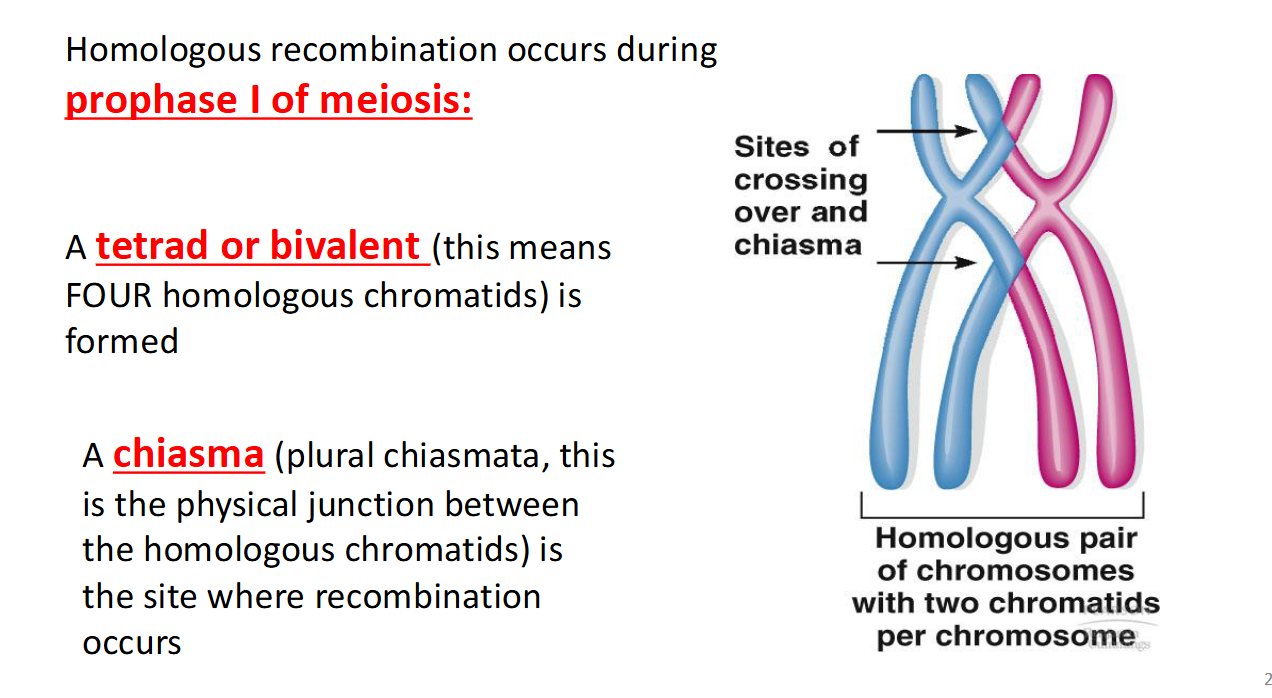
What are tetrads and chiasmata, and how many chromatids participate in a crossover?
A tetrad (bivalent) consists of two paired homologous chromosomes, each containing two sister chromatids (four chromatids total).
A chiasma is the visible junction between homologous chromatids associated with crossing over.
A single crossover involves only two of the four chromatids in a tetrad.
If the crossover occurs between two linked genes, two chromatids remain parental and two become recombinant (50% each).

How does the distance between two linked genes affect their recombination frequency?
Genes located close together on the same chromosome have a lower probability of crossing over between them and therefore show lower recombination frequencies.
Genes located farther apart have a higher probability of crossing over between them and generally show higher recombination frequencies.
Closer genes exhibit stronger linkage, while more distant genes exhibit weaker linkage.
Recombination frequency can therefore be used to estimate genetic distance between linked genes.

What is chromosome mapping, and how is genetic distance calculated?
Chromosome mapping estimates the distance between linked genes using their recombination frequency.
Formula: (Number of recombinant offspring / Total offspring) × 100.
Genetic distance is measured in map units or centimorgans (cM), where 1% recombination = 1 cM.
Genes farther apart generally have higher recombination frequencies than genes closer together.
How do offspring phenotypic ratios differ depending on whether two genes are linked or independently assorting?
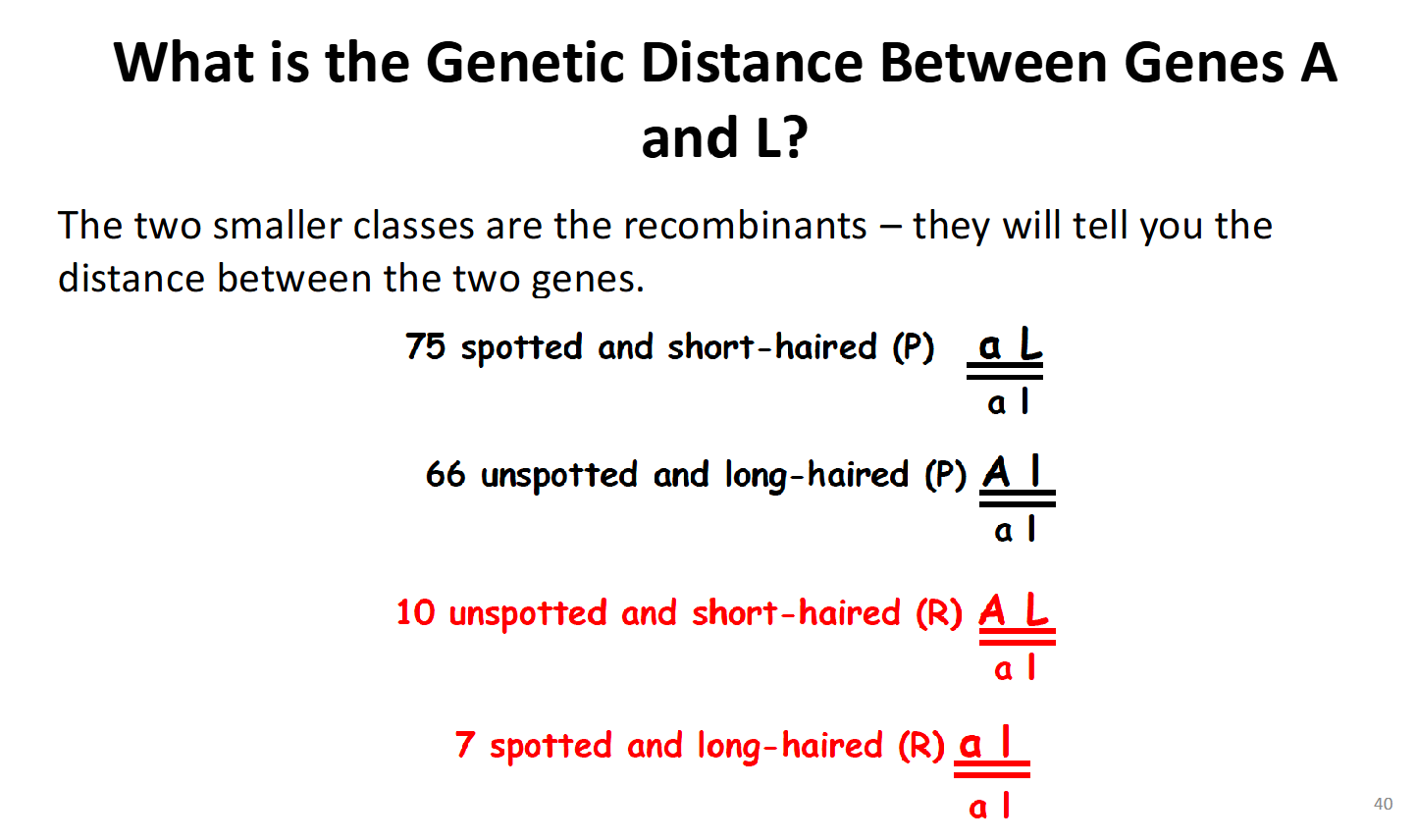
Identify the two parental allele combinations, usually represented by the two largest offspring classes.
The two smaller classes represent recombinant combinations produced through crossing over.
Add the recombinant offspring and divide by the total offspring, then multiply by 100.
Example: (18 + 10) / 164 × 100 = 17 cM.
This indicates that genes A and B are approximately 17 map units apart.
How do offspring phenotypic ratios differ depending on whether two genes are linked or independently assorting?
What are the key characteristics of crossing over during meiosis?
Crossing over occurs during prophase I of meiosis after chromosome replication.
It involves the exchange of chromosome segments between non-sister chromatids of homologous chromosomes.
A single crossover involves only two of the four chromatids in a tetrad.
Crossovers become visible as chiasmata later in prophase I.
Recombination frequency can be used to estimate genetic distances between linked genes.
How can recombination frequencies be used to construct a chromosome map?
Recombination frequencies between pairs of linked genes are used to estimate genetic distances in centimorgans (cM).
Comparing distances between multiple gene pairs helps determine their relative positions along a chromosome.
For example, if A–B = 5 cM, B–C = 10 cM, and A–C = 15 cM, the gene order can be A–B–C.
Multiple crossovers can cause observed recombination frequencies to underestimate longer genetic distances.

Why is the maximum observable recombination frequency 50%, even when genes are more than 50 cM apart?
Genes that are very far apart may experience multiple crossing-over events, sometimes restoring parental allele combinations.
As genetic distance increases, the four gamete types (AB, ab, Ab, aB) approach equal frequencies of 25% each.
Therefore, recombinant gametes make up at most 50% of the total (25% + 25%).
Genes with 50% recombination appear to assort independently, even if they are located on the same chromosome.
Genetic map distances can exceed 50 cM, but observable recombination frequencies cannot exceed 50%.

How do you identify parental and recombinant offspring in a linkage testcross?
The two most frequent offspring classes are typically parental, retaining the original allele combinations.
The two least frequent classes are recombinant, produced by crossing over.
The parental classes reveal which alleles were originally together on each homologous chromosome.
In this example; homozygous parent aall→ Use this info to determine heterozygous parent
AaLl → Al and aL linked!
What is the difference between cis and trans configurations?
Cis (coupling): Both dominant alleles are on one homolog and both recessive alleles on the other (AL/al).
Trans (repulsion): Each homolog carries one dominant and one recessive allele (aL/Al).
Both arrangements have the same overall genotype (AaLl), but different parental gametes.
How is genetic distance calculated in the rabbit linkage example?
Parental offspring: Spotted/short (75) and unspotted/long (66).
Recombinant offspring: Unspotted/short (10) and spotted/long (7). • RF = (10 + 7) / 158 × 100 = 10.8%.
Therefore, genes A and L are approximately 10.8 cM apart.
How do you calculate parental and recombinant gamete frequencies from genetic distance?
Genetic distance in cM approximates recombination frequency (%) for closely linked genes.
Each recombinant gamete type = RF / 2.
Each parental gamete type = (100 − RF) / 2.
Example: RF = 10.8% → each recombinant type = 5.4%, each parental type = 44.6%.
