Foundations of Ecology and Evolution: Exam 3 Vocabulary Review
 Call Kai
 Learn
 Practice Test
 Spaced Repetition
 Match
 Flashcards
 Knowt Play
1/214

Earn XP
Description and Tags
Comprehensive vocabulary flashcards covering evolutionary mechanisms, trait variation, population genetics, sexual selection, speciation, and life history strategies for Exam 3.
215 Terms
Phenotypic Plasticity
When one genotype makes different traits in different environments (such as temperature setting reptile sex).
Broad-Sense Heritability (H2)
The share of total trait variance (VP) caused by genes (VG): H2=VPVG.
Narrow-Sense Heritability (h2)
The share of trait variance passed directly from parents to young, measured as the slope (h2) of offspring on parent traits.

Hardy-Weinberg Equilibrium
A rule stating gene frequencies stay unchanged across generations without evolution (p2+2pq+q2=1.0).
Genetic Drift
Random shifts in gene frequencies purely by chance, which have the largest effect in small populations.
Genetic Bottleneck
A sharp crash in population size that wipes out most genetic variation.
Founder Effect
Low genetic diversity that happens when a few individuals colonize a new area.

Inbreeding Coefficient (F)
The chance, from 0 to 1, that two gene copies come from the exact same ancestor.
Inbreeding Depression
A drop in survival and health when close relatives mate and express harmful recessive genes.
Heterozygote Advantage
When having two different alleles gives higher fitness than having two identical alleles (like sickle cell carriers resisting malaria).
Directional Selection
Selection that favors one extreme trait, shifting the population average toward that side.

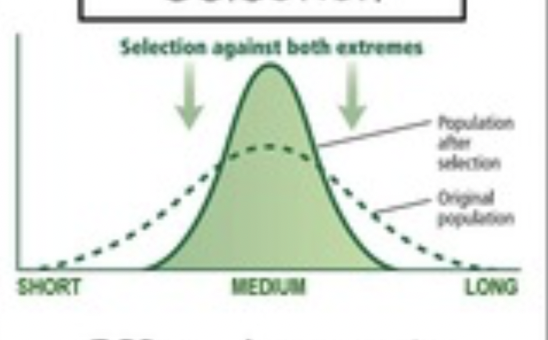
Stabilizing Selection
Selection that favors average traits and removes both extremes (such as typical human birth weight).
Disruptive Selection
Selection that favors both extremes over the average, splitting the population into two distinct types.
Lamarckism
The incorrect idea that traits acquired by use or disuse during life pass directly to offspring.
Anisogamy
Having sex cells of unequal size: large, nutrient-rich eggs versus tiny, cheap sperm.
Two-Fold Cost of Sex
The theoretical 50% loss in reproduction rate compared to asexual species because males cannot bear offspring.
Intrasexual Selection
Direct competition between members of the same sex (usually males) to win access to mates.
Intersexual Selection
Mate choice where one sex (usually females) selects partners based on ornaments, displays, or resources.
Runaway Selection
When female preference and a male display trait become linked and drive extreme exaggeration over time.

Lek
A shared display ground where males gather to compete and perform for visiting females.
Sneaker Male
A smaller male that slips past large guarding males to fertilize eggs in secret.
Sperm Competition
Competition between sperm from multiple males inside the female to fertilize the eggs.
Biological Species Concept
Defines a species as groups of natural populations that can interbreed and produce fertile young.
Phylogenetic Species Concept
Defines a species as the smallest group of organisms sharing unique derived evolutionary traits.
Morphological Species Concept
Defines species purely by measurable physical shapes, anatomy, and appearance.
Monophyletic Group
A group containing a common ancestor and all of its descendants.
Paraphyletic Group
A group containing a common ancestor and some, but not all, of its descendants.

Polyphyletic Group
A group of organisms from different lineages that leaves out their recent common ancestor.
Allopatric Speciation
Speciation that occurs when a physical geographic barrier divides a population.
Sympatric Speciation
Speciation that happens while populations live in the exact same geographic area.
Reinforcement
Natural selection strengthening mating barriers because hybrid offspring have low fitness or die.
Homoploid Hybrid Speciation
The formation of a new hybrid species without changing or duplicating chromosome numbers.
Anagenesis
Evolutionary change within a single unbranched lineage over time.

Cladogenesis
Branching evolution where one lineage splits into two or more separate lineages.
Principle of Allocation
Energy used for one need (such as growth or defense) cannot be used for another (such as reproduction).
Lack's Hypothesis
Selection favors an intermediate clutch size that produces the highest total number of surviving chicks.
r-Selection
A life strategy in disturbed places: fast growth, early breeding, many small young, and weak competitive ability.
K-Selection
A life strategy in stable places: slow growth, late breeding, few large young, and strong competitive ability.
Semelparity
A life strategy with a single, massive reproductive event before death.
Iteroparity
A life strategy with repeated breeding events across multiple adult seasons.
Gonadosomatic Index (GSI)
The ratio of reproductive organ weight to total body weight, tracking breeding effort.
how often do boobie birds mate
skip season to increase blue pigment in legs or every season
cheetahs are ex of what term
genetic bottle neck- cuz had loss of diversity in population size cuz inbreeding and population decline.
cave fish are ex of what term
genetic drift cuz scale color lost pigment by chance
& natural selection cuz lost eyes cuz they took up too much energy and it was rlly dark
r selected char for intrinsic rate of increase, compet ability, development, repro when & how often, body size, offspring AND EXAMPLE
high intrin rate of increase, weak competitors, rapid development, reproduction early in life & semelparous (once in life), many and small offspring EX. dandelion
k selected char for intrinsic rate of increase, compet ability, development, repro when & how often, body size, offspring AND EXAMPLE
low intrin rate of increase, strong competitors, slow development, reproduction later in life & iteroperalous (many times in life), big few offspring EX. orangoutangs, elephants, sea turtles
benefit of asexual reproduction
fast- no removal of traits
pre zygotic barriers
temporal, mechanical, habitat, gametic, behavioral
post zygotic barriers
hybrid inviability (visible deform), hybrid sterility (infertile), hybrid breakdown (survive but low fitness, reduced hybrid fertilityeth
heterozygote advantage examples
sickle cell, malaria
what can happen if reproduction isolation is incomplete & examples
hybrid zones (two species are completely isolated so they can make hybrid offspring), fire bellied toads and yellow bellied toads & small bodied small beak finches w/ large body large beak finch——> intermediate finch
What’s not a cost of sexual reproduction
certainty of paternity (no certainty who will be father, doesn’t affect egg production)
allospeciation occurs initially due to….
geographical isolation
two modes of geographical isolation and ex for each
dispersal- species move to another location + traits emphasized makes new species ex. hawaillpn flies ( hoped from island to island, wings got bigger, bodies changed)
vicsrence- geographical location physically splits, species adapt and traits emphasize. ex. snapping shrimp (isthmus in Panama split to become Pacific and caribbean)
what did lack figure out clutch sizes
he said mathematically peaked at 5, clutch sizes are lower than optimal
experiment results of second experiment after lacks experiment abt clutch size
compared age 1 vs age 2 and clutch size first then added egg to first year breeders. result of #1- lower the age, smaller the clutch size. result #2: clutch size decreased in following years cuz didnt have energy to support them cuz first year bird had egg added so automatically smaller clutch size (basically intiatd energy decrease pattern).
experiment results of third experiment after lacks experiment abt clutch size
fitness of offspring vs mothers clutch size. result: less siblings = daughters that adulated could have larger clutch sizes. if had more siblings, daughters had smaller clutch size.
experimental results of third experiment led to what concept + what is it
variable reproductive capacity- diff # eggs individual females will produce, optimal level for pop dodes’t mean optimal level for individual

explain inbreeding depression graphs
scale: inbreeding coefficient is 0 to 1, tells freq of homozygous individuals. in breeding depression is increasing. more they mate, lower the survival
3 concepts w/ black footed ferrets
genetic bottle neck, genetic drift, founders effect
3 things tht affected black footed ferrets pop dec
habitat loss
hunting of food source (prairie dogs hunted)
disease (K9 distemper, syllabic plague)
3 types of graphs selection
directional, disruptive and stabilizing
disruptive graph details + 2 ex
two different options, intermediate fails
black bellied seed crackers- small beak (eats soft food) & large beak (eat hard), one in the middle dies off cause cant eat either
Darwins finches

stabilizing graph details + 2 ex
2 options but both extreme, intermediate is favored
mothers pelvis size and baby weight, obvi is baby is too big and pelvis too small doesn’t work duh
bird clutch size. if too many babies cant feed all, if too little then can keep generation moving forward
directional graph details + 2 ex
extreme transition with slope, either up or down
shift could b caused by humans unintentionally, adaptations shift cuz of the changes (before + after)
pepper moths ( Industrial Revolution caused white lichen to go cuz the smog and the moths needed to keep camouflage so print changed)
ginseng plants ( too many ppl in Asia were picking them for medical use so plants changed colors to look dead/ not like previous)

Darwin vs Wallace studies (location, who published first)
Wallace- Malay , giraffes thought traits were just acquired, epigenetic as well
Darwin- galapagos, finches, talked to lack but published first, talked abt evolution and trait adaptation from evolution, has 4 postulates
Large population, no mutation, random mating, no migration, no selection.
By chance allele can become fixed in population.
Founder effect.
House finches: What concept, where did they move, and what happened?
Founder effect → eastern US → low diversity and disease susceptibility.
Probability 2 alleles are identical by descent ranges from 0 to 1.
Florida panthers: What was the problem, solu
Small population/inbreeding → 8 Texas females introduced → increased heterozygosity and reduced inbreeding depression.
AA = p² + Fpq, Aa = 2pq(1−F) aa = q² + Fpq.
Beta-globin (HBB) gene heterozygotes are carriers.
What did Lamarck say about giraffe necks?
Necks grow because giraffes keep using/stretching them.
Variation between individuals, some die,specific traits increase survival,survivors pass on traits.
Catching big fish → smaller fish reproduce earlier, hunting big-horned rams → smaller horns,harvesting ginseng → changes in plant traits.
Natural selection does not lead to perfection,is nonrandom but not progressive,not for good of species, not forward-looking.