9: Financing a business & Investment appraisal
 Call Kai
 Learn
 Practice Test
 Spaced Repetition
 Match
 Flashcards
 Knowt Play
1/58

There's no tags or description
Looks like no tags are added yet.
59 Terms
What does choosing where to obtain finance depend on
Depends on purpose, duration, risk and control
Two forms of finance
Internal and External
Types of internal finance (2)
Retained profit= profits reinvested rather than distributed
Working-capital release= reduce inventory, collect receivables faster, delay payables carefully
Types of external finance (3)
long term= shares, debentures, long-term loans, grants
medium term= leasing, hire purchase, medium-term loans
short term= overdraft, factoring and invoice discounting
Long-term finance: … or …?
Equity or debt
→ both can fund growth, but the obligations and control implications differ
Equity
= capital provided by owners
ordinary share issues
retained earnings
no contractual repayments (not repaid on a specified date)
dividends are discretionary
may dilute ownership and control (if existing shareholders do not buy enough of the new shares, their percentage ownership can fall)
Debt
= capital borrowed from lenders or investors
long term bank loans
debentures/ loan notes
preference shares may be treated as debt
interest and repayment obligations
does not normally dilute voting control
Which out of equity and debt have the lower risk to investor
Equity
The 3 common forms of debt finance
bank loans
debentures
preference shares
→ each instrument changes the pattern of cash commitments and investor rights
Bank loans
Negotiated borrowing with agreed interest, security and repayment terms
Debentures
Tradable acknowledgement of debt; may be secured, unsecured or convertible
Preference shares
Usually fixed dividend capital with priority over ordinary dividends; often classified as a non-current liability
Preference shares:…, not …
priority, not control
→ a hybrid instrument with features of both debt and equity
3 parts of preference shares
Balance-sheet treatment= often presented as NCL when redemption or payment obligations are contractual
Dividend priority= preference dividends are paid before ordinary dividends
fixed return= the dividend is commonly stated as a fixed percentage, subject to the terms of issue
Debentures is a what type of borrowing
Formal long-term borrowing
What does debentures define
The issue document defines the company’s obligations to investors
Debentures: 5 obligations to investors
acknowledgement of debt= the company owes principal plus interest under specified terms
security= may be secured against assets or unsecured and dependent on creditworthiness
transferability= public company debentures can be traded, depending on the issue terms
conversion= some issues can convert into shares at maturity
Investor profile= a contractual return is usually less risky than ordinary shares
What does every source of finance have
A cost
Name the 3 types of cost
Cost of debt
Cost of equity
Cost of capital (affected by the costs above)
Cost of debt
= the effective cost of borrowing
typically linked to the interest rate, fees and tax effect
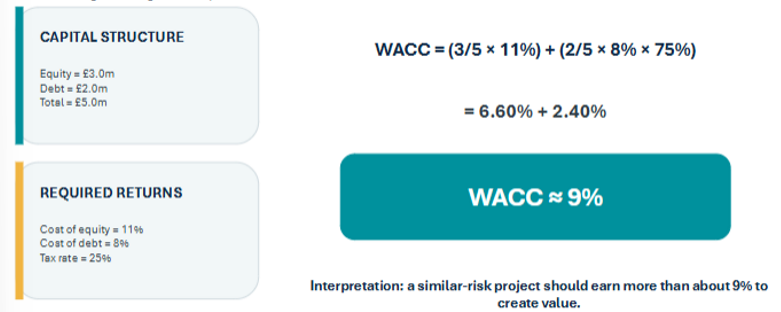
for WACC, use the after-tax cost where interest is tax-deductible
Cost of equity
= the return expected by shareholders
reflects expected dividends and capital growth
usually higher than debt because shareholders bear greater risk
this is more difficult to assess as it is based upon their expectations for dividends and increase in investment value
→ equity should be the largest part of a business’s finance***
What is the cost of capital and how is it impacted by the cost of equity and debt
= the return required by providers of finance
→ different weights from cost of equity and debt (equity bigger)→ WACC
Why does the cost of capital matter
It links financing decisions with investment decisions
What are the 4 costs of capital
capital structure
minimum return
investment appraisal
value creation
Capital structure
Compare the cost and risk of debt and equity
Minimum return
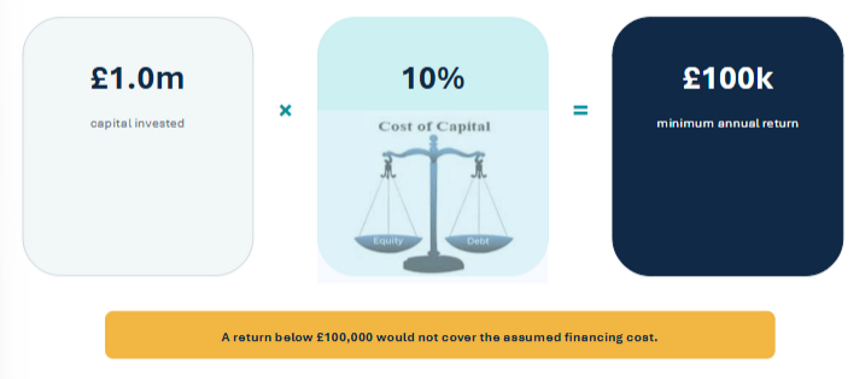
projects should earn at least the financing cost before creating value
Investment appraisal
Use the cost of capital as the discount rate when risk is appropriate
Value creation
Returns above the hurdle rate add value; returns below it destroy value
→ see if investment is worthwhile (use investment appraisals)
Example of cost of capital
A 10% cost of capital creates a 10% hurdle
What does WACC combine
Combines the costs of debt and equity
→ reflects the financing mix
What does WACC stand for
Weighted
Average
Cost
Capital

Equity component of WACC
Weight of equity x cost of equity
Debt component of WACC
Weight of debt x after tax cost of debt
Calculation for WACC
(E/V x Re) + (D/V x Rd x (1 - T))
The information needed to calculate WACC
E= market value of equity
V= total capital: E +D
Re= cost of equity
D= market value of interest - bearing debt
Rd= pre tax cost of debt
T= corporation tax rate
(E/V x Re) + (D/V x Rd x (1 - T))
Worked example of WACC
How should a business know if it should commit scarce capital
Investment appraisal tests whether expected benefits justify the resources committed
→ it supports the judgement, does not replace the judgement
Three steps of deciding whether to commit scarce capital
Define= clarify the project, timing, relevant cash flows and decision objective
evaluate= apply appropriate appraisal methods and test key assumptions
decide= accept, reject or rank the opportunity and explain the rationale
What are the 4 methods of investment appraisal and which one do we do for this module
ARR
Payback
IRR
NPV***
What is NPV
Net present value
= present value of cash inflows less present value of cash outflows
→ measures value creation
→ recognises both cash-flow magnitude and timing
→ takes into account the time value of money
NPV calculation
present value of future cash inflows - present value of cash outflows
NPV > 0
Expected return exceeds the discount rate: accept, subject to risk and constraints
NPV = 0
Expected return equals the discount rate: financially neutral
NPV < 0
Expected return is below the discount rate: reject on financial grounds
What is time value of money
Money today is worth more than money later
4 reasons why money today is worth more
Opportunity cost- money available now can earn a return
Inflation- future money may buy fewer goods and services
Risk and uncertain future- future cash flows may not arrive as forecast
Preference for liquidity- cash now provides flexibility and security
Are present value and future value interchangeable
no
Present value
What a future amount is worth today after discounting
Present value calculation

Future value
What money invested today could grow to in the future
Calculation for future value

Investment question example (just scenario and solution and considerations)

Investment question example (continued)

What is the discount rate
the project-appropriate cost of capital
What does discounting charge
Charges the project for the time and risk of financing it
→ don’t need to learn calculation as the table is given

Example of discounting

Calculating the NPV after discounting

The 5 key ideas to take away
