Mod 6 Bioenergetics
 Call Kai
 Learn
 Practice Test
 Spaced Repetition
 Match
 Flashcards
 Knowt Play
1/168

Earn XP
Description and Tags
Objectives: 1. Recognize the laws of thermodynamics 2. Contrast metabolism, catabolism, and anabolism 3. Describe the processes involved in the formation of ATP from the macronutrients, fat, carbohydrates, and protein 4. List examples of energy-requiring processes in the human body
169 Terms
What is the first rule of thermodynamics?
energy cannot be created or destroyed
What is the second rule of thermodynamics?
conversion of one form of energy into another always leads to a loss of some energy, typically in the form of heat
What is the third rule of thermodynamics?
-highly organized systems have a lot of potential energy (organized = lot of energy)
-disorganized/chaos systems have low energy (high chaos = entropy)
What is the natural trend for thermodynamics?
find the most stable state in a system, which means the trends is towards high chaos (entropy) and low potential energy
What is metabolism?
the sum of all biochemical reactions in a cell or organism
What is catabolism?
the sum of all degradative reactions in a cell or organism
What is anabolism?
the sum of all biosynthetic reactions in a cell or organism
When people saying metabolism, what do they actually biomechanically mean?
catabolism
What does catabolism and anabolism together make?
metabolism

What does catabolic pathways generate?
generate energy (ATP, heat) and oxidize carbon (electrons to NAD+, NADP+, and FAD)

Which pathway goes from large to small?
catabolic
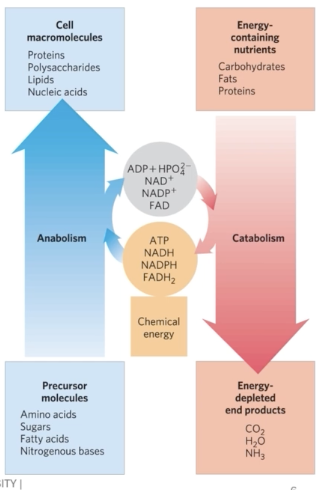
Which pathway goes from small to large?
anabolic

What do anabolic pathways need?
require energy and reduce carbon (electrons from NADH, NADPH, and FADH2)

Oxidative/Reduction of Carbon
catabolism = oxidation of C
anabolism = reduction of C

What are the types of energy and cycling of carbon?
photosynthesis and cellular respiration
What performs photosynthesis?
phototrophs
What preforms cellular respiration?
heterotrophs
What can ATP be used for?
maintenance or restoration of membrane potentials, muscle work, anabolic pathways, etc.
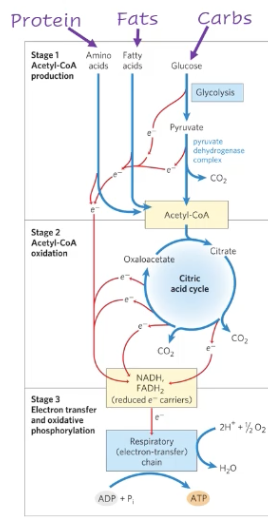
What are the three stages of cellular respiration
acetyl-CoA production
Acetyl-CoA oxidation
Electron transfer and oxidative phosphorylation
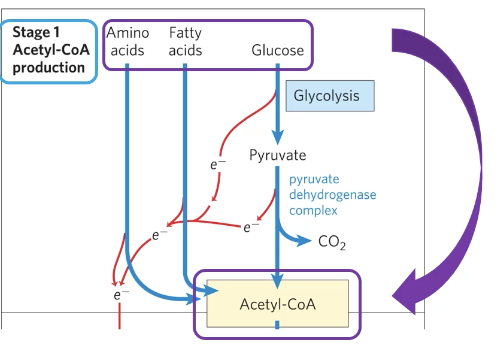
What is happening in the first stage of cellular respiration, Acetyl-CoA production?
oxidation of fatty acids, glucose, and some amino acids yields acetyl-CoA

What is happening in the second stage of cellular respiration, Acetyl-CoA oxidation?
oxidation of acetyl groups in the citric acid cycle includes fours steps in which electrons are abstracted

What is happening in the third stage of cellular respiration, electron transfer and oxidative phosphorylation?
electrons carried by NADH and FADH2 are funneled into a chain of mitochondria (or, in bacteria, plasma membrane bound) electron carriers - the respiratory chain which reduce O2 and H2O
What does the electron flow of cellular respiration do?
produce ATP

Cellular Respiration Process
to capture energy in our macronutrients to form ATP
What is the splitting of sugar?
glycolysis
What is the primary source of metabolic energy in some mammalian tissues and cell types (brain, red blood cells, anaerobic muscle, sperm, etc.)?
glycolysis
How many phases is the glycolysis process?
2

What is happening in glycolysis?
glucose molecule is oxidized, in two phases, to two molecules of pyruvate, with energy conserved as 2 ATP and 2 NADH
What acts sequentially in glycolysis?
10 cytosolic enzymes
What are many enzymes in glycolysis dependent on?
magnesium
What is the starting point of glycolysis preparatory phase?
glucose
What is the end point of glycolysis preparatory phase?
glyceraldehyde 3-P
Is glucose stable or unstable?
stable (has to be energetically activated by 2 ATP)

What is the preparatory phase overall?
glucose + 2 ATP → 2 glyceraldehyde 3-P + 2 ADP
What is the starting point of glycolysis pay-off phase?
glyceraldehyde 3-P
What is the end point of glycolysis pay-off phase?
pyruvate

What process is this “each of the two molecules of glyceraldehyde 3-phosphate derived from glucose undergoes oxidation at C-1; some of the energy of this oxidation reaction is conserved in the form of one NADH and two ATP per triose phosphate oxidized”
glycolysis pay-off phase

Glycolysis Overall
glucose to 2 pyruvate to 2 ATP and 2 NADH (need 2 NAD+)

What process is this?
pyruvate dehydrogenase (PDH) complex

What does coenzyme A bond in a metabolite do?
makes it more reactive
Reactions that involve Coenzyme A are dependent on what?
vitamin B5
Function of isomerase?
catalyze the formation of an isomer of the substrate (requires the braking of bond, reversible reactions)
What is the function of deydrogenase?
catalyze redox reactions (coenzymes NAD+/NADH, FAD/FADH2, or NADP+/NADPH)
What is the function of kinase?
catalyze transfer of a phosphate group from one organic molecule to another, usually involving ADP or ATP (most non-reversible)
What is the function of phosphatase?
remove a phosphate group, yielding inorganic phosphate (Pi) (non-reversible)
What are two other names for Citric Acid Cycle (CAC)?
Tricarboxylic acid cycle (TCA cycle)
Krebs cycle
What is the citric acid cycle part of?
it is stage 2 of cellular respiration. (link between acetyl-CoA formation and electron transport chain)
Where does the Krebs cycle happen?
matrix of mitochondria

What happens at each turn of the cycle?
three NADH, one FADH2, one GTP (or ATP), and two CO2 are released in oxidative decarboxylation reactions
Is the krebs cycle reversible?
yes
What goes into the kreb cycle?
acetyl-CoA

What is the product of the Kreb cycle per one acetyl-CoA
two CO2 (waste), three NADH, one FADH2, and one ATP
What products of the Kreb cycle go on into stage 3?
the three NADH and one FADH2
How do you find the yield per glucose?
multiple by two (we get two acetyl-CoA per glucose molecule)
What happened to carbon in stages one and two?
completely oxidized
What is stage 3 about?
reduce oxygen and create chemical energy (ATP)

What are the two parts/area for oxidative phosphorylation?
electron transport chain and ATP synthesis
How many complexes are there in the electron transport chain?
4
What do the complexes in the electron transport chain do?
enzymes that catalyze redox reactions
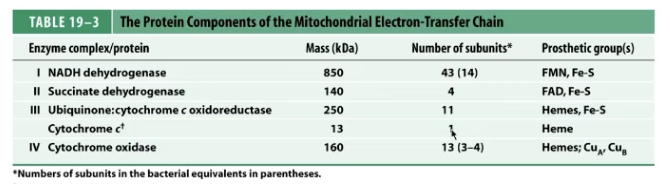
How are the complexes complicated?
1 and 4 have a ton of subunits
What is the proton-motive force?
proton gradient (concentration and charge)
How many protons does it take moving through the F0F1 complex for 1 ATP?
4
What is ATP synthesis driven by?
proton-motive force
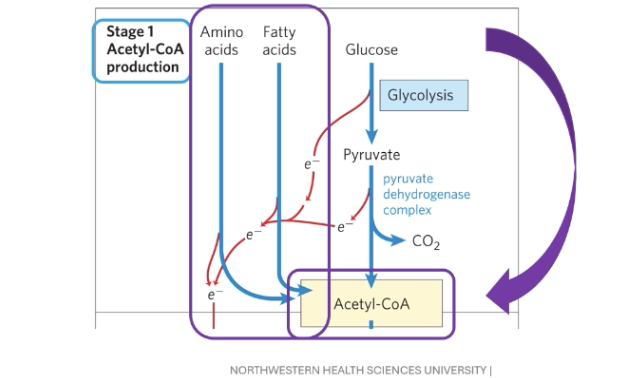
What other parts of stage 1 cellular respiration is there but not talked about as much?
amino acids and fatty acids (it is not just glucose/glycolysis)

What is the first stage of Fatty Acids to ATP?
beta oxidation (four recurring enzyme reactions that process fatty acids)
What is required for the fatty acids to ATP reaction?
4 carbon and the fatty acids have to be saturated
What is the second stage of Fatty Acids to ATP?
citric acid cycle
What is the third stage of Fatty Acids to ATP?
oxidative phosphorylation
What breaks down triacylglycerol?
lipase
What is the cost for activating fatty acid?
2 ATP (same as glucose)

Each cycle of fatty acid yields?
one NADH, one FADH2, one Acetyl-CoA
What is the difference between fatty acid and glucose regarding Acetyl-CoA
glucose yields 2 and fatty acid yields 1
What breaks down protein?
proteases
Why does NH4 from the amino acid waste get flushed out in urea?
it is toxic

What is the process of amino acid catabolism?
amino acid → pyruvate + acetyl-CoA → krebs cycle → oxidative phosphorylation
What is the yield of ATP per glucose?
ATP per glucose: 30-32
What is the yield of ATP per fatty acid?
depends on size of fatty acid and physiological state of the body
What is the yield of ATP per amino acid?
depends on which amino acid and physiological state of the body

What is the fermentation process?
pyruvate (the final product of glycolysis) to lactate

When does fermentation occur?
anaerobic conditions (skeletal muscle) and no mitochondria (red blood cells)
What micronutrients are needed for energy making?
Vitamin B1, B2, B3, B5. Minerals: magnesium, iron (Fe2+), and copper (Cu2+)
What does B vitamin deficiencies lead to?
neurological issues
How much of the calories we consume daily go to the nervous system?
30%
What is the trivial name of vitamin B1?
thiamin
What is the trivial name of vitamin B2?
riboflavin
What is the trivial name of vitamin B3?
niacin
What is the trivial name of vitamin B5?
pantothenic acid
What coenzyme belongs with B1 (thiamin)?
coenzyme TPP (thiamin pyrophosphate)
What coenzyme belongs with B2 (riboflavin)?
coenzyme FAD
What coenzyme belongs with B3 (niacin)?
coenzymes NAD+ and NADP+
What coenzyme belongs with B5 (pantothenic acid)?
coenzyme A
What metabolite is the point of convergence of carbohydrate, fat, and protein catabolism for the purpose of ATP production?
Acetyl-CoA
What coenzyme relies on riboflavin?
FAD
Fermentation converts NADH to NAD+ so it can be used in___ .
glycolysis
The sum of degradative reactions is called .
catabolism
In which of the following is carbon the most oxidized?
CO2
Anabolic pathways
require ATP and reduced electron carriers
Citrate is a C compound.
C6
catalyze the transfer of phosphate groups from one organic molecule to another.
Kinases
In the CAC cycle, acetyl-CoA gets combined with to form citrate.
oxaloacetate