copying DNA and RNA in vitro
 Call Kai
 Learn
 Practice Test
 Spaced Repetition
 Match
 Flashcards
 Knowt Play
1/17

There's no tags or description
Looks like no tags are added yet.
18 Terms

explain the diagram in terms of DNA polymerase replication
DNA polymerase releases a pyrophosphate from deoxyribonucleoside triphosphate (dnTPs) and adds the resulting dnMP to the 3'-hydroxyl end of the primer strand
Pyrophosphate is cleaved by pyrophosphatase -> reaction is irreversible
in DNA replication, the template strand is read in a (? to ?) direction and the new strand is synthesised in a (? to ?) direction
template strand: 3’ to 5’ direction
new strand: 5’ to 3’ direction
what polymerase is used in PCR?
Taq DNA polymerase
heat stable → found in bacteria that live in hot springs
PCR process
Double stranded DNA needs to be separated into two template single strands
Denatured by heating
Hybridisation -> primers bind to respective sequences on the single stranded template DNA strands
3. DNA polymerase uses the four dnTPs to synthesise new DNA strands by extending the primers
the hybridisation of the primers in PCR needs a (?) temperature than the denaturing process
cooler (from 95 in denaturing down to 50-60 degrees celsius for hybridisation)

what are the different temperatures for the 3 steps of PCR
95 → to separate the two DNA strands via denaturing
50-60 → allow primers to hybridise to the template strands
72 → optimal temperature for Taq DNA polymerase
each PCR cycle (?) the DNA amount
doubles
components of PCR (list 7)
Template DNA -> the double stranded DNA to be amplified
Two primers -> specific to each single stranded DNA template
Taq DNA polymerase -> heat resistant DNA polymerase that will add dnTPs to primers
dnTPs → building blocks for new DNA strand synthesis
Buffer -> keeps pH stable
Magnesium ions -> required as cofactor for Taq DNA polymerase
PCR machine -> provides correct temperatures and timings for each PCR step

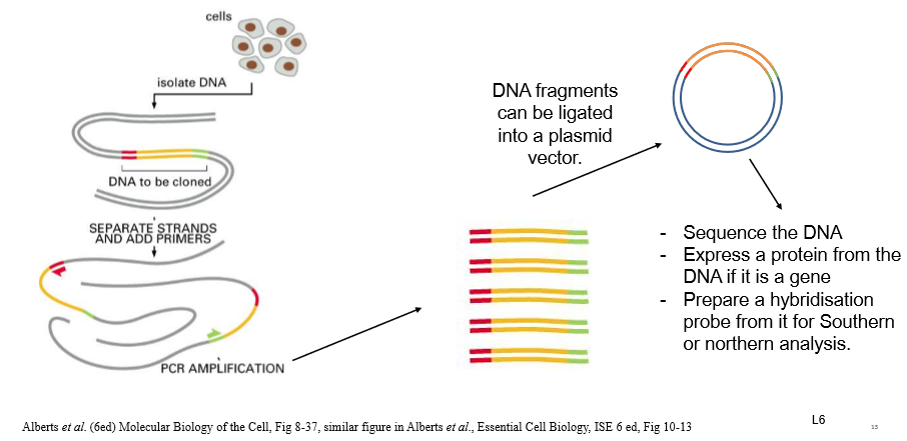
PCR and DNA fragment cloning (explain how they are linked)
isolate DNA from cell
identify DNA fragment of interest within isolated DNA
separate double stranded DNA and add primers
PCR amplification → DNA fragments copied
new DNA fragments inserted into plasmid
plasmid replicates DNA sequence/ synthesises protein (if DNA is a gene sequence

PCR in parental studies - what are short tandem repeats?
STR’s are repeated base sequences in the human genome
Individuals inherit specific STR's with a different number of repeats from their mother and from their father
PCR used to amplify these STR markers found in chromosomes
Gel electrophoresis is then used to separate the markers and compare between parents and child


explain why father 2 is the child’s biological father
their STR markers are the same -> more match ups than with father 1

PCR in forensic science - explain the diagram
used to identify crime suspects
three suspects had three STR loci analysed and amplified using PCR
the forensic sample (DNA from crime scene) underwent the same PCR amplifications
gel electrophoresis was then used to compare suspect and sample STRs to identify the perpetrator
does bacterial DNA have introns? how does this impact the expression of eukaryotic genes inserted into bacteria?
no → bacteria have no introns and therefore no mechanism to remove introns from a primary mRNA
eukaryotic genes need to undergo splicing to remove non-coding introns
therefore eukaryotic protein cannot be produced in a bacteria
cDNA
complimentary DNA → mature mRNA converted to DNA to allow for eukaryotic protein synthesis in bacteria

cDNA synthesis process
Eukaryotic mRNAs have a poly-A tail which hybridises with a poly(T)primer
Reverse transcriptase
Synthesises DNA in 5' to 3' direction
Creates a RNA-DNA hybrid
Found in retroviruses
RNaseH
Degrades RNA in newly synthesised RNA-DNA hybrid
Leaves some RNA undegraded
This RNA acts as a primer for complementary DNA or cDNA synthesis by DNA polymerase
reverse transcription - PCR is used to produce a (a) copy of an (b)
(a) DNA
(b) mRNA
RT-PCR explained
mRNA isolates from eukaryotic cells
Add DNA primer to 3' poly A tail of mRNA
Reverse transcriptase adds deoxyribonucleoside triphosphates to synthesise DNA strand
RNaseH degrades most of RNA from DNA-RNA hybrid
Leaves some RNA which acts as primer for cDNA
DNA polymerase adds dnTPs to primer
PCR → add PCR primers, Taq DNA polymerase and dNTPs for PCR amplification
Creates cDNA clones which can be ligated into plasmid vectors for replication
PCR or RT-PCR can be used to detect the presence of a viral genome in a sample
