ecn 3 and 4 (FINAL EXAM)
 Call Kai
 Learn
 Practice Test
 Spaced Repetition
 Match
 Flashcards
 Knowt Play
1/22

There's no tags or description
Looks like no tags are added yet.
23 Terms
Ex-ante real rate
expected return, based on expected inflation
Ex-post real rate
actual return, based on actual inflation
If inflation is higher than expected,
borrowers gain and lenders lose.
Fisher effect
in the long run, i rises one-for-one with Eπ.
Ex-post real interest rate formula
r = i − π
Ex-ante real interest rate formula
r = i − Eπ
Fisher equation formula
i = r + π
because r = i − π (move π to the other side)
i = r + Eπ
because r = i − Eπ (ex-ante version)
Fisher + quantity theory
i = r + π = r + (ΔM/M − ΔY/Y)
because π = ΔM/M − ΔY/Y
Money demand formula
(M/P) demand = L(i, Y) = L(r + Eπ, Y)
because i = r + Eπ
Money market equilibrium formula
M/P = L(r + Eπ, Y)
Liquidity preference
Money is liquid but earns no interest. Bonds earn interest but are less liquid.
Money demand falls when i rises (i is the cost of holding cash) and rises when Y rises.
If Eπ rises, i rises, so money demand falls. With M fixed, P jumps up right away.
Graph: if M rises, supply shifts right (S1 to S2) and r falls from r1 to r2.

Natural rate = the long-run average unemployment rate.
Frictional: time spent searching for a job. Raised by sectoral shifts and unemployment insurance.
Structural: real wages stuck above market-clearing. Caused by minimum wage, unions, and efficiency wages.
Cyclical: short-run swings from booms and recessions (NOT part of the natural rate).
Labor force
L = E + U
Employed workers
E = L − U
Unemployment rate
=U/L = U/(E + U)
Total jobs and filled jobs formulas
J = F + V and F = E
Vacancies formula
V = J − F = J − E = J − (L − U) = J + U − L
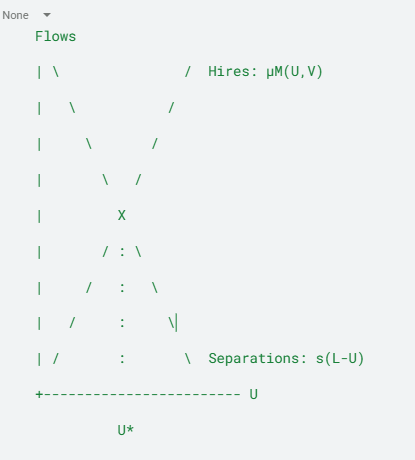
Separations formula
sE = sF = s(L − U)
because F = E (each filled job = one employed worker) and E = L − U
New hires formula
μM(U, V) = μM(U, J + U − L)
because V = J + U − L
Change in unemployment
ΔU = sE − μM(U, V) = s(L − U) − μM(U, J + U − L)
Steady state
0 = s(L − U) − μM(U, V), so s(L − U) = μM(U, V)
Natural rate of unemployment
= Frictional unemployment + Structural unemployment
Natural rate of unemployment MODEL
Steady state: separations = hires (U*)
Higher μ or more vacancies: the hiring curve shifts up, so U* falls
Higher s: the separations curve shifts up, so U* rises