Lecture 8 Max Molars
 Call Kai
 Learn
 Practice Test
 Spaced Repetition
 Match
 Flashcards
 Knowt Play
1/62

There's no tags or description
Looks like no tags are added yet.
63 Terms
When do these teeth erupt?
first
These teeth are ____-succedaneous.
non
There are … or … each forming a cusp.
4, 5
There are ____, ____, and _____ cusps.
major, minor, supplementary
Second molars usually do not have _____ cusps are the minor cusps are very _____.
supplementary, small
Describe the size of max. 1st molars related to their arch.
largest
Give the amount of major, minor, and supplemental cusps for max. 1st.
3, 1, 1
How many cusps are functional in max. 1st molar? Give the types.
4, 2 lingual, 2 buccal
Where are lingual cusps located in relation to buccal cusps?
distal and lingual
Give the size order of cusps on max. 1st molar.
mesiolingual, mesiobuccal, distobuccal, distolingual
What divides the 2 buccal cusps in max. 1st molar?
buccal developmental groove
What structure is at the end of the buccal developmental groove?
buccal pit
What cusp may or may not be present on the lingual surface of max. 1st molar?
carabelli
The _____ ______ separates the Carabelli from the mesiolingual cusp.
mesiolingual groove
What separates the mesiolingual cusp from the distolingual cusp on the lingual aspect?
lingual groove (distolingual)
What is an extension of the distal oblique groove?
lingual groove

Distal oblique groove + lingual developmental groove=
distolingual groove
What is the lingual height of contour for max 1st molar?
center of middle
What is the buccal height of contour for max 1st molar?
cervical
What are the contact areas for max 1st molar?
middle
On the distal aspect, the ____ marginal ridge is shorter.
distal
What is the shape of the occlusal surface?
rhomboidal
The lines connecting the three largest cusp tips form a ______.
triangle
Is the max 1st molar wider mesially or distally? Lingually or buccally?
mesially, lingually
This is the only tooth that is wider _____ than _____.
lingually, buccally
Define oblique ridge.
union of 2 ridges diagonally (from ML cusp to DB cusp)
Define transverse ridge.
when triangular ridge of ML cusp meets triangular ridge of MB cusp
Give the order of the largest to smallest fossa in max. 1st molar.
central, distal, mesial
Where is the central fossa located?
center of occlusal (mesial to oblique)
Where is the distal fossa located?
distal to oblique ridge
Where is the mesial fossa located?
within mesial marginal ridge
Each of the 3 fossa have _____.
pits
What are the 2 major grooves of max. 1st molar?
central, buccal
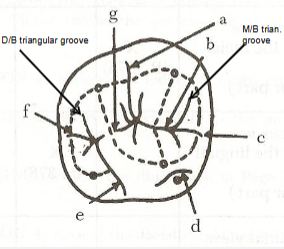
b+g=
central groove

Give a.
buccal groove
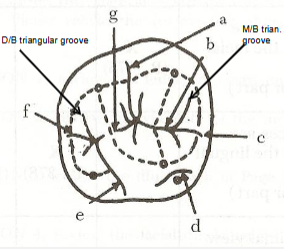
Give b.
mesial groove (of central groove)

Give c.
mesial marginal groove

Give d.
mesiolingual groove

Give e.
distal oblique groove ends

Give f.
distal marginal groove
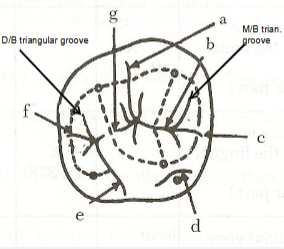
Give g.
distal groove (of central groove)
What are primary grooves that separate a marginal ridge from the triangular ridge of a cusp?
triangular groove
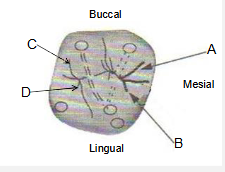
Give A.
m/b triangle groove

Give B.
m/l triangle groove

Give C.
d/b triangle groove

Give D.
d/l triangle groove
How many roots do max molars have?
3
Give the size order of the 3 roots.
lingual, mesiobuccal, distobuccal
How many pulp horns do max. molars have?
4
How long are the roots?
2x crown
2nd molars crown ___ and ____ than the first molar
shorter, narrower
As you move toward the posterior what happens to the
developmental characteristics of the molars?
less defined, rounder
The oblique ridge is ____ prominent on the ___ molar, most likely not existent on the ____.
less, 2nd, 3rd
There is usually no Cusp of ____ on 2nd, even less like on 3rd.
Carabelli
Which cusp is less developed on 3rd? Might be non existent on 3rd.
distolingual
The shape of the occlusal table on the 2nd molar is _____, the 3rd is more ____ shaped.
rhomboid, heart
Which max molar is it very common to see fused roots?
3rd
____ molars show more variation than 1st in crown and root, ____ molars show the most variation.
2nd, 3rd
How many cusps and lobes do 2nd molars have?
2
What is the most variable tooth in max arch?
3rd molar
Which tooth is rarely well developed?
max. 3rd
Which of the well developed cusps on the 1st & 2nd molars is frequently missing on the 3rd molar?
distolingual
Roots tend to get shorter and less divided as you move ______ in the mouth
posterior