Small Coding Problems
 Call Kai
 Learn
 Practice Test
 Spaced Repetition
 Match
 Flashcards
 Knowt Play
1/5

There's no tags or description
Looks like no tags are added yet.
6 Terms
Linked List: Dedup
prev = None: Keeps track of the node immediately before the current node.curr = self.head: Starts traversing the linked list from the head.repeat = set(): Creates an empty set to store values that have already been encountered.while curr:: Traverses the linked list until the end is reached.if curr.data in repeat:: Checks whether the current node's value has already appeared.If yes,
prev.next = curr.nextskips over the current node, removing the duplicate.
else:: If the value has not appeared before:repeat.add(curr.data)adds the value to the set.prev = currupdates the previous pointer to the current node.
curr = curr.next: Advances to the next node, whether the current node was a duplicate or not.Result: The linked list contains only the first occurrence of each value, preserving the original order.

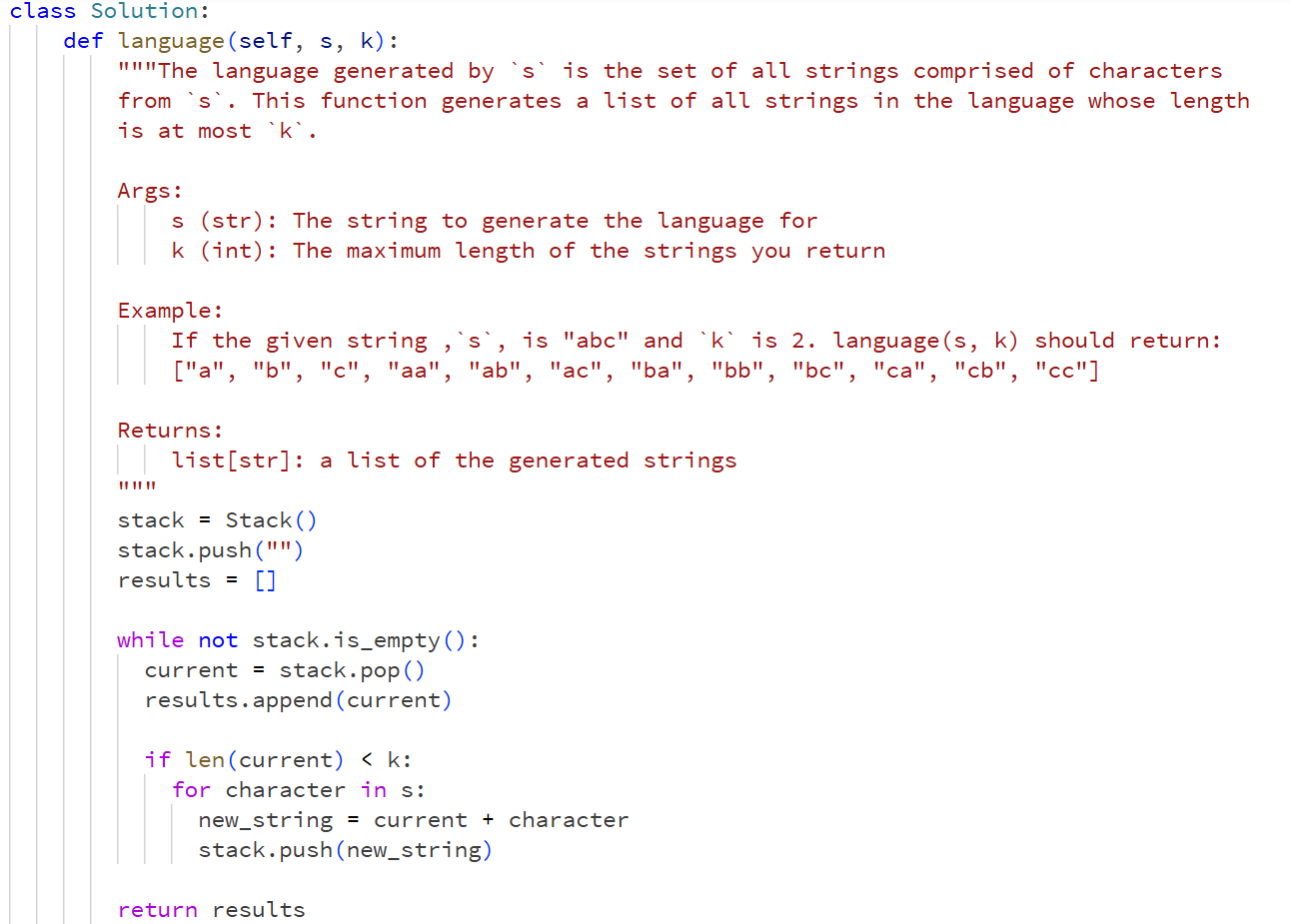
Stacks / Recursion: Language
stack = Stack(): Creates an empty stack to store strings that need to be processed.stack.push(""): Pushes the empty string onto the stack as the starting point.results = []: Creates an empty list to store all generated strings.while not stack.is_empty():: Continues processing until the stack is empty.current = stack.pop(): Removes and returns the top string from the stack.results.append(current): Adds the current string to the results list.if len(current) < k:: Checks whether the current string is shorter than the maximum allowed length.If yes, the function can generate longer strings from it.
for character in s:: Iterates through every character in the original strings.new_string = current + character: Creates a new string by adding the character to the end of the current string.stack.push(new_string): Pushes the newly generated string onto the stack so it can be processed later.return results: Returns the list of all generated strings.
BST: Width
if self.root is None:: Checks whether the tree is empty. If it is, returns0because there are no nodes.queue = [self.root]: Creates a queue containing the root node. The queue is used to traverse the tree level by level.max_width = 0: Initializes a variable to keep track of the largest number of nodes found at any level.while queue:: Continues traversing the tree until the queue is empty.level_size = len(queue): Counts how many nodes are currently in the queue. This represents the number of nodes at the current level.if level_size > max_width:: Checks whether the current level has more nodes than the previous maximum.If yes, updates
max_width = level_size.
for i in range(level_size):: Processes exactly the nodes belonging to the current level.curr = queue.pop(0): Removes the first node from the queue (FIFO: First In, First Out).if curr.left is not None:: Checks whether the current node has a left child.If yes, adds the left child to the end of the queue.
if curr.right is not None:: Checks whether the current node has a right child.If yes, adds the right child to the end of the queue.
return max_width: Returns the largest number of nodes found at any level.

n-queens
HW 1: N-Queens
Checks whether queen placements are valid (no same row or diagonal).
Uses a dictionary to store queen positions.
Uses a stack to track which rows to try.
If a placement works, moves to the next column.
If no placement works, backtracks by removing the previous queen and trying another row.
Returns the completed solution or
Noneif no solution exists.
shakespeare
Uses linked lists to store words grouped by word length.
Each node stores a word, its frequency, and a pointer to the next node.
find_frequency()increments a word's frequency or adds it if it is new.sort()uses insertion sort to order words by highest frequency, then alphabetically.Reads each query's word length and rank, then returns the word at that position or
"-"if none exists.
triangles
The
Triangleclass stores the three side lengths.getTriangleClass()checks that there are exactly three sides, all sides are positive, and the triangle inequality is satisfied.Uses a
setto count distinct side lengths:1 distinct length = equilateral
2 distinct lengths = isosceles
3 distinct lengths = scalene
Returns
"invalid"if the sides cannot form a valid triangle.The main program reads side lengths from an input file, classifies each triangle, and writes the results to an output file.
If a line has too few sides, the
IndexErrorhandler writes"-".