Nutritional Phenotype Nutri-Omics Approaches & Precision Nutrition
 Call Kai
 Learn
Learn Practice Test
 Spaced Repetition
 Match
Match Flashcards
 Knowt Play
1/31

There's no tags or description
Looks like no tags are added yet.
Name | Mastery | Learn | Test | Matching | Spaced | Call with Kai | Chat |
|---|
No analytics yet
Send a link to your students to track their progress
32 Terms
Do diets benefit everyone the same?
no
there’s an average response, however there are some people who group up and respond differently
What accounts for wide inter-individual variability in response to foods aka what is the mechanism?
still widely unknown in terms of mechanism, however we do know that it is related to the biologic and phenotypic complexity of our systems alongside metabolic flexibility
What is metabolic flexibility?
ability of cells and tissues to switch fuel sources, alter gene expression, adapt to various stressors, magnitude of responses, etc.
What is an example of phenotypic differences that can result in heterogeneity of responses to food?
traits in lean vs obese state as this would alter phenotypic traits such as
body weight
BP/hypertension
insulin resistance
diabetes
inflammation
hypercholesterolemia
etc.
What are examples of heterogeneity biological responses to nutrition inputs?
there are examples in which postprandial responses to the same food vary significantly between individuals

Why is it so important to take into consideration phenotypic differences?
phenotypic differences can influence metabolic response to nutrition
precision/personalized nutrition seeks to understand these factors in order to better predict responses and make tailored dietary recommendations
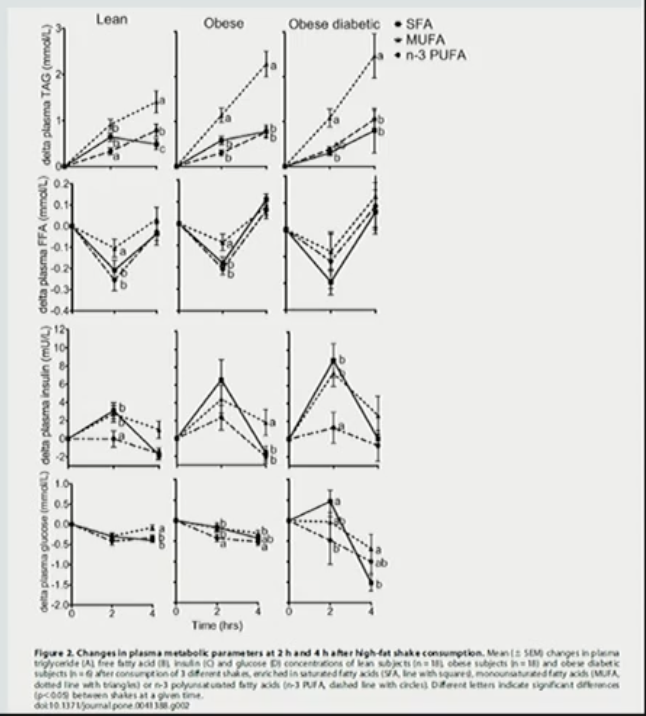
What are two reasons why there is so much variability in different individuals’ responses to foods and diet patterns?
health is affected by complex and dynamic interactions between genetics, epigenetics, diet, environment, lifestyle, physiologic state, age… etc.
diet is heterogeneous (adds complexity to the gene x diet and diet metabolism interactions)
How do we monitor and study metabolic responses in a research setting?
-omics approaches
What are the three different -omics approaches?
genomics
proteomic
metabolomic
What is genomics?
what can happen due to DNA potential
what appears to be happening due to transcriptomics (transcription/expression of DNA)
What is proteomics?
what makes it happen → the proteins/enzymes that are currently active in the body making things happen
What is metabolomics?
what has happened and is happening in metabolic pathways measured by circulating or excreted metabolites in biologic fluids
identification and quantification of metabolites in a biologic system
metabolites tend to be low molecular weight compounds which are reactants, intermediates or products of biochemical reactions
links genotype w/ phenotype
assumes that individual’s metabolic state reflects their health status and allows us to group people in terms of their phenotype
Describe this picture in terms of genomics.

A. environmental exposure by gene response
when risk allele is present, the health risk is greater even without environmental exposure
with environmental exposure the magnitude of health risk is significantly greater than when the risk allele is absent
B.
effects of increasing doses of environmental exposure on health risk differs when risk allele is absent or present
a medium dose of environmental exposure has a greater effect when the risk allele is present
Describe this graph showcasing a gene-environment (diet) interaction and its effect on a health risk.

a health risk is associated with a risk allele (as it is higher with different genotypes)
all genotypes change in the same way from exposure (same slope)
no gene x diet (environment) interaction bc there is no differential response in how they change as a result of diet (all have the same slope)
Describe this graph showcasing a gene-environment (diet) interaction and its effect on a health risk.
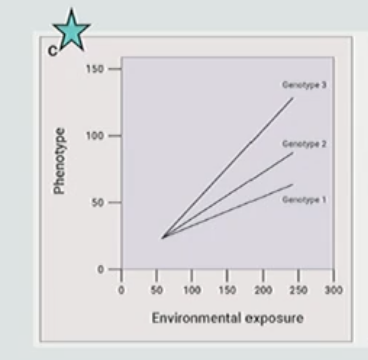
the effect of diet is somewhat similar on all alleles (as they change in the same direction) but slope of change differs by genotype
gene x diet interaction is present (diet exposure differentially affects genotype)
Describe this graph showcasing a gene-environment (diet) interaction and its effect on a health risk.

diet affects each allele of gene very differently as slop and direction of all lines vary
gene x diet interaction is present as differential effects of diet are clearly seen by genotype
What are two forms of nutritional metabolomics?
marker of dietary intake → markers from food
marker of metabolic effect → markers from metabolic systems
Describe the characteristics associated with biomarkers of dietary intake/diet composition.
a measure of diet exposure
reflects the food components, their metabolites and metabolites from the gut microbiota
What are the uses of biomarkers of dietary intake (3)?
assess validity of dietary assessment in observational trials
assess compliance during clinical trials
provide objective marks for dietary intake of specific foods
What are some examples of signature metabolites originating from foods?
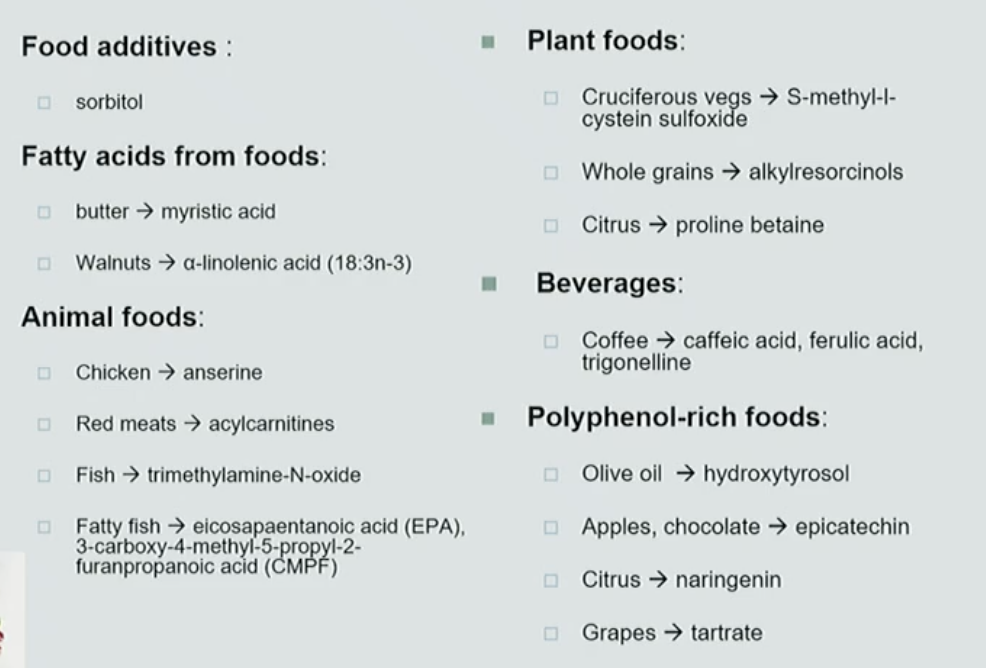
Give an example of the use of metabolomics in terms of orange juice.
goal: quantify the intake of orange juice based on metabolites
proline betaine has a specific dose response relationship to orange juice in both 24-hour urine and fasting urine
saw that citrus intake has a good agreement with self reported intake; proline betaine is a good marker of OJ
could be applied in the future to other foods in order to quantify dietary intake measurements
Describe the characteristics associated with biomarkers of (metabolic) effect.
tends to reflect endogenous intermediary pathways and metabolites that are not directly related to the food
includes biomarkers of disease risk, and health status
can describe a metabolic phenotype, or metabotype
What are three uses of biomarker of effect?
provide insights into mechanisms and pathways involved in diet (informs us of disease pathways)
provide ability to look at patterns of changes/responses to diet and physiologic status
distinguishment between groups of individuals (responders v. non-responders)
What are some examples of endogenous metabolites?

Give two examples of ways biomarkers of metabolic effect been used specifically in research?
Goal: examine relationship between BMI and 145 endogenous metabolites
found association with obese BMI and kynurenine, BCAA, glutamate, 1SM, and 19PCs
Goal: identify biomarkers of high vs low visceral fat area (in stomach region) in overweight healthy subjects matched for BMI, age, gender
found that 12 metabolites distinguished between high and low visceral adiposity (Long chain FA’s, MC, acylcarnitines, Lyso PCs)
can use this info to feed people different diets as they seem to have differential responses
What is the current use of metabolomics in nutrition and dietetics?
predominately research based
What is the goal/future use of metabolomics in nutrition and dietetics?
identify nutritionally “high risk” patients through quantifying metabolic responses → therapy → establish precision nutrition recommendations to prevent and manage disease of free-living individuals and groups
develop innovative education and counseling approaches based on incorporation of targeted personal and phenotypic metabolomics information
What is metabotyping?
grouping individuals based on similarities in their metabolic characteristics and phenotype (metabotype)
look at weight, anthropometric measures, clinical parameters, metabolomics data, gut microbes, etc.
What is precision nutrition?
a nutrition and health approach to lower risks of chronic disease, optimize health outcomes, and promote wellness across the lifespan
accounts for unique characteristics and phenotypes instead of a one-size-fits-all population based guideline
data driven, profiles characteristics (through metabolic and -omic tech), phenotypic grouping based on responses to diet and metabolic characteristics → help us to develop dietary pattern recommendations that are precise/individualized
What has been discovered as a result of research related to nutri-omics?
Personalized Glycemic response predictions
post-prandial glycemic responses are heavily influenced by gut microbiome
Nutrition for Precision Health Study
collecting blood, urine, fecal, social, contextual, etc.
goal is to develop algorithms to predict metabolic responses based on phenotypic characteristics → eventually to be tested and used in developing precision nutrition recommendations
showed good prediction of response using an algorithm that includes metabolic background, gut microbiome, etc which is better than simply knowing the glycemic index of foods and meal composition BUT has ye to show whether this information helped them to make different dietary choices
Describe characteristics associated with the Nutrition for Precision Health Study

wear CGMs for glucose response
diets were designed to be metabolic challenges (each is developed in a way where they are each distinctive and elicit metabolic responses)
diet 1: American diet
diet 2: high fat + low carb
diet 3: high carb + mod fat and protein + rich fruits and veggies
Does knowing your genes make an impact on behavior change in terms of dietary changes?
no; there is still an importance placed on behavior change techniques for education and counseling
