Professor Messer 2.3 | Spanning Tree Protocol
 Call Kai
 Learn
 Practice Test
 Spaced Repetition
 Match
 Flashcards
 Knowt Play
1/4

There's no tags or description
Looks like no tags are added yet.
5 Terms
Loop Protection Introduction
In a network with two interconnected switches, creating a loop by connecting them with two cables can cause a traffic loop. This results in the switches endlessly sending traffic back and forth, as the MAC layer lacks a counting mechanism to detect such loops. To stop this, the only immediate solution is to physically unplug one of the cables, which can be challenging to troubleshoot and disrupts the network.
To prevent such loops, IEEE 802.1D, introduced in 1990 and created by Radia Perlman, provides a solution through the Spanning Tree Protocol (STP).
STP port states
In the Spanning Tree Protocol (STP) process, a network interface goes through several port states to ensure no network loops are created:
Blocking: The port is not forwarding traffic to prevent loops. It is administratively blocked if a loop would be created by enabling the interface.
Listening: The port is not forwarding traffic but is cleaning the MAC table to prepare for proper network operation.
Learning: The port is not forwarding traffic but is adding MAC addresses to the MAC table for future use.
Forwarding: The port is fully operational and forwarding traffic as usual.
Disabled: The port is turned off by the network administrator and does not participate in STP or traffic forwarding.
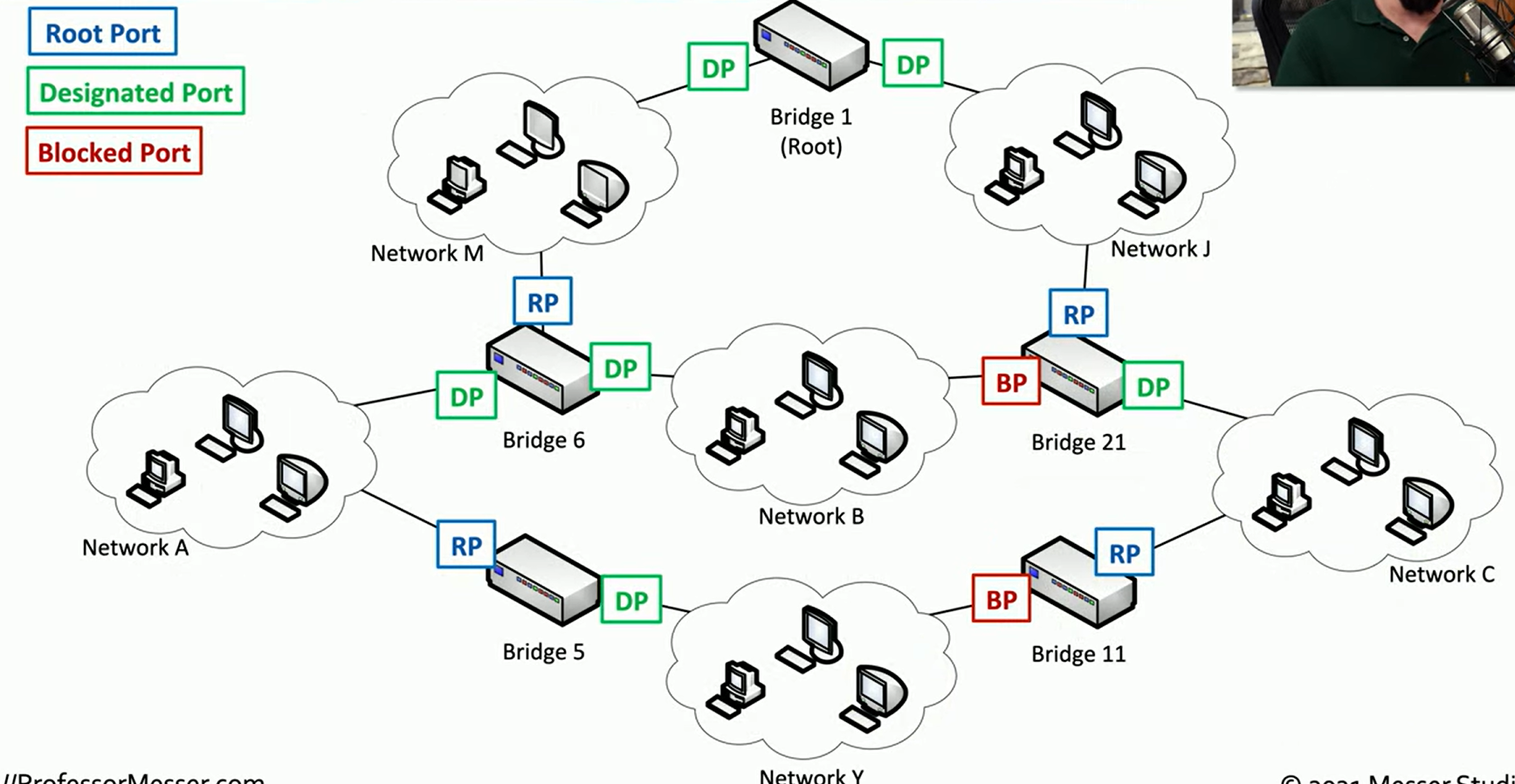
STP modes:
Root Port: This is the port on a bridge that has the shortest path to the root bridge (the central switch in the network). Each non-root bridge has one root port.
Designated Port: This port is on every switch and is the one that has the best path to the root bridge for each segment. All operational ports on the network are designated ports except for the root port.
Blocked Port: STP identifies potential loops and disables or blocks these ports to prevent network loops and ensure a loop-free topology.
Spanning Tree Change
Spanning Tree Protocol (STP) will recognize it, converge, and reconfigure the network topology to account for the change. However, the traditional STP convergence process can take 30 to 50 seconds, which is a significant delay in modern networks.
The Rapid Spanning Tree Protocol (RSTP)
Defined in IEEE 802.1w, is an updated version of STP designed to address its slow convergence times. RSTP significantly speeds up convergence from the 30 to 50 seconds typical of STP to just 6 seconds. It is backwards-compatible with the older 802.1D STP standard, allowing both protocols to coexist in a network. While RSTP introduces improvements, it maintains a similar process to STP, providing an update rather than a complete overhaul of the original protocol.