Thurs 10/29 Quiz 26: Depth Perception (p 184-189)
 Call Kai
 Learn
 Practice Test
 Spaced Repetition
 Match
 Flashcards
 Knowt Play
1/12

There's no tags or description
Looks like no tags are added yet.
13 Terms
depth perception
the ability to see objects in three dimensions although the images that strike the retina are two-dimensional; allows us to judge distance- JUDGES HOW FAR AWAY SOMETHING IS
We judge depth with both binocular cues and monocular cues
visual cliff
a innovative laboratory device for testing depth perception in infants
demonstrates an early ability in infants to perceive depth - a combination of nature and nurture - biology prepares us to be wary of heights and experience crawling amplifies the fear

binocular cues
depth perception cues, such as retinal disparity and convergence, that depend on the use of two eyes - tells us how far away something is with the calculations of these two eyes and the brain
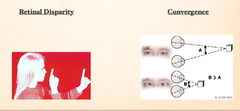
retinal disparity
a binocular cue for judging how far or close something is depth perception: By comparing images from the retinas in the two eyes, the brain computes distance-- the greater the disparity (difference) between the two images, the closer the object

convergence
A binocular cue for judging how far or close something is depth perception
The extent to which the eyes get closer and closer inward when looking at an object. If you become cross eyed, your brain will know the object is very close to you, but if your eyes are far apart, your brain will know the object is far away from you.

Monocular depth cues
cues of depth perception that are available to each eye alone
study the picture

Interposition
OVERLAPPING: if one object partially blocks our view of another, we perceive it as closer
Monocular depth cue
study the picture

Linear Perspective
Parallel lines appear to meet in the distance. Hallways, roads, railroad tracks all have this depth cue.
Monocular depth cue
study the picture

relative clarity
a monocular cue for perceiving depth; hazy objects are farther away than sharp, clear objects
Tends to work outdoors because light from distant objects passes through more atmosphere, making them appear farther away

Relative Size
If we assume two objects are similar in size, most people perceive the one that casts the smaller retinal image as farther away and the larger image on the retina is perceived closer.
Monocular depth cue
study the picture

texture gradient
a gradual change from a coarse distinct texture to a fine, indistinct texture signals increasing distance. objects far away appear smaller and more densely packed
Monocular depth cue
study the picture

Depth cues practice
Use this picture to find examples of monocular depth cues:
1 Interposition
2 Linear perspective
3 Relative clarity
4 Relative size
5 Texture gradient

perceptual constancy
perceiving objects as unchanging even as illumination and retinal images change
Your brain keeps things CONSTANT, like-
Brightness
Color
Shape
Size
