AT Chapter 10
 Call Kai
 Learn
 Practice Test
 Spaced Repetition
 Match
 Flashcards
 Knowt Play
1/39

There's no tags or description
Looks like no tags are added yet.
40 Terms
Essential for clinicians to know…
the healing process
phases, time frames, and physiological changes associated with each phase
Healing is a….
continuum
healing happens over time
synovial fluid primary purposes
lubricate joint
provide nourishment inside joint
joint can’t create synovial fluid unless it’s moving
Response phases
inflammatory response phase
fibroblast repair phase
maturation and remodeling phase
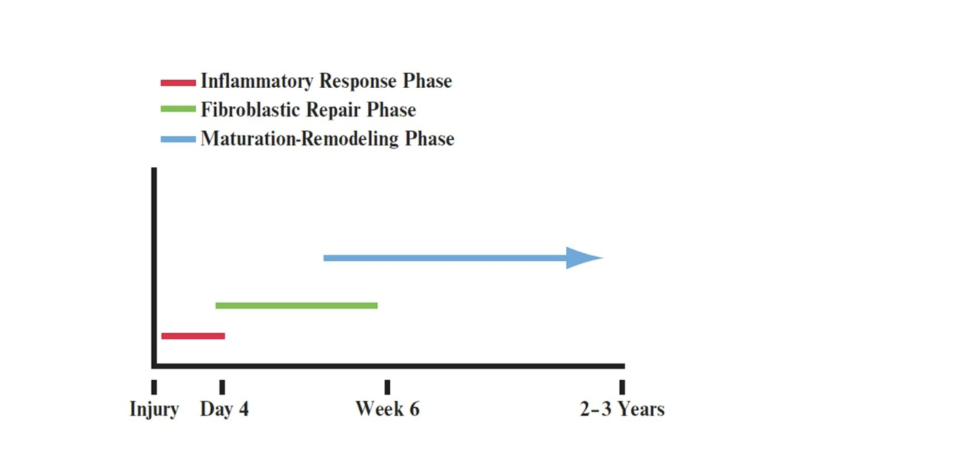
length of each response phase
inflammatory response phase- as long as 4 days
fibroblast repair phase- lasts up to week 6
maturation and remodeling phase- can last 2-3 years
Cardinal signs of inflammation
rubor (redness)
tumor (swelling)
calor (heat)
dolor (pain)
function lasea (loss of function)
Phase 1: inflammatory response phase
healing begins immediately
goals:
protect injury site to prevent further injury
localize (keep damage as localized as possible)
decrease things that cause injury to get worse
prepare for healing and repair
Chemical mediators
causes vasodilation and increases cell permeability increasing swelling
ice can help decrease chemical mediators to prevent swelling, but once swelling occurs ice can no longer help
vascular response (blood vessels)
vasoconstriction and coagulation occur to seal blood vessels (helps reduce blood loss), and chemical mediators are released
followed by vasodilation 5-10 mins later (allowing more blood flow into injured area)
initially increases blood flow
vasodilation decreases blood flow (helps reduce blood loss), increases blood viscosity resulting in edema (swelling)
initial effusion of blood and plasma lasts 24-36 hours
Clot formation
platelets adhere to exposed collagen fibers leading to formation of a plug (clot)
clots obstruct lymphatic fluid drainage and localize injury response
stops mediators from causing swelling to spread outside of injury site
Chronic inflammation
occurs when acute inflammatory response does not eliminate injuring agent
tissue not restored to normal physiological state
as inflammation persists necrosis and fibrosis prolong the healing process
necrosis: to die off
fibrosis: different type of tissue that does not respond well
cause of shift from acute to chronic is unknown
Phase 2: fibroblast repair phase
scar formation through two phases
resolution (occurs when there is little tissue damage so there is just normal restoration) (tissue returns to normal condition)
regeneration (replacement of tissue by same tissue)
scar formation
formation of delicate connective tissue (granulation tissue)
tensile strength increases with proliferation of collagen
tension force (pulling apart) are reduced by collagen
collagen keeps tissue from being torn when stretched
Phase 3: maturation and remodeling
long term process- can impact patients mental health
realignment of collagen is relative to tensile force
tissue will gradually assume normal appearance
may require several years to complete
Role of progressive mobilization
initially: immobilization to allow for initial healing
repair phase: controlled activity should be added
work toward regaining normal flexibility and strength
remodeling phase: aggressive ROM and strength exercises should be incorporated
facilitates tissue realignment and remodeling
must be aware of pain
factors that impede healing
extent of injury
infection
edema
poor vascular supply
health, age, and nutrition
Is bone considered soft tissue
BONE IS NOT CLASSIFIED AS SOFT TISSUE
4 types of soft tissue
epithelial tissue- skin
connective tissue- ligaments and tendons
muscle tissue- skeletal muscle
nerve tissue- peripheral nerve
Soft tissue adaptations
metaplasia- transformation of tissue from one type to another that is not normal for that tissue (type of cell)
dysphasia- abnormal development of tissue (incorrect size or shape)
atrophy- decrease in the size of tissue due to cell death and reabsorption or decreased cell proliferation
hyperplasia- increase in number of cells
hypertrophy- increase in size of cells
Cartilage healing
limited capacity to heal
little or no direct blood supply
(cartilage does not have its own blood supply)
(synovial fluid provides nutrients to cartilage when there is movement in the joint)
ligament healing
follows similar healing process as other vascular tissues
proper care will result in acute, repair, and remodeling phases in same time required as other vascular tissues
repair phase will involve random laying down of collagen that, as scar forms, will mature and realign in reaction to stresses and strain
collagen can be harmful if it isnt laid down correctly
full healing may take 12 months
factors affecting healing of ligaments
surgically repaired ligaments tend to be streonger due to decreased scar formation
exercised ligaments are stronger
exercise versus immobilization
muscles must be strengthened to reinforce the joint
increased tension will increase joint stability
skeletal muscle healing
collagen will mature and orient along lines of tensile force
tendon healing
abundance of collagen is required for good tensile strength
tensile strength is not strong enough until 4-5 weeks
peripheral nerve healing
regeneration can take place within a nerve fiber
for regeneration, an optimal environment is necessary
not too much stress but not too little
rate of healing occurs at 3 to 4 mm per day (SLOW)
therapeutic modalities
modality: something that makes someone better
Major aim is pain free movement, full strength, power, and extensibility of associated muscles.
6 elements all clinicians should consider in decision making
indication- a valid reason (ex: symptom) to use a particular medicine, test, etc.
contraindication- anything that will absolutely cause adverse effect
effectiveness
precautions
advantages
disadvantages
Platelet Rich Plasma Injections
uses the patients own platelets to promote the natural healing of musculoskeletal conditions
Medicine is always evolving
Bone healing
follows same phases as soft tissue healing
less complex process
acute fracture management
must be immobilized, until x ray shows presence of hard callus
fractures can limit participation for weeks or months
a clinician must be certain that the following areas do not interfere with healing
poor blood supply
infection
poor immobilization
infection
may interfere with normal healing, particularly with compound fractures
severe streptococcal and staphylococcal infections
modern antibiotics reduce the risk
closed fractures are not immune to infection
healing of stress fractures
early recognition is necessary to prevent complete fractures
decreased activity and elimination of factors causing excess stress are necessary to allow for appropriate bone remodeling
pain
major indicator of injury
pain is individual and subjective
pain sources
cutaneous
deep somatic
visceral
psychogenic
cutaneous
sharp, bright, burning
fast or slow onset
deep somatic
originates in tendons, muscles, joints, periosteum, and blood
visceral
begins in organs and is diffused at first and may later be localized
psychogenic
felt by the individual but is emotional rather than physical
acute vs chronic pain
acute: lasts less than 6 months
chronic: lasts more than 6 months
referred pain
pain that occurs away from the actual site of injury
may elicit motor and/or sensory response