Valuation
 Call Kai
 Learn
Learn Practice Test
 Spaced Repetition
 Match
Match Flashcards
 Knowt Play
1/31

There's no tags or description
Looks like no tags are added yet.
Name | Mastery | Learn | Test | Matching | Spaced | Call with Kai | Chat |
|---|
No analytics yet
Send a link to your students to track their progress
32 Terms
What are capital investments?
Allow companies to generate cash flow in the future or to maintain profitability of existing business activities.
Usually they require:
Cash outflow at the beginning
Cash inflows over several years.
Describe the payback period.
Number of years it takes to recover the original investment from the net cash flow resulting from a capital investment project.
This payback period is compared with a benchmark value, called the target value, where you accept the payback period if it is < target value.


Pros and cons of the payback period?

What is the discounted payback period?
Payback period, but factoring in the time value of money.
You first shrink (discount) the cash flow to its present value using the firms cost of capital. Same diea that DPP<TV
However: still, it takes no account of cash flows after the arbitrary target value, so that long-term projects such as A continue to risk rejection.
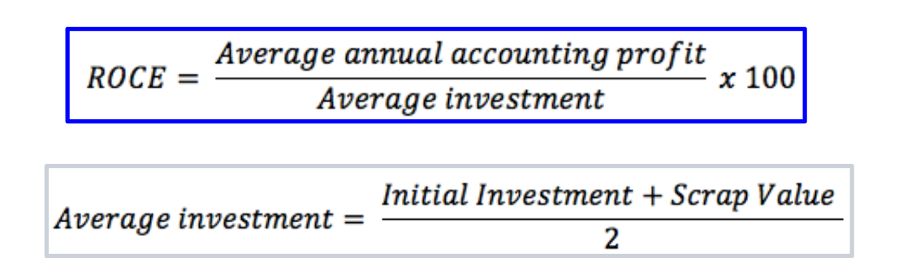
What is the return on capital employed?
A metric used to measure how efficiently a project turns invested capital into profit. Unlike the payback period methods, ROCE relies on traditional accounting numbers rather than actual cash flow.
Take the project’s average annual accounting profit and divide it by the average investment, then x100 for percentage.
Because equipment and assets depreciates the money tied up in the project decreases over time. To find the ‘average investment’, you add the day 1 cost to whatever you expect to sell the leftovers for at the very end, as scrap value, then divide by 2.
A firm will set a target (or hurdle rate). If the project’s calculated ROCE is higher than the target value, you accept the project.
Advantages
• It gives a value in percentage terms to compare to the existing ROCE of a firm
• Simple to apply, can be used for mutually exclusive projects
Disadvantages
• It is not based on cash but on accounting profits (open to manipulation)
• The use of average profits ignores the timing of profits (i.e. it ignores the time value of money)
• It does not consider the length of the project and the size of projects (as it is expressed in
percentage terms)
What is NPV?
Calculates the exact amount of wealth a project will generate for a company in today’s dollars. It is the main tool used to determine if an investment is worth making.
C0: Theinitial capital spent on day 1,
PV0: The sum of all future cash flows generated by the project, discounted back to their present value using the firm’s required return rate.
NPV = C0+PV0
If NPV is >0, you accept it.
Advantages
·It recognizes that earning $1 today is better than earning $1 tomorrow because today's dollar can be invested immediately to earn interest.
Unlike ROCE, NPV relies entirely on actual forecasted cash flows rather than easily manipulated accounting rules or personal tastes. It also accurately accounts for risk.
· Because NPV converts every project into today's dollars, you can simply add them together to see the total value of multiple projects combined ().
Disadvantages
· Capital Rationing: The standard rule says "accept all positive NPV projects," but this doesn't help if a company has restricted capital and can only afford to fund a few of them.
· Constant Discount Rate: The standard formula assumes the firm's cost of capital (the ) will stay exactly the same for the entire duration of the project, which may not happen in reality.

Describe IRR
A metric that calculates a project’s overall ROI as a %.
IRR is the specific discount rate that makes a project’s NPV = 0. In other words, it is the exact break-even rate where the present value fo the money going out perfectly matches the present value fo the money coming in (inflows).
To find the IRR, you set the standard NPV formula to zero and solve for the IRR variable. The maths is complicated, so most of the time it is done through trial and error.
NPV tells you how much richer a project makes you in absolute currency (e.g., dollars or euros), whereas IRR tells you the overall profitability in a percentage format. Like NPV, IRR is a Discounted Cash Flow (DCF) method, meaning it properly accounts for the time value of money.
Difference between IRR and cost of capital (COC)?
IRR is the internal profitability generated by the specific project's own cash flows and timing. COC is an external benchmark set by financial markets; it represents the return you could generate by putting your money into a different investment with the exact same level of risk.
You can purchase a turbo powered machine tool gadget for $4,000. The investment will generate $2,000 and $4,000 in cash flows for two years, respectively. What is the IRR on this investment?

What is the rule relating to IRR and COC?
If the IRR is greater than the COC, then you should accept the project.
In the graph, as the discount rate (the COC) increases, the present value of future cash flow shrinks, causing the NPV line to slope downward.
The X intercept is the IRR.
This means if the firms actual COC is anywhere on the leftm the red line sitss above zero, meaning the NPV is postitive and the project is a success.

What is an IRR pitfall relating to lending or borrowing?
The IRR cannot differentiate between making an investment (lending money) and taking out a loan (borrowing money).
Project A (lending): you spend $1000 today (outflow) to receive $1.5k next year (inflow). THis means you are earning a 50% ROI. The 50% IRR is higher than the 10% COC.
Project B (borrowing): you receive $1000 today, but have to pay $1.5k nex year. You are borrowing at a 50% interest rate, which is a terrible financial decision.
The math will say that IRR>COC, hence you would accept project B.
The solution is that if the project involves borrowing money, do the opposite and only accept if IRR<COC.
You can also solve for the NPV.

What is an IRR pitfall relating to multiple rates of return.
It can produce multiple conflicting answers, or no answer at all, depending on how a project’s cash flows change direction.
In a standard project, you spend money once at the start and earn money thereafter, but projects involving natural resources or heavy infrastructure often require massive cleanup at the end. This means your cashflow switches from negative (initial investment), to positive, then back to negative.
The math behind IRR dictates that there can be as many different IRR solutions as there are changes in the sign (positive/negative) of the cash flow stream. Because the sign changes twice in the slide's example, the equation produces two completely different IRRs: 3.50% and 19.54%.
Some projects have cash flow structures that prevent the IRR formula from working at all. This can happen if an investment has no initial outflows, or if the cash flows are erratic.
In the bottom example (Project C), you receive $1,000 upfront, pay out $3,000 in Year 1, and receive $2,500 in Year 2. Even though this project is ultimately profitable and generates a positive NPV of $339 at a 10% discount rate, it produces "None" for an IRR because there is no economically consistent percentage that makes the NPV equal exactly zero.
TO FIX, USE NPV.

What is an IRR pitfall related to mutually exclusive projects?

What is an IRR pitfall related to changes in the discount rate.
In calculating NPV, we have always assumed that the cost of capital (discount rate) is the same for all CFs (cash flows).
There is the assumption that there is a flat interest rate term structure.
Implement the NPV rule.
What is capital rationing?
When a company has a fixed, limited budget and cannot afford to fund every project with a positive NPV. When funds are limited, the goal shifts from accepting all positive projects to maximising total wealth createrd per dollar of capital spent.
Essentially you would combine project B and C together opposed to A, which on paper has the highest NPV, to maximise profitx.
TO test this, use the profitabiltiy index (PI) = NPV/Initial outlay (C0).
Ranking projects by their PI gives the optimal priority order: fund Project B first, then Project C, and only fund Project A if additional capital remains.

When would you use free cash flow versus accounting income.
FCF tracks the physical cash moving into and out of the company’s bank account, where accounting profit is an accrual-based figure designed to measure operational performance over a reporting period.
Accounting income records revenues when goods or services are delivered and matches expenses to those revenues, regardless of whether the customer has actually paid cash yet.
FCF is the literal money available at the time of the firm.
Becomes important knowing the difference when talking about CapEx (physical cash leaving the bank account today) and depreciation.
Suppose a company purchases a machine for $100k in year 0 and the machine lasts 5 years (depreciating by $20k per year).
Year 0
CapEx: Bank account decreased by $100k
Accounting Income: Accountant records $0 expense, rather it is logged as an asset on balance sheet.
Y1-5
Cash flow: $0 leaves the bank acc.
Accounting income: Accountant deducts a $20k depreciation expense each year to reflect wear and tear.
What is FCFF and FCFE
FCFF: free cash flow to the firm. It measures the cash generated by core operations, ignoring how the company is financed. It is owned by both shareholders and lenders.
Discounting FCFF gives you the enterprise value (EV) - total market value fo the company’s operating assets.
To find equity value (E), you subtract net financial position (NFC, or net debt).
E=EV-NFP
FCFE: free cash flow to the equity. It measures the cash remaining after lenders have been paid their interest and the gov has taken actual taxes.
Equity shareholders exclusively own it.
EV=E+NFP
ALWAYS USE FCFF, because FCFE becomes volatile whenever debt levels fluctuate.
How do we estimate FCFs on an incremental basis?
When deciding whether to launch a project, you only care about the cash that will physically enter or leave the company because of that specific decision.
Consider a 10 truck company, considernig 2 extra trucks.
We do not look at the total future of the business as 12 trucks, moreso to do it incrementally we ignore the existing 10 and only calculate:
Cost of the 2 trucks, fuel and driver wages.
Benefit: extra revenue generated by the 2 new trucks.
If they generate a positive NPV, you can buy them.
To decide if something belongs in your NPV value, you ask ‘if you cancel the project tmr, will cash flow still happen?’
If yes, it is not incremental and must be excluded.
If no, it is incremental and must be discounted.
A common corporate trap is assigning capital to a division simply because it has high historical average profits. Past track records are irrelevant to project valuation. A division might have generated 30% average returns over the last decade, but its next potential project might only produce a 2% return. Capital budgeting only cares about future incremental payoffs—what the next dollar invested will yield today.
What is the incidental effect (cannibalisation or erosion effect)?
Occurs when launching a new project harms or reduces the existing cash flows of your other products. ANy loss in existing business caused by the new product, must be counted as a cost against that project.
The firm Cups & Cakes (C&C) sells every year 100m of its banana cakes at the price of 3.4$ per cake. The operating cost per cake is 1.75$. A new recipe for new type of cakes (cherry and banana cake) would allow C&C to sell the new cake with an operating cost per cake of 2$ and price per cake equal to 4.50$. You estimate to sell every year 130m the new cakes. The sale of the new cake implies an estimated drop in the sales of the banana cake equal to 15%. What incidental effect (sales and operating costs) should you consider for the new project?

What are additoinal things you must consider if they belong in your FCF?

Suppose that you decide to sell a machine you bought 2 years ago at the price of $430,000 (this is the historical asset price) to another firm, for the price of $380,000 (this is the current selling price). The machine follows a 10-year amortization schedule (constant depreciation charge). Consider a taxation rate equal to 35%. What’s the net cash flow that you should consider for the asset sale?

Describe the depreciation tax shield.
The standard FCF formula subtracts depreciation and adds it back.
It is subtracted to calculate taxable income (EBIT). By making taxable income lower, the firm pays less cash in income taxes to the government.
This is the DTS
Without Depreciation:
Taxable Income: $100
Taxes Paid (30%): $30
Ending Cash: $100 - $30 = $70
With Depreciation:
Taxable Income: $100 - $20 = $80
Taxes Paid (30% on $80): $24 (a physical cash savings of $6)
Operating Profit After Tax (NOPAT): $80 - $24 = $56
Add Back Depreciation: $56 + $20 = $76
What is the MACRS (modified accelerated cost recovery system)?
An accelerated depreciation method that allows companies to take larger depreciation deducgtions in the early years of an asset’s life, rather than spending them evenly across its lifespan.
While the total dollar deduction over the life remains the same, it creates significant tax advantage due to the time value of money.
Front-Loaded Tax Shields: Because depreciation is a tax-deductible expense, larger depreciation charges in Years 1 and 2 directly lower taxable income (EBIT), resulting in lower cash tax payments to the government upfront.
Higher Present Value: Even though depreciation deductions become smaller in later years (meaning taxes rise later), saving $1,000 in taxes today is worth significantly more than saving $1,000 in Year 5. When discounted back to Year 0, those early tax savings produce a higher overall Net Present Value.

What is net working capital?
NWC = current assets - current liabilities.
Current Assets (Receivables + Inventory): Cash tied up in unpaid customer invoices and unsold goods on warehouse shelves.
Current Liabilities (Accounts Payable): Cash you still hold because you have not yet paid your suppliers for materials already received.
∆NWC>0: tied up extra liquidity in unpaid bills or unsold stock. This is a cash outflow and must be subtracted from profit.
∆NWC<0"L you collected receivables or ran down inventory, freeing up cash. This is a cash inflow and is added to profit.

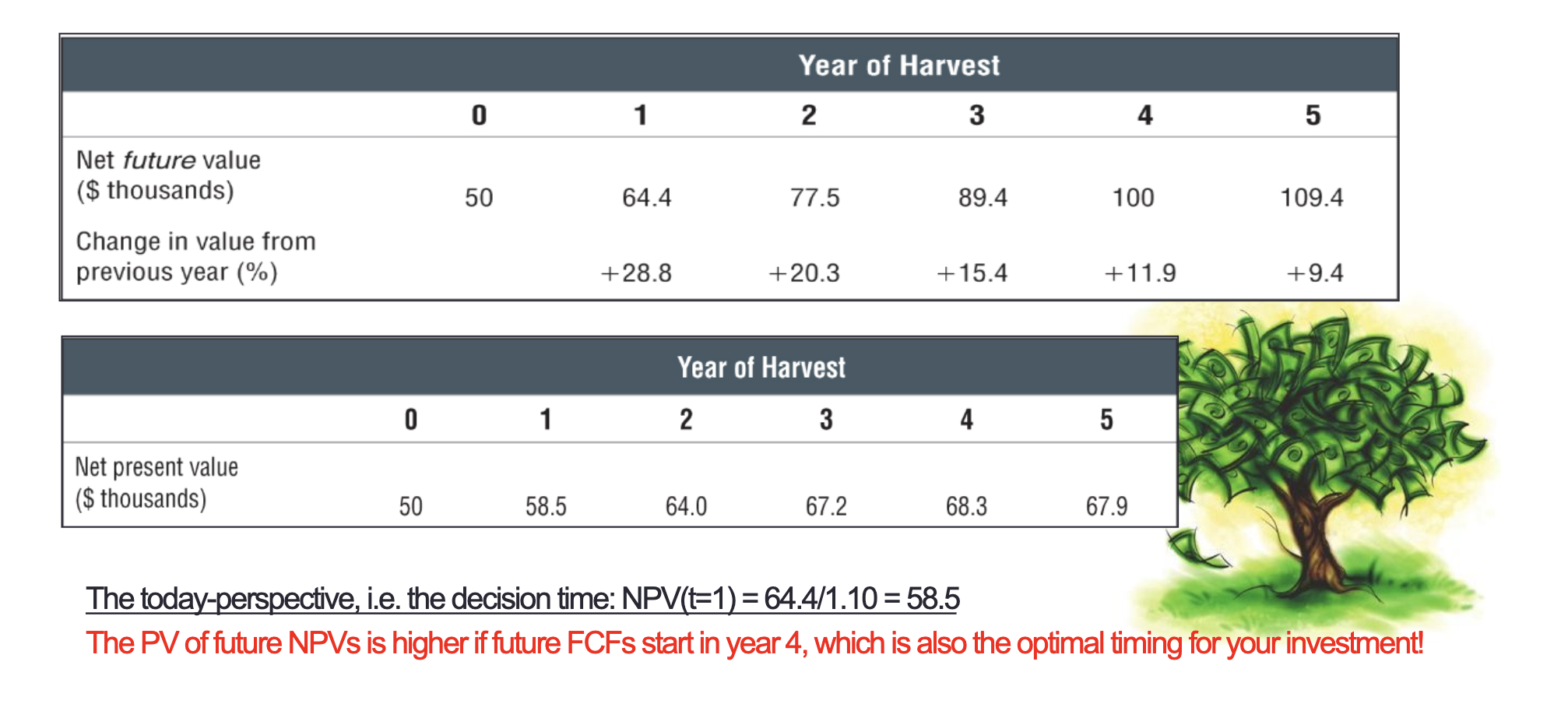
Describe investment timing.
Just because a project has a positive Net Present Value today does not mean you should execute it immediately—delaying an investment can often create even more value. The rule of investment timing is simple: undertake the project in the year that maximizes its NPV evaluated from today’s perspective (Year 0).
You own a large tract of inaccessible timber. To harvest it, you have to invest a substantial amount in access roads and other facilities. The longer you wait, the higher the investment required. On the other hand, lumber prices will rise as you wait, and the trees will keep growing, although at a gradually decreasing rate. Given the following data and a 10% discount rate, when should you harvest?
Describe EAC.
Equivalent Annual Cost (EAC) solves the problem of comparing mutually exclusive equipment or projects that have unequal lifespans and will be replaced continuously over time.
Comparing total costs directly between a machine that lasts 2 years and one that lasts 3 years creates a distorted picture. EAC levels the playing field by converting a project’s total present value into an identical, annualized installment (like an annual rental cost).
EAC= PV(costs)/Annuity Factor
Where Annuity Factor (AFt)=1-(1+r)-t/r
When projects generate revenues rather than just costs, the same logic applies to Net Present Value, termed Equivalent Annual Annuity (EAA):
EAA=Annuity FactorNPV

Which machine should you take?


Select one of the two following projects, based on highest EAC (COC=9%).


Solution: NPV = $7.3m > 0, Yes go for it!

