DD 3 (NGO) Questions
 Call Kai
 Learn
 Practice Test
 Spaced Repetition
 Match
 Flashcards
 Knowt Play
1/32

There's no tags or description
Looks like no tags are added yet.
33 Terms
A patient receives an intravenous dose of 2000 mg. What is the plasma drug concentration in mg/L if the volume of distribution is 28.6 L?
(The answer must be numeric, with no units or commas; include a leading zero when the answer is less than 1. Round the final answer to the nearest whole number.)
Cp=
2000 mg/28.6 L = 69.93 ≈ 70 mg/L
4 mcg/kg dose of an investigational drug is ordered for a patient. The patient weighs 110 pounds. Following the intravenous bolus administration of the drug, plasma levels were measured. The extrapolated concentration at time zero was determined to be 0.429 mcg/L.
Calculate the volume of distribution (in liters) for the investigational drug.
(The answer must be numeric, with no units or commas, and round the final answer to the nearest WHOLE number.
110 lbs • 1 kg/2.2 lbs = 50 kg
50 kg • 4 ug/1 kg = 200 ug
200 ug • 1 L/0.429 mcg = 466.2 L ≈ 466 L
After an IV bolus dose of 250 mg of an investigational drug, plasma samples were collected and assayed by HPLC for drug concentration. What if, graphically, the half- life of the drugs?
t1/2 = 2 days
What is the Half-Life in Hours Associated With First-Order Drug Elimination
For a starting concentration of 60 mg/L, and if k = 0.1 hr-1?
(Round the final answer to the nearest whole number)
t1/2 = 0.693/0.1 hr = 6.93 ≈ 7 hrs
What is the renal clearance in liter per hour if the renal rate constant of elimination ke = 0.12 hr-1 and the volume of distribution is 65L?
(The answer must be numeric, with no units or commas, and round the final answer to the nearest tenth.
65 L • 0.12 hr-1 = 7.8 L/hr
A drug is administered intravenously as a 500 mg dose. The AUC is
102 mg•hr/L. The oral bioavailability is 35%. What is the clearance of the drug in L/hr?
(The answer must be numeric, with no units or commas, round the final answer to the nearest whole number.)
Cl=
500 mg/102 mg•hr/L = 4.9 L/hr
An drug is administered P.O. as a 500 mg dose. The AUC is 100 mg•hr/L. The oral bioavailability is 55%. What is the clearance of the drug in L/hr?
(The answer must be numeric, with no units or commas, round the final answer to the nearest tenth.)
Cl=
0.55 [(500 mg)/(100 mg•hr/L)] = 275/100 = 2.75 ≈ 2.8 L/hr
Immunosuppressants play a vital role in preventing and treating allograft rejection in the transplant patient. Which of the following statements is true?
A. Immunosuppressants have wide therapeutic window
B. Immunosuppressants drug therapy is NOT individualized
C. Subtherapeutic concentrations can lead to toxicity and adverse effects
D. Supratherapeutic concentrations can lead to toxicity and adverse effects
D. Supratherapeutic concentrations can lead to toxicity and adverse effects
Sandimmune® (cyclosporine), the Original formulation of cyclosporine, and Neoral® (cyclosporine modified) are bioequivalent.
(Select the correct response)
A. True
B. False
B. False
HO is a 50-year-old, 75-kg male renal transplant patient 2 days post transplant surgery. The patient's liver function tests are normal. The desired steady-state cyclosporine trough blood concentration equal to 250 ng/ml. The clearance of the patient is 6 mL/min/kg. The dosing interval is 12 hr.
What is the drug clearance in L/hr according to disease states and conditions preset in the patient?
Round the final answer to the nearest whole number.
75 kg • (6 mL/min/kg) = 450 mL/min
450 mL/min • 1 L/1000 mL = 0.45 L/min
0.45 L/min • 60 min/1 hr = 27 L/hr
HO is a 50-year-old, 75-kg male renal transplant patient 2 days post transplant surgery. The patient's liver function tests are normal. The desired steady-state cyclosporine trough blood concentration equal to 250 ng/ml. The clearance of the patient is 6 mL/min/kg. The dosing interval is 12hr.
What is an initial oral cyclosporine dose designed to achieve a steady-state cyclosporine trough blood concentration equal to 250 ug/ml?
Round the final answer to the nearest 100 mg.
D = (Css • Cl • τ) / F
(250 ug/L • 27 L/hr • 12 hr) / 0.3 = 270000 ug
270000 ug • 1 mg/1000 ug = 270 mg ≈ 300 mg
What is the volume of distribution of Cyclosporine if the clearance is 27 L/hr and the half-life is 10 hr?
(The answer must be numeric, with no units or commas; include a leading zero when the answer is less than 1 . Round the final answer to the nearest whole number.)
Vd=
Vd = Cl / k ; k = 0.693 / t1/2
k = 0.693/10 hr = 0.0693 hr
Vd = (27 L/hr) / 0.0693 hr
Vd = 389.6 L ≈ 390 L
E.R., a 48-year-old, 59-kg male patient, received a living-related renal transplant many years ago. He is currently receiving Sandimmune 300 mg PO as the solution BID and, in addition, prednisone 5 mg/day and mycophenolate 1,000 mg BID.
E.R.'s current serum creatinine is 2.1 mg/dL, and his steady-state cyclosporine trough concentration is 590 mcg/L. The physician has ruled out the possibility of rejection and believes that the recent rise in serum creatinine is because of cyclosporine toxicity.
What questions would one ask E.R., and how would one adjust his cyclosporine regimen to achieve a new steady-state cyclosporine concentration of approximately 200 mcg/L?
(The answer must be numeric, with no units or commas; include a leading zero
when the answer is less than 1 . Round the final answer to the nearest 100 mg).
Desired dose= (_________________)
[(200 mcg/L) / (590 mcg/L)] • 300 mg = 101.7 mg ≈ 100 mg
The hepatic metabolism of Tacrolimus is mainly through (____________).
(Select the single best answer)
A. CYP1A1
B. CYP3A5
C. CYP3A4
D. CYP2C19
C. CYP3A4
HO is a 50-year-old, 75-kg (height = 5 ft 10 in) male renal transplant patient 2 days post-transplant surgery. The patient's liver function tests are normal. The mean tacrolimus clearance for adult patients is 0.06 L/hr/kg.
What is the Estimate clearance (L/hr) according to disease states and conditions present in the patient?
(The answer must be numeric, with no units or commas; Round the final answer to the nearest tenth.)
75 kg • 0.06 L/hr/kg = 4.5 L/hr
HO is a 50-year-old, 75-kg (height = 5 ft 10 in) male renal transplant patient 2 days post-transplant surgery. The patient's liver function tests are normal. The mean tacrolimus clearance for adult patients is 0.06 L/hr/kg. A 12-hour dosage interval will be used for this patient. The average bioavailability is 25%.
What is an initial oral tacrolimus dose designed to achieve a steady-state tacrolimus trough blood concentration equal to 15 ug/mL?
(The answer must be numeric, with no units or commas; Round the final answer to the nearest whole number.)
(15 mcg/L • 4.5 L/hr • 12 hr) / 0.25 = 3240 mcg • (1 mg/1000 mcg) ≈ 3mg
CF continues to improve clinically 4 days after the liver transplant. He is currently taking tacrolimus 6 mg PO BID. Trough tacrolimus concentrations have been obtained serially daily in the morning (day 2:8 mcg/L; day 3:10 mcg/L; and day 4:12 mcg/L). The transplant physician would like the patient to have a higher therapeutic target of tacrolimus because he has increased risk of organ rejection in this immediate post-transplant period. The team would like you to adjust the tacrolimus dose to achieve a trough concentration of 18 mcg/L. What is the desired daily dose?
(The answer must be numeric, with no units or commas; Round the final answer to the nearest whole number.)
(18 mcg / 12 mcg) • 12 mg/day = 18 mg/day ≈ 9 mg/Q12hr
The mean sirolimus Cl/F for adult renal transplant patients taking Sirolimus is 240 mL/hr/kg. What is the clearance in L/hr if the patient weighs 70 Kg?
(The answer must be numeric, with no units or commas; Round the final answer to the nearest whole number.)
(240 mL/hr/kg) • 70 kg - 16800 mL/hr
(16800 mL/hr) • 1 L/1000 mL = 16.8 ≈ 17 L/hr
HO is a 50-year-old, 70-kg (height = 5 ft 10 in) male renal transplant
patient. The patient's liver function tests are normal, and the patient
is taking Sirolimus. The mean sirolimus Cl/F for adult renal transplant
patients taking Sirolimus is 240 mL/hr/kg and the mean V/F is 10 L/kg.
What is the oral loading dose for sirolimus designed to achieve a
steady-state sirolimus trough blood concentration equal to 5 ng/mL?
(The answer must be numeric, with no units or commas; Round the
final answer to the nearest whole number.)
10 mL/kg • 70 kg = 700 L • 5 ug/L = 3500 ug
3500 ug • 1 mg/1000 ug = 3.5 mg ≈ 4mg
HO is a 50-year-old, 70-kg (height = 5 ft 10 in) male renal transplant patient. The patient's liver function tests are normal, and the patient is taking Sirolimus. The mean sirolimus Cl/F for adult renal transplant patients taking Sirolimus is 240 mL/hr/kg and the mean V/F is 10 L/kg.
What is the initial oral maintenance dose for sirolimus designed to achieve a steady-state sirolimus trough blood concentration equal to 5 ng/mL?
(The answer must be numeric, with no units or commas; Round the final answer to the nearest whole number.)
D = 5 ng/mL • 240 mL/hr/kg • 70 kg • 24hr = 2016000 ng
2016000 ng • 1 ug/1000 ng • 1 mg/1000 ug = 2.0 mg
C.G. was taking a stable regimen of cyclosporine modified 200 mg PO BID, sirolimus 2 mg PO daily, and prednisone 10 mg PO daily. Her steady-state cyclosporine concentration was 200 mcg/L (via HPLC assay) and steady-state sirolimus concentration was 9 mcg/L on this regimen. C.G. was started on fluconazole 200 mg PO daily to treat a fungal infection. Two weeks later, her platelet count decreased from 200K to 75K, and her white blood cells decreased from 7K to 2.5K. Her latest cyclosporine blood concentration was 470 mcg/L, and sirolimus concentration was 22 mcg/L. What could account for her thrombocytopenia and leukopenia and elevated cyclosporine and sirolimus concentrations? How would you manage this interaction?
Thrombocytopenia and leukopenia are two adverse events associated with sirolimus, especially at toxic concentrations. Since sirolimus is a substrate of CYP3A4 and P-glycoprotein, fluconazole as an inhibitor of both enzymes will decrease the metabolism of sirolimus and cyclosporine. As the patient is showing signs of toxicity, the choice is to either discontinue the
fluconazole and substitute for another drug or decrease the dose of sirolimus.
Over a wide range, the concentration of sirolimus is directly proportional to the dose. Since this patient’s last sirolimus concentration at her current dose of 2 mg daily was 22 mcg/L, reducing her dose to 1 mg daily should result in a concentration of about 11 mcg/L., which is within the therapeutic range.
Regardless of the choice made, the sirolimus concentration should be checked after 1 to 2 weeks to make sure that it is within the therapeutic range.
A patient receives an intravenous dose of 2000 mcg. What is the volume of distribution in Liters if the plasma concentration is 24 ng/mL?
(The answer must be numeric, with no units or commas; include a leading zero when the answer is less than 1. Round the final answer to the nearest whole number.)
Vd = (________________)
Vd = Dose/Cp
Vd = 2000 mcg/24 L
Vd = 83.3 ≈ 83 L
A 5 mcg/kg dose of an investigational drug is ordered for a patient. The patient weighs 180 pounds. Following the intravenous bolus administration of the drug, plasma levels were measured. The extrapolated concentration at time zero was determined to be 10 mcg/L. Calculate the volume of distribution (in liters) for the investigational drug.
(The answer must be numeric, with no units or commas, and round the final answer to the nearest WHOLE number.
5 mcg/kg • (180 lbs/2.2 kg) = 409.09 mcg
409.09 mcg • 1 L/10 mcg = 40.9 L ≈ 41 L
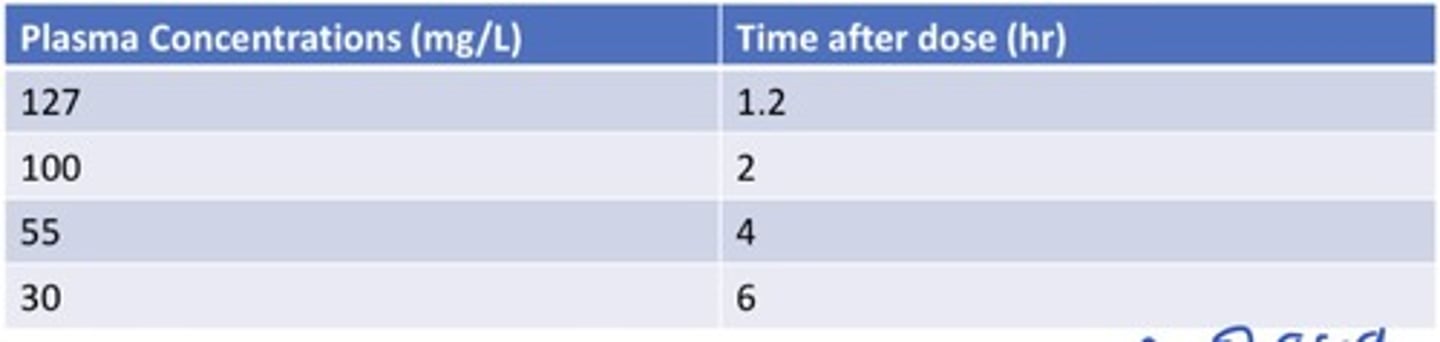
A dose of 500 mg of a drug X is administered to a patient, and the following concentrations results at the indicated times below (OPEN model & first-order elimination has been assumed). Round the result to the nearest tenth. What is an estimate of the half-life in hours of drug X?
(Rounds to the nearest tenth).
(The answer must be numeric, with no units or commas, and round the final answer to the nearest tenth or 1 decimal place.
k = (Ln 127 - Ln 100)/(2-1.2) = 0.2988 hr-1
t1/2 = 0.693/0.2988 hr = 2.32 hr ≈ 2.3 hr
What is the renal clearance in liter per hour if the renal rate constant of elimination ke = 0.2 hr-1 and the volume of distribution is 40 L?
(The answer must be numeric, with no units or commas, and round the final answer to the nearest whole.
Cl = Vd • k
40 L • 0.2 hr-1 = 8 L/hr
A drug is administered intravenously as a 400 mg dose. The
AUC is 85 mgxhr/L. The oral bioavailability is 25%. What
is the clearance of the drug in L/hr?
(The answer must be numeric, with no units or commas,
round the final answer to the nearest whole number.)
Cl= (___________________)
Cl = (D • F)/AUC
(400 mg • 1.0)/85 mg•hr/L = 4.71 L/hr ≈ 5 L/hr
An drug is administered P.O. as a 400 mg dose. The
AUC is 85 mgxhr/L. The oral bioavailability is 25%.
What is the clearance of the drug in L/hr?
(The answer must be numeric, with no units or
commas, round the final answer to the nearest tenth).
Cl = (D • F)/AUC
(400 mg • 0.25)/85 mg•hr/L = 1.18 L/hr
What is the volume of distribution of Cyclosporine if the clearance is 27 L/hr and the half-life is 12 hr?
(The answer must be numeric, with no units or commas; include a leading zero when the answer is less than 1. Round the final answer to the nearest whole number.)
Vd= (_____________).
k = 0.693/12 hr = 0.05775 hr
Vd = (27 L/hr)/0.05775 hr = 467.5 ≈ 468 L
A patient weighs 180 lbs. What is the volume of distribution in Liter of Cyclosporine if the population estimate of the volume of distribution is
5 L/kg?
(The answer must be numeric, with no units or commas; include a leading zero when the answer is less than 1. Round the final answer to the nearest whole number.)
Vd= (_____________).
(180 lbs/2.2 kg) • 5 L/kg = 409.09 ≈ 409 L
E.R., a 48-year-old, 59-kg male patient, received a living-related renal transplant many years ago. He is currently receiving Sandimmune 300 mg PO as the solution BID and, in addition, prednisone 5 mg/day and mycophenolate 1,000 mg BID.
E.R.'s current serum creatinine is 2.1 mg/dL, and his steady-state cyclosporine trough concentration is 590 mcg/L. The physician has ruled out the possibility of rejection and believes that the recent rise in serum creatinine is because of
cyclosporine toxicity.
What questions would one ask E.R., and how would one adjust his cyclosporine regimen to achieve a new steady-state cyclosporine concentration of approximately 200 mcg/L?
(The answer must be numeric, with no units or commas; include a leading zero when the answer is less than 1 . Round the final answer to the nearest 100 mg).
Desired dose= (_________________)
Desired Dose/Current Dose = Desired Css/Current Css
Desired Dose/(300 mg) = (200 mcg/L)/(590 mcg/L)
= 101.7 mg ≈ 100 mg
OR
Desired Dose = (Desired Css/Current Css) • Current Dose
Desired Dose = (200 mcg/L)/(590 mcg/L) • 300 mg = 101.7 mg ≈ 100 mg
Sirolimus is an immunosuppressant drug. Which of the following plasma proteins does Sirolimus mainly bind to?
A= Albumin
B= Alpha glycoprotein
C= Lipoprotein
D= Glycoprotein coupled receptor
A= Albumin
*only cyclosporine is likely to bind to lipoproteins
BT is a 50-year-old, 75-kg (height = 5 ft 10 in) male renal transplant patient. The patient's liver function tests are normal, and the patient is taking Sirolimus. The mean sirolimus Cl/F for adult renal transplant patients taking Sirolimus is
240 mL/h/kg and the mean V/F is 10 L/kg.
What is the oral loading dose in milligrams for sirolimus designed to
achieve a steady-state sirolimus trough blood concentration equal to
5 ng/mL?
(The answer must be numeric, with no units or commas; Round the
final answer to the nearest whole number).
5 ng/mL = 5 mcg/L
5 mcg/L • 10 L/kg • 75 kg = 3750 mcg
3750 mcg • 1 mg/1000 mcg = 3.75 ≈ 4 mg
DT is a 48-year-old, 85-kg (height = 5 ft 10 in) male renal transplant patient. The patient's liver function tests are normal, and the patient is taking Sirolimus. The mean sirolimus Cl/F for adult renal transplant patients taking Sirolimus is 240 mL/h/kg and the mean V/F is 10 L/kg. The dosing interval is 24 hours.
What is the initial oral maintenance dose in milligrams for sirolimus designed to achieve a steady-state sirolimus trough blood concentration equal to
6 ng/mL?
(The answer must be numeric, with no units or commas; Round the
final answer to the nearest whole number.)
Dose = Css • (Cl/F) • τ
6 ng/mL • 240 mL/hr/kg • 85 kg • 24 hr = 2,937,000 ng
2,937,000 ng • 1 mg/1,000,000 ng = 2.94 ≈ 3 mg