Pediatric: Reflexes
 Call Kai
 Learn
Learn Practice Test
 Spaced Repetition
 Match
Match Flashcards
 Knowt Play
1/26

There's no tags or description
Looks like no tags are added yet.
Name | Mastery | Learn | Test | Matching | Spaced | Call with Kai | Chat |
|---|
No analytics yet
Send a link to your students to track their progress
27 Terms
Rooting
baby turns towards the direction of the corner of the mouth, lip, or cheek that is stimulated/touched; functionally for finding food (why it’s also called the “searching reflex”)
birth-3 months
onset: 28 weeks gestation
integration: 3 months
“roots” growing “towards” the water

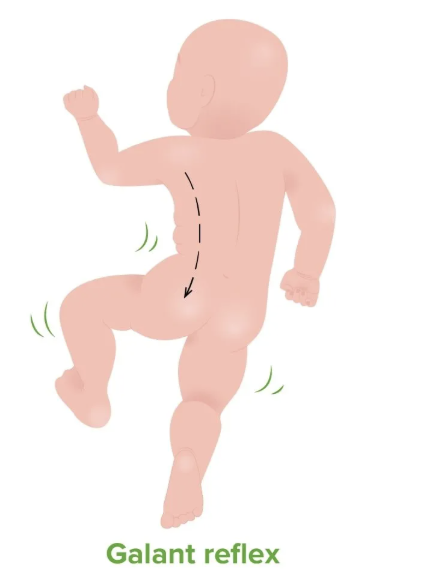
Galant
elicited by holding the newborn face down (prone) and stroking 1 side of the spine; baby’s trunk laterally flexes towards the stimulated side
important for facilitating (1) lateral trunk movements/trunk stabilization, (2) hip movement, and (3) ROM in preparation for crawling and walking
birth-3 months
onset: 32 weeks gestation
integration: 2 months
mnemonic:
going to a “gala” and “posing”
ga”L”ant (L pose when the trunk “L”aterally flexes)
Suck-swallow
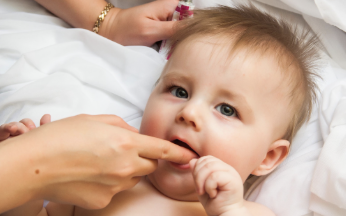
elicited by a finger, nipple, or bottle in the mouth, resulting in baby rhythmic sucking-swallowing; important for eating food/ingestion for nourishment
birth-6 months
onset: 28 weeks gestation
integration: 2-5 months
Palmar grasp
fingers grasp (flex) when baby’s palm is stimulated; important for increasing tactile input in the palms + facilitating reflexive grasp
if the reflex doesn’t integrate, there will be…
poor fine motor coordination
poor motor development, like grasping, releasing, and hand manipulation (which can impact handwriting)
birth-6 months
onset: 37 weeks gestation
integration: 4-6 months

Plantar grasp
similar to palmar, but for the feet; when the sole is stroked/pressured, the toes curl in flexion
importance: increases tactile input to the sole of the foot —> assisting in positioning of feet when standing, walking, running
if this reflex is retained, foot positioning will be more difficult, as the child may experience (1) hypersensitivity to touch and (2) gravitational insecurity when standing (which will make it hard to walk, run, and maintain balance in motion)
birth-9 months
onset: 28 weeks gestation
integration: 9 months

Traction
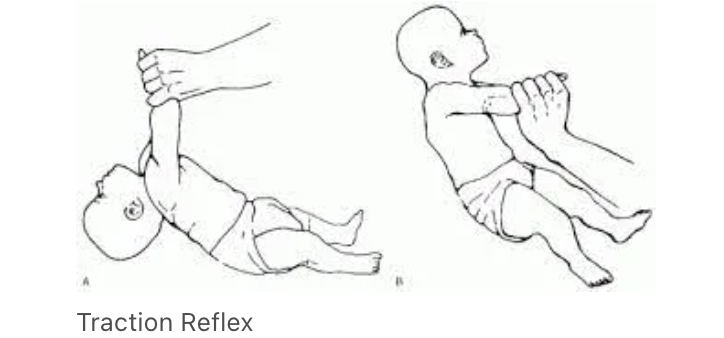
elicited by pulling the baby up by their forearms into sitting (pull-to-sit), resulting in (1) head lag, then —> (2) baby flexing their head, *UEs, and *hands —> and (3) ending in a sitting position; importance is the enhanced *momentary reflexive grasp, preparing baby for voluntary control of grasping
birth-6 months
onset: 28 weeks gestation
integration: 2-5 months
“pulling” is a form of “traction”; “traction of the neck” resulting in it —> “following the body into flexion”
Moro
elicited by a sudden noise, rapid movement, or sudden change in movement (e.g., by raising the baby’s head and allowing it to drop); baby (1) extends + abducts their arms, legs, and neck, and then (2) rapidly brings their arms together with flexion + adduction
importance: development of a protective response; an alarm system or “fight or flight” response triggered with a sudden loss of support
birth-6 months
onset: 28 weeks gestation
integration: 4-6 months
also called the startle reflex
baby got “scared” from a “moro”n playing loud music in the nursery

TLR (Tonic Labyrinthine Reflex)
elicited by changes in the position of the head and body in relation to gravity; causes a tonic extension of the limbs when the head is tilted backwards + a tonic flexion of the limbs when the head is tilted forward
image
TLR prone (baby in prone) —> response: body in flexor tone
TLR supine (baby in supine) —> response: body in extensor tone
if reflex isn’t integrated: profound functional limitations in movement
you will have difficulty extending the head in prone
you will have difficulty flexing your head to sit up from supine + roll over
—> poor posture, muscle tone, coordination, etc.
birth-6 months
onset: 37 weeks gestation
integration: 6 months
so named because it is influenced by the orientation of the “labyrinth”, which is the “part of the inner ear that helps with balance and spatial orientation”; all extremities follow the neck:
neck flexion —> extremity flexion
neck extension —> extremity extension
believed to help with the development of postural control and balance; as the reflex integrates and disappears, the infant begins to develop more advanced motor skills, such as rolling over, sitting up, and crawling

ATNR
elicited by head turning to 1 side (while baby is in supine); face side | arm extension, skull side | arm flexion
importance: precursor to hand-eye coordination, promoting visual and hand movement in regard; if it doesn’t get integrated…
e.g., poor reading comprehension 2/2 poor visual tracking and eye pursuit associated with difficulty crossing midline + losing place while reading
e.g., poor FM skills + handwriting 2/2 head rotation dictates arm movement —> arm extension on face side (i.e., with every slight head turn, the arm/hand will want to open and extend)
e.g., poor hand-eye coordination; because movement of arms is dependent on head position, it can cause asymetrical movment/positioning of the arms, making it
difficult to bring both hands to midline
difficult to hold an object with both hands
difficult to bring objects to mouth
difficult to reach for objects in front
birth-6 months
onset: 37 weeks gestation
integration: 4-6 months
also known as the fencing reflex, as it resembles a fencer
A= asymmetric (arms are different)
T= tonic (involves a sustained muscle tone or contraction in the neck muscles)
N= neck (neck turns towards the same side as the head)
R= reflex

Landau
elicited when the infant is held horizontally in the prone position (facing down), and the head is lifted; results in a curve-like shape, with the legs and arms extending and the head lifting up
importance: to break up flexor tone and facilitate prone extension, which is important for posture development
3 months-2 years
onset: 3-4 months
integration: 12-24 months
considered an important milestone in the development of motor skills, as it helps the infant to develop postural control, balance, and coordination
as the reflex integrates and disappears, the infant gains more control over their body and is able to perform more complex movements, such as crawling, standing, and walking
resembles an airplane “landing”

Parachute
elicited when the baby (or adult) is suspended in mid-air and suddenly moves towards the ground, as if falling; they will automatically extend their arms and legs forward, as if trying to catch themselves, even if they are not actually falling (helps to protect the body in the event of sudden fall or loss of balance)
infancy-lifetime
baby folds like a “parachute” with the “top of the parachute being the mid-section of the body” and the “bottom of the parachute being all the extremities”

STNR (Symmetric Tonic Neck Reflex)
6 months-12 months
onset: 4-6 months
*notice this is not primitive/newborn and begins at 6 months
integration: 8-12 months
i.e., the “crawling reflex”, as it functions to “help the baby get onto their hands and knees for crawling”; a transitional reflex, precursor to crawling
symmetrical extension of the arms and flexion of the legs (underneath the butt) when the head is extended (in crawling position)
symmetrical flexion of the arms and extension of the legs when the head is flexed (in crawling position)
mnemonic: S= symmetric
“arms follow the neck” in flexion/extension, as the “arms are closer to the head than the legs are”; the legs do the opposite
the “left/right of the upper or lower extremities” are “symmetric,” NOT the upper AND lower extremities are symmetric
also remember the “function”
the baby has different movement patterns for upper vs lower extremities because this helps facilitate movement in “crawling”; if the upper and lower extremities were in the same flexion or extension position, they would be in prone/quadruped pattern instead of the unique STNR pattern
poor integration of STNR would result in:
difficulty sitting up from supine 2/2 sitting up requires neck flexion, but in STNR, head flexion would result in hip/leg extension (which gets in the way of sitting up)
poor muscle tone and posture
e.g., when arms are bent, the legs will extend, resulting in a slouch backwards (imagine when a child is sitting at their desk writing); the same vice versa
e.g., when legs are bent, the arms will extend, resulting in a slouch forward (imagine when a child is sitting at their desk writing)

Gag and cough
a combination of 2 different reflexes (gag + cough) that protect the airway and prevent foreign objects from entering the lungs
birth-continue throughout life, although their sensitivity and strength may change over time
TLR vs STNR
lack of integration of both would result in difficulty sitting up, but the mechanisms are different
TLR
supine position —> increase in extensor tone —> difficulty flexing the neck to sit up
STNR
neck flexion —> hip and leg extension —> resists movement to sit up
righting reactions
a reflex that develops after birth that helps us assume a position, by maintaining alignment (head-trunk + trunk-limbs); in babies it helps to initiate…
head control
rolling
crawling
eventually standing
types
neck righting
body righting
optical head righting
labyrinthine righting
righting reactions
neck righting
test: place baby in supine and rotate head to 1 side; results: *log rolling of the body in the direction of the head to maintain alignment
importance: allows baby to roll and serves as a transition reflex that facilitates rolling supine to side-lying + is a precursor to crawling
onset: 3-6 months
integration: 6 months
*less mature form of rolling than segmental rolling, involving body moving as ONE unit

righting reactions
body righting
test: place baby in supine and flex 1 hip/knee towards the chest; result: *segmental rolling of the upper trunk and spine in order to maintain head-body alignment
importance: facilitates rolling through spinal/trunk rotation + supine > side-lying position
onset: 3-6 months
integration: 6 months
*more mature form of rolling than log rolling

righting reactions
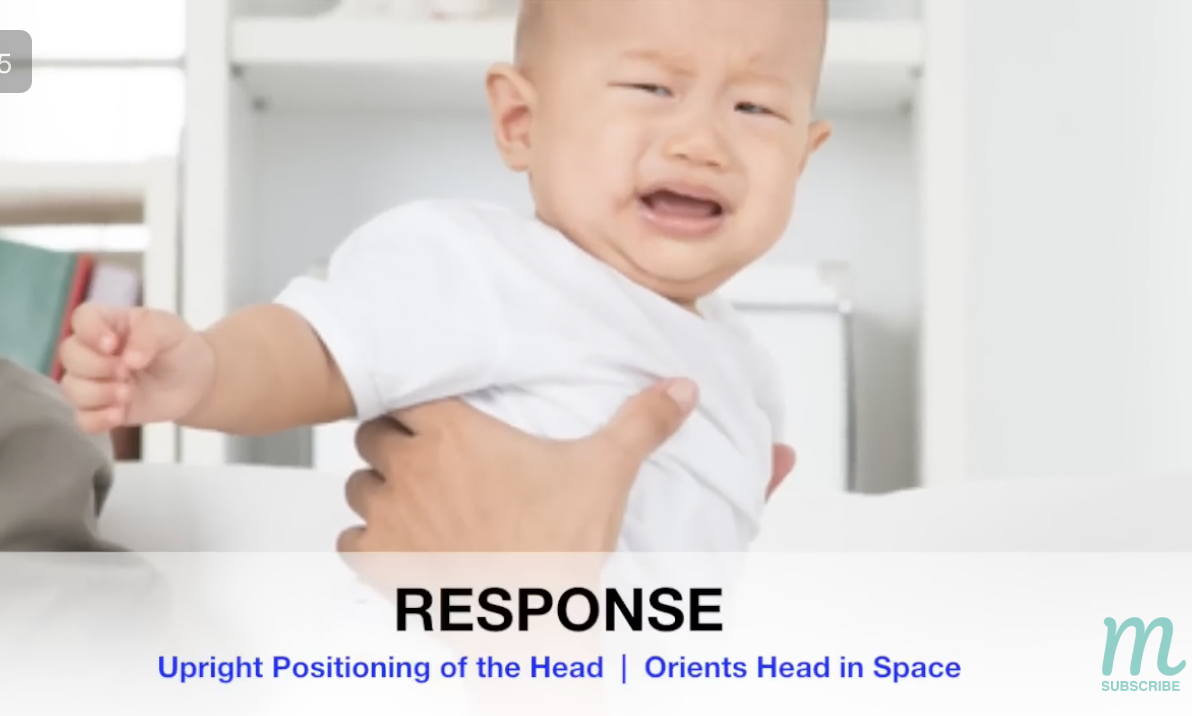
*optical head righting
test: hold baby suspended vertically and slowly tilt off-center by moving it side-to-side/forward-backwards; result: upright positioning of the head + orienting the head in space
importance: what allows us to correct the orientation of our head in space (i.e., alignment of the head vertically + in the upright position)
onset: birth-2 months
integration: persists
*called “optical” head righting, as the baby is using its “VISUAL” system to mediate
righting reactions
labyrinthine righting
tests: WITH BABY’S EYES CLOSED, hold baby suspended vertically and slowly tilt off-center by moving it side-to-side/forward-backwards; result: upright positioning of the head + orienting the head in space (same outcome as optical head righting reflex, but this time it is mediated by the **VESTIBULAR system)
importance: to orient the head in space (i.e., alignment of the head vertically + in the upright position)
onset: birth-2 months
integration: persists
*baby will not be able to use visual cues or information in the environment for orientation
**2/2 the labyrinth, a structure in the inner ear that helps maintain and regain balance

reflexes that emerge before birth
observed within the 1st year
integrated within the 1st year
may recur after injury to the brain
important for survival, posture, and alignment of head with body
reflexes
rooting
suck-swallow
galant
moro
traction
palmar
plantar
ATNR
TLR
reflexes that emerge from birth to ~6 months
STNR
Landau
lifetime reflexes that persist
optical head righting
labyrinthine righting
protective reactions
downward parachute
forward parachute
sideward parachute
backward parachute
equilibrium reactions
prone tilting
supine tilting
quadruped tilting
standing tilting
protective reactions
downward parachute
test: lower baby toward a surface while vertically suspended; result: extension of the *lower extremities
importance: protective defense against a fall + facilitates accurate placerment of feet
onset: 4 months
integration: persists
*the only protective reaction that involves lower extremity extention

protective reactions
forward parachute
test: rapidly tip a baby forward while vertically suspended; result: extension of upper extremities + hand opens
importance: protective defense against a fall
onset: 6-9 months
integration: persists

protective reactions
sideward parachute
test: tip a baby off to the side while in a sitting position; result: arm extension and abduction to the side
importance: protective defense against a fall
onset: 7 months
integration: persists

protective reactions
backward parachute
test: tip a baby off balance backwards while sitting; result: arm extension backward + arm extension to 1 side w/ spinal rotation
importance: protective defense against a fall
onset: 9-10 months
integration: persists

equilibrium reactions (4)
responses
the spine will curve on the raised side
both arms and legs will extend and abduct
importance= FIRST line of defense against falling (protective reactions are the SECOND line of defense)
maintain equilibrium without arm support
ability to make postural adjustments
types
prone tilting
onset: 5 months
position baby in prone on a tilt board and raise 1 side of the surface
supine tilting
onset: 7-8 months
position the baby in supine or sitting on a tilt board and raise 1 side
quadruped tilting
onset: 9-12 months
position the baby on all 4 on a tilt board and raise 1 side
standing tilting
onset: 12-21 months
position the baby in standing on a tilt board and raise 1 side