2.5- Shapes of molecules and ions
 Call Kai
 Learn
 Practice Test
 Spaced Repetition
 Match
 Flashcards
 Knowt Play
1/36

There's no tags or description
Looks like no tags are added yet.
37 Terms
What determine bond angles and bond geometry
Electron pairs that repel each other
Linear shaped molecule information:
When there are 2 regions of electron density around
Typically from double bonds or 2 single bonds with no lone pairs- these bonding regions repel equally to minimise repulsion- this creates a straight line in molecular geometry with a bond angle of 180 degrees
Bond angle of linear molecule
180 degrees

When does trigonal planar bonding occur
When there are 3 bonding pairs and no lone pairs around the central atom

How does trigonal planar bonding get its shape
An electron deffcient atom gives the trigonal planar shape with bond angles of 120 degrees
Trigonal planar bond angle
120 degrees
How does tetrahedral shape occur
4 bonding pairs and no lone pairs
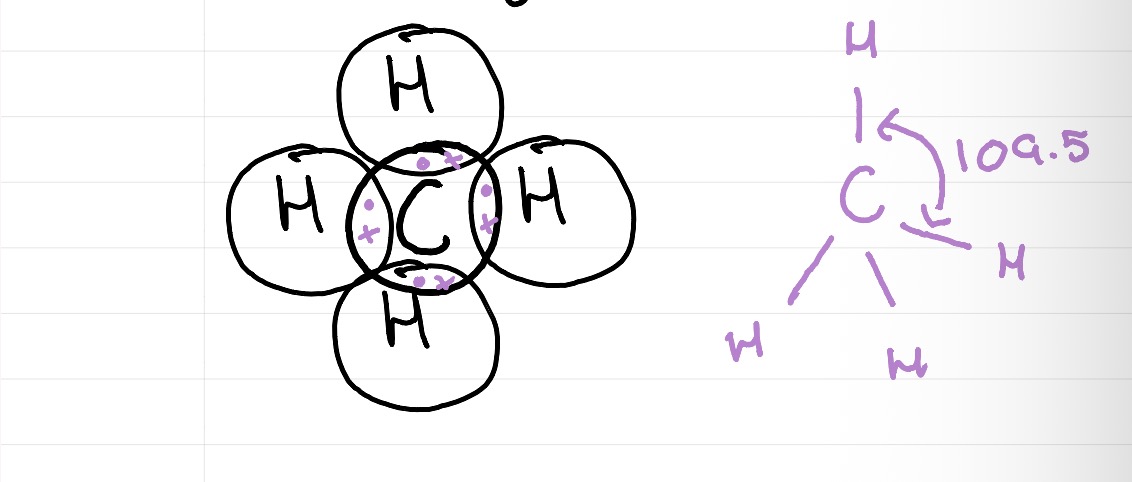
Tetrahedral bond angle
109.5 degrees
How does pyramidial bonding work?
3 bonding pairs and one lone pair on the central atom→ the lone pair repels the bonding pairs more strongly pushing tg resulting in a bond angle of 107 degrees

Pyramidial bond angle
107 degrees
How does non-linear (bent) bonding work?
When central atom has 2 bonding pairs and 2 lone pairs→ the lone pairs exert strong repulsive forces, compressing the bonding angle
Bond angle for non-linear bent bonding
104.5 degrees

How does octahedral bonding work?
6 bonding pairs and no lone pairs→ bonding pairs repel equally in 3d space and arrangements at 90 degrees

Is octahedral bonding symetrical
Yes
Bond angle for octahedral bonding
90 degrees
How many bonded pairs are in linear bonding
2
How many lone pairs are in linear bonding
None
How many bonded pairs are their in trigonal planar bonding
3
How many lone pairs are there in trigonal planar bonding
0
How many bonded pairs are in tetrahedral bonding
4
How many lone pairs are there in tetrahedral bonding
None
How many bonded pairs are there in pyramidial bonding
3
How many lone pairs are there in pyramidial bonding
1
How many bonded pairs are their in non linear bonding
2
How many lone pairs are there in non linear bonding
2
How many bonded pairs are there in octahedral bonding
6
How many bonded pairs are in octahedral bonding
0
Electronegativity
Power of an atom to attract the pair of electrons in a covalent bonds towards itself
Why is the electron distribution in a covalent bond between elements with different electronegativities unsymmetrical
The ability of the positive nucleus to attract the negatively charged electrons in the outer shells towards itself
What is the Pauling scale used for?
Used to assign a value of electronegativity for each atom
Most electronegative atom
Fluorine
Pauling scale value of fluorine
4.0
Why is fluorine the most electronegative atom
It is the best at attracting electrons towards itself when covalently bonded to another atom
How does nuclear charge affect electronegativity?
Increase in protons means an increase in the nuclear attraction for the electrons in the outer shells
More nuclear charge= more electronegativity
Factors that affect electronegativity
1: nuclear charge
2: atomic radius
3: sheilding
How does atomic radius affect atomic radius
Increased atomic radius means decreased electronegativity
How does sheilding affect electronegativity
Energy levels can shield the effect of nuclear charge causing the outer electrons to be less attracted to the nucleus
More subshells and shells= decreased elctronegativity