BIOL 1215 LAB 5
 Call Kai
 Learn
 Practice Test
 Spaced Repetition
 Match
 Flashcards
 Knowt Play
1/62

There's no tags or description
Looks like no tags are added yet.
63 Terms
1. Animals are multicellular eukaryotes.
2. They are heterotrophs that ingest other organisms for nutrients.
3. They are capable of some form of locomotion at some stage in their life cycle.
4. Most have 4 kinds of tissue: epithelial, connective, muscle, and nervous tissue
5. The multicellular stage in any animal's life cycle is diploid. In contrast, the multicellular stage
in fungal life cycles is haploid, and every plant has both a multicellular haploid form and a
multicellular diploid form.
What characteristics do all animals have in common?
1.) Adult animals make haploid gametes.
2.) A sperm fertilizes an egg, producing a zygote.
3.) The zygote divides in mitosis.
4.) The zygote develops into a diploid multicellular animal.
What is the animal life cycle?
Porifera - poorly organized tissues; asymmetrical
Cnidaria - true tissues; radial symmetry
Platyhelminthes, Mollusa, Annelida - true tissues; bilateral symmetry; protostomic embryonic development; do not molt
Nematoda, Arthropoda - true tissues; bilateral symmetry; protostomic embryonic development; molt
Echinodermata, Chordata - true tissues; bilateral symmetry; deuterostomic embryonic development
What are the characteristics we can use to identify different animal phyla?
1. What type of symmetry is displayed by the specimen?2. Are the cells which make up the body of the animal organized into tissues? Are there organs or organ systems present?
3. Is there evidence of segmentation (the repetition of similar units)?
4. Is there evidence of cephalization (having a definite head), perhaps with sensory organs?
5. Is a skeleton present? Is it external to the body wall (an exoskeleton, which results in molting), or is it internal (an endoskeleton)?
6. Is there a circulatory system? Is it an open circulatory system (a vessel carries blood part of the way through the body but then ends, allowing the blood to find its own way back between cells or through body cavities) or a closed circulatory system (the blood is confined to vessels)?
7. What type of digestive anatomy is present?
a. Sac-like with one opening for both entrance of food and exit of wastes. Such a digestive cavity, which is usually highly branched is known as a gastrovascular cavity.
b. A tube-within-a-tube; has a separate entrance for food and exit for wastes. The specimen usually contains an intestine.
8. Take note of any other characteristics not covered in the previous 7 points that are unique to a particular phylum.
What are the 8 steps we can use to identify phlya?
Phylum Porifera includes the animals called sponges. Sponges are made up of a collection of cells that are arranged into poorly organized tissues. Although some members of Porifera appear
radially symmetrical, most are asymmetrical. Most members of Porifera are marine, but some do live in freshwater. Living sponges are often brightly colored: orange, purple, yellow and lavender. Preserved specimens have their colors fade. Choanocytes are the key unique feature of Porifera.
What is Porifera?
They are in the shape of an irregular cylinder with a large central cavity, the spongocoel, occupying the inside of the cylinder.
What is the general shape and appearance of sponges?
Sponges - Porifera
What are these specimens called?

1. Osculum = opening at the top where the air/unneeded particles go out (filter feed through the pores then go out at the top)
2. Spongocoel = central cavity
3. Pores = Where food/air goes in to be filtered
4. Choanocytes = Create the current for water to flow into the spongocoel
Locate the osculum, spongocoel, pores and choancytes and describe their function.

Water is drawn in through the pores. The collar cells lining the pores filters out food from the water, after which the water flows out through the osculum. Through this method, they can eat detritus, plankton, viruses and bacteria.
Describe how a sponge filters water to obtain its food and what size of food can be digested through this method.
Those are spicules (protein frameworks, composed of silica or calcium carbonate) and keep pores open to allow water to flow in and out. No defensive function, just structure and support.
What is this and what is its function?

An animal characterized by cnidocytes, radial symmetry, gastrovascular cavity, a poly and medusa body form with examples including hydra, jellies, sea anemones, and corals. Nematocysts are the key feature of this phylum.
What is Cnidaria?
1. Polyp = tentacles facing upwards attached to a solid substrate
2. Medusa = tentacles facing downwards and they can swim in the water (free-swimming)
What are the two types of body plans the cnidarians are usually arranged into?
They have a larger area where food can be digested in therefore can digest bigger foods not just small particles.
What major advantage does an animal with a gastrovascular cavity have over an animal (such as
a sponge) which lacks one?
Nematocysts (stinging cells) have 4 functions:
1. To coil around a structure
2. To wrap around prey
3. Stick onto prey
4. Release toxins onto prey to capture the prey
What is this called and what is its function?

Bilaterally symmetrical and show protostome embryonic
development. This phylum includes both free-living and parasitic subgroups. Parasitic examples include flukes and tapeworms. Flatworms can range in size from 1 mm to several metres in length. The absence of a body cavity (known as a coelom) is one of the unique features of the Platyhelminthes.
What is Platyhelminthes?
- Bilaterally symmetric
- Triploblastic
- They lack a coelom (fluid-filled body cavity where organs usually go)
What features do Platyhelminthes have in common?
These are flatworms that belong to Platyhelminthes.
What phylum are these?

Planaria.
What animal is this?

- Yes
- The food enters through the pharynx (mouth) where food is also deposited, because they have gastrovascular cavity
- Digestive waste is expunged through the mouth, but there are tubules called protonephridia that lead to pores which expel nitrogen and ammonia from the body
does the Planaria have cephalization? and where does the food enter? Is there a separate exit for large indigestible wastes?
The planaria has a Gastrovascular Cavity that carries the nutrients from chemical digestion to all parts of the body. The GVC is highly branched so it is able to come close to every cell to give it its nutrients via diffusion.
How does the digested food get to all parts of the body where it is needed for energy in planarians?
The animal has an acoelomate body (no internal cavity to hold organs), no anus and lacks a circulatory system.
Where is the GVC in this planaria? Does Planaria have an internal body cavity that contains the internal organs?

The Phylum Mollusca is remarkable in that its members have been shaped by evolution into a great diversity of body forms. All are bilaterally symmetrical at some point in their development
and also show protostome embryonic development. The key feature that is unique to them is the radula.
What is Mollusca?
They belong to Mollusca. Some common names for this phylum are clams, scallops, oysters, snails, slugs, octopus, squid and chitons.
What phylum do these belong to and what are some of the common names that belong to this phylum?

1. Shell = for protection
2. Mantle = Layer between inner and shell
3. Radula = For eating food (scrapes up food to put it in the mouth)
4. Muscular foot = For movement
5. Visceral mass = Organs (gas exchange)
What unique feature(s) do most members of Mollusca have in common?
allows for separation and specialization of different parts of the body. Rather than having connected, they're able to separate organs eg. muscles and digestive organs. Also, the organs are more protected, a little more pushing. If one part of the body is affected not all of the body is affected.
Many of the organs inside a mollusc are suspended within a fluid-filled body cavity, called a
coelom. What advantages are offered by such an arrangement vs. a solid body, as seen in the
flatworms?
The ability to breathe using gills/trachea instead of only through surface absorption.
What other major anatomical development appears in the Mollusca that was absent in the previously described phyla?
allows separation of food and waste, maximizes absorption.
What advantage does a one-way digestive tract have over a gastrovascular cavity?
They possess an open circulatory system except for the cephalopoda.
What kind of circulatory system do molluscs have?
Herbivorous mollusks use the radula to scrape food such as algae off rocks. Predatory mollusks use the radula to drill holes in the shells of their prey.
What sort of modifications to body form relate to filter feeding vs. predation in Mollusca?
This is a snail's radula. The teeth of the radula are lubricated by the mucus of the salivary gland, just above the radula. Food particles are trapped into this sticky mucus, smoothing the progress of food into the esophagus. The radula scrapes up, or rasps, food particles and the jaw cuts off larger pieces of food, like a leaf, to be rasped by the radula.
- eg. grasping structure used to scare algae
What is this and what is its function?
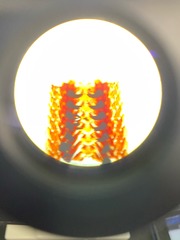
Earthworms, leeches, bristleworms, and tube-worms are all annelids. One of their defining features is a segmented body with some organs repeated in each body segment. They may be found in terrestrial, marine or freshwater habitats.
What is Annelida?
They have a fluid-filled body cavity in which the gut and other organs are suspended. The coelom is divided into separate compartments by partitions called septa, which give the "segmented worms" their segmented appearance.
What is the general morphology of annelids?
They have a closed circulatory system. Multiple hearts and blood vessels:
- blood flows through connected blood vessels, pumped by muscular hearts. The blood flows through vessels to supply tissues with nutrients.
What kind of circulatory system do annelids have?
does have presence of coelom; suspension for different types of organs
Do annelids have a coelom? What is its function?
It is a leech. It belongs to Annelida. Blood sucking, sucker on one end that attaches to host and body is expandable allowing to drink blood.
What animal is this? What phylum does it belong to? How is it adapted to its way of life?

This is a polychaete worm. It belongs to Annelida. Aquatic; using setae (paddle-like structures that help swim through the water).
What animal is this? What phylum does it belong to? How is it adapted to its way of life?

This is an earthworm. It belongs to Annelida. Terrestrial; pointy head helps them burrow through the soil.
What animal is this? What phylum does it belong to? How is it adapted to its way of life?

- prostomium
- clitellum
- sperm groove
- seta in pits
Locate the prostomium, clitellum, sperm groove, and seta in pits

Each segment on an earthworm's body has a number of bristly hairs called setae which provide grip to help the earthworm move through the soil. The streamlined body of an earthworm is an adaptation which allows the earthworm to live in narrow burrows underground and to move easily through the soil
How does the body shape facilitate movement through soil in earthworms?
they secrete a slimy mucus produced by epithelial cells
An earthworm's epidermis (skin) must stay moist for the worm to survive. How do earthworms
achieve this?
Diffusing air across the skin, therefore needs that layer of moist in the skin. Its more easily absorbant to have gas exchange through moist "water"
How does gas exchange occur in earthworms, and why is maintaining a moist skin layer important for this?
Earthworms do not have specialized respiratory organs like we do instead they take and expel CO2 directly thru their skin. That's why a large SA:V ratio is important. because diffusion happens slowly, if they were bigger in diameter, the worm would suffocate (they are limited in size)
Most earthworms are relatively small in size. How does an earthworm's small size and diameter relate to their method of gas exchange?
1. Crop = stores food
2. Gizzard = Mechanical digestion
3. Intestine = Chemical digestion/absorption of nutrients
4. Clitellum = Produces mucus to protect incoming sperm, protect eggs as they're laid, and cover the worm
5. Spermathecae = Store sperm given from the partner to fertilize eggs (small)
6. Seminal vesicles = Store and produce their own sperm (large)
Give the functions of the crop, gizzard, intestine, clitellum, spermathecae and seminal vesicles in earthworms.
They use cross fertilization to sexually reproduce, therefore it has both female and male parts = can produce egg and sperm, however they still need to mate to reproduce. They mate by lining up beside one another in opposite directions to facilitate sperm transfer. The earthworm can later use the stored sperm to externally fertilize
its own eggs.
Earthworms are reciprocal hermaphrodites. What does this mean?
Located in the photo.
Identify the crop, gizzard, seminal vesicles, spermathecae and intestine.
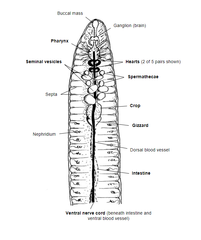
Cross-section of earthworm.
What is this a cross-section of? Can you identify the coelom?

Also known as the round worms, thrive in virtually every
habitat on the planet, from deserts to glaciers. They are especially common in wet soil and many are parasites in plants or other animals. They are typically less than 1 mm in length, but a 9 m parasite has been found in the placenta of a sperm whale. They simply exchange
waste materials across their body wall, because they lack organ systems found in other animals. Nematodes are covered by a tough cuticle, which is shed (molted) periodically as the animal grows.
What is Nematoda?
Typically elongate, tapered at both ends, and bilaterally symmetrical.
Describe the general body morphology of the Nematoda.
Although nematodes do have a space in the body between the digestive tract and the body wall, it is not lined with tissue and is not considered to be a true coelom.
Do organisms in the Nematoda phylum have a true coelom?
Annelids are segmented and nematodes are unsegmented.
Both the nematodes and the Annelids are "worm shaped". What is one striking difference in the
morphology of the two groups?
Nematoda.
What phylum do these animals belong to?

These are vinegar eels and they belong to Nematoda.
What animals are these and what phylum do they belong to?

Insects, spiders, crabs, shrimps, and barnacles are
all arthropods. Approximately two-thirds of all named species on the planet are Arthropods. They have segmented bodies but the segments are often fused into distinct body regions. They
have an exoskeleton, and molt periodically.
What is Arthropoda?
jointed appendages (legs) and exoskeleton made of chitin
What characteristics do all arthropods share?
open circulation system; blood flows through a vessel with muscular thickenings that act as a pump. Blood empties into an open body cavity to supply the tissues with nutrients and is returned to circulation.
What circulatory system do arthropods have?
head, thorax, abdomen. legs are attached to the thorax.
What are the 3 main segments phylum Arthropoda bodies are divided into?
Jointed legs, claws and body segments
What feature do arthropod appendages have in common?
1. paddle-like hindleg of a water beetle
2. grasping organ, the foreleg of a praying mantis
3. digging foreleg of a mole cricket
4. hindleg of a ground beetle, for running
5. the foot of a house fly has claws and sticky climbing pads
Arthropod appendages are often well adapted to a particular function. List and describe at least five
adaptations.
The exoskeleton does not grow with animal, they solve this by molting.
The external skeleton of arthropods provides protection from the external environment as well
as a site for muscle attachment. What are some problems created by an external skeleton, and how are they solved?
Sea stars, sand dollars, sea urchins, sea cucumbers, brittle stars and feather stars. All are marine. Echinoderm larvae have bilateral symmetry, but most adults have pentaradial symmetry, i.e., a tendency for body parts to come in multiples of five. Echinoderms are most closely related to Phylum Chordata (the one that includes humans);
the two groups show deuterostome embryonic development.
What is Echinodermata?
These are sea stars and they belong to Echinodermata.
What animals are these and what phylum do they belong to?

Most echinoderms have a meshwork of small calcareous plates embedded in the tissue of the body wall. Because this supportive structure within the body, it is known as an endoskeleton. Some of these plates may fuse to produce numerous movable and immovable calcareous spines. The phylum name, translated as 'spiny skin', refers to this feature. Another unique feature of the taxon is an internal system of water-filled tubes called the water vascular system, which acts like a hydraulic system that allows for locomotion in echinoderms.
What are some key features of Echinodermata?
Can be divided into five down the middle easily.
What is pentaradial symmetry?