UNIT3 AOS2
 Call Kai
 Learn
Learn Practice Test
 Spaced Repetition
 Match
Match Flashcards
 Knowt Play
1/78

There's no tags or description
Looks like no tags are added yet.
Name | Mastery | Learn | Test | Matching | Spaced | Call with Kai | Chat |
|---|
No analytics yet
Send a link to your students to track their progress
79 Terms
What is an electrolysis reaction?
a non spontaneous, endothermic redox reaction that converts electrical energy into chemical energy and requires electricity for it to occur
→ opposite of a galvanic cell
an external power source has to be applied to provide a flow of electrons that forces a non-spontaneous reaction to occur
→ the energy source must provide a potential greater than the cell potential
How can you predict electrolytic reactions?
reactions occur between the strongest oxidant and the strongest reductant
→ for electrolytic reactions, the substances that formed the smallest positive gradient will occur
There are two types of electrolytic cells: molten and aqueous
What is a molten electrolyte?
Melted ionic compound with ions that are free to move and are in a liquid state
→ no water is present
→ this type of electrolyte is expensive because you need to maintain a high temperature to keep the electrolytes in its molten state
What is an aqueous electrolyte?
Dissolved ion compound with ions that are free to move and are in the aqueous solution
Substances include ions as well as water (where it can be oxidised or reduced)
What are reactive electrodes?
There are instances where reactive electrodes are used and they participate in their reaction
→ a reactive anode may oxidise preferentially
What are the features of an electrolytic cell?
anode: positively charged electrode where oxidation occur occurs
cathode: negatively charge electrode reduction occur occurs
electrolyte: chemical compound that allows the flow of electrical charge with a cell
power supply: electrical device that provides electrical energy to a circuit acting as an electro pump
What is the electron flow for electrolytic cells and galvanic cells?
galvanic: chemical energy → electrical energy
electrolytic: electrical energy → chemical energy
what is and isn’t required in an electrolytic cell?
a salt bridge is not needed, however a power supply is required
How do you select electrolytes for an electrolytic cell?
the electrolytes should minimise expenses and ensure that the correct reaction takes place
An aqueous electrolyte can be used in a cell we both:
→ the desired oxidising agent is a stronger oxidising agent than water (> -0.83 V)
→ the desired reducing agent is a stronger reducing agent than water (< +1.23 V)
Aqueous electrolytes are preferable because they are cheaper and less dangerous than molten electrolytes
What must you consider when you select electrolytes for an electrolytic cell?
Any metal located under the water half-equation (> -0.83 V) cannot be obtained from an aqueous solution. It must be produced through electrolysis using a molten electrolyte.
How do you determine the minimum voltage required to energise an electrolytic reaction?
E∘ required > E∘ cathode − E ∘ anode
what are spectator ions?
ions that are functionally inert
only conduct a current
doesn’t take part in the reaction
→ carbon in the form of platinum, graphite etc…
How do you find the minimum voltage of an electrolytic cell/ overall equation?
List species present
Circle species present on electrochemical series
Select the strongest oxidising agent which is reduced that the cathode
Select the strongest reducing agent which is oxidise at the anode → this reaction is flipped backwards
Write both chosen equations
Write overall equation - use single arrows
Determine minimum voltage
what are the factors affecting the electrolysis of solutions?
the concentration of the electrolyte
the nature of the electrolyte
the nature of the electrodes.
what is the effect of concentration on electrolysis reactions?
When they reactant is of high concentration, it becomes more likely to react than it would understand conditions.
what is the effect of the nature of the electrode on electrolysis reactions?
Inert electrodes (e.g., graphite, platinum): Do not react. They simply pass electrons, allowing ions in the electrolyte to be oxidised at the anode (producing gas or non-metals) and reduced at the cathode.
Reactive electrodes (e.g., copper anode): The anode itself gets oxidised and dissolves into the solution (corrodes), while the cathode is where metal ions from the solution are deposited.
what effect does the electrolyte have on electrolysis reactions?
At the Cathode (Reduction): * If the electrolyte contains reactive metal ions (like Na+ or K+), water is reduced instead, producing hydrogen gas bubbles.
If the electrolyte contains less reactive metal ions (like Cu2+ or Ag+), the metal is deposited on the electrode.
At the Anode (Oxidation):
If the electrolyte has high concentrations of halide ions (like Cl−, Br−), halogen gas is produced.
If it contains dilute solutions or polyatomic ions (like SO42−), water is oxidized to produce oxygen gas bubbles.
what are the two faraday’s laws?
CHARGE (Q) = CURRENT (L) X TIME (T)
CHARGE (Q) = MOLES OF ELECTRONS (n(e-)) X FARADAYS CONSTANT (F)
→ c is charge in coulombs (C)
→ current is in amperes (A)
→ time is in seconds (s)
→ faradays constant = 96500 C/mol
what is electroplating?
The process by which a layer of metal is deposited onto the surface of another metal by electrolysis
→ used to enhance the properties of objects e.g, improving electrical conductivity strength appearance and corrosion prevention
The metal we are plating with is the anode
The object we want to plate is the cathode
e.g, gold plated earrings - the anno is the gold and the earrings is the cathode
Give an example of silver plating a spoon
The power supply act as an electron pump, pushing electrons onto the negative electrode and removing electrons from the positive electrode
The silver is oxidised providing a constant supply of silver 2+ ions that migrate to the cathode where they are reduced inform a solid silver coating on the spoon.
what is electro-refining?
the process of purifying and impure metal using electrolysis
The impure copper is the anode
The pure copper is the cathode
→ copper is oxidised at the anode and the pure copper is then electrochemically deposited from the electrolyte solution onto the cathode
→ since impurity such as nickel and sync are weaker oxygen than copper. They will remain as ions that stay in the solution.
what is a primary cell?
a primary cell is an electrochemical (galvanic cell) that generate electricity, but cannot be recharged
what is a secondary cell?
Secondary cells, often referred to as rechargeable batteries, are devices that can be recharged when they become ‘flat’.
During discharge they are galvanic cells that use spontaneous redox reactions to produce electricity.
During recharge they become electrolytic cells, converting electrical energy back into chemical energy.
the polarity must remain unchanged
what are some factors that impact the metal coating in electroplating?
the solution
the shape of the anode - must be similar to the anode for even coating
type and concentration of the electrolyte
what is a membrane cell?
an electrochemical cell used for th electrolysis of brine
what is brine?
a high concentration solution of salt, usually sodium chloride in water
what is a discharge reaction?
a spontaneous, galvanic cell that produces electricity
negative anode, postive cathode
what is a recharge reaction?
a non-spontaneous, electrolytic cell that produces chemical energy
positive anode, negative cathode
how do you derive the recharging or the discharging processes from equations?
Flip reactants and products in each half-equation
As a result, the anode and cathode labels swap: the negative electrode goes from anode to cathode, and the positive electrode goes from cathode to anode.
what are fuel cells?
electrochemical galvanic cells that require a continuous supply of reactants
how can you tell if a reaction is discharge or recharge?
→ look at the external circuit and what its connected to → power supply = recharge
what is the voltage required for recharge?
the voltage required for recharge must be HIGHER than the voltage produced by discharge
How do you find the half-equations from an overall discharge/recharge equation?
Find the oxidation number of the key elements on both sides of the equation
Identify the change via OIL RIG
Pull out the specific elements required and and balance the charge via KOHES, while simultaneously adhering to where it has OH- or H+ ions
what are reversible reactions?
equilibrium arrows in which the reactants re-from into products
what are irreversible reactions?
occurs only in the forward direction; reactants do not reform from products
what is the content of reactions?
the amount of product formed at equilibrium
what is yield?
the amount of product formed at equilibrium
what is an equilibrium reactions?
a dynamic reaction where the forwards and reverse reactions are equal - same speed - cancel each other out - concentration becomes constant
must be a closed system
for a system to be at dynamic equilibrium…
concentration must be constant
pressure of the system is constant
temperature of the system is constant
forward/reverse occur at the same time
what is the extent of a reaction?
the degree to which the reactants are converted to products and describes the equilibrium position
how do you calculate percentage yield?
percentage yield = actual / theoretical X 100
what is the equilibrium constant?
a degree of conversion from reactants to products in an equilibrium reaction, that can only be affected by temperature
compares the ratio of concentration:
high K: significant reactions → products conversion significant extent - more products
low K: little conversion of products → reactions low extent - more reactants
Do catalysts have effect on extent?
catalysts have no effect on the extent, they only alter the rate of reactions. Equilibrium position is not changed.
How can equilibrium reactions be represented graphically?
rate V time graphs
concentration V time graphs
what is Le Chatlier’s principle?
when the position of equilibrium shifts to counteract the change
what are concentration V time graphs?
graphs with concentration in mols per litre on the y axis and time as the x axis and highlights how different substances have different gradients due to different molar ratios between them
How are adding/subtracting components in a concentration v time graph displayed?
the change is sudden in one of the substances
If there’s an increase in concentration in either the reactant or product, the component being increased will gradually decrease while the other part of the reaction will gradually increase until both sides reach equilibrium → making up for the gained concentration
If there’s an decrease in concentration in either the reactant or product, the component being decreased will gradually increase while the other part of the reaction will gradually decrease until both sides reach equilibrium → making up for the lost concentration
How are temperature changes displayed on concentration v time graph displayed?
the change is a gradual decrease or increase in all substances
treat heat as either a reactant (for endothermic reactions) or a product (for exothermic reactions)
In an endothermic reactions, the heat is a reactant, so if you increase the temperature you’re increasing amount of reactant, and therefore the forward reaction is favoured
If the temperature is decreased your decreasing the amount of reactant, and therefore the backwards reaction is favoured
In an exothermic reactions, the heat is a product, so if you increase the temperature you’re increasing the amount of product, and therefore the backward reaction is favoured
If the temperature is decreased your decreasing the amount of product, and therefore the forward reaction is favoured
what is the relation between K value and temperature?
only factor that affects the k constant
if the reaction is exothermic then the K value decreases as temperature increases
if the reaction is endothermic then the K value increases as temperature decreases
How are volume and pressure changes displayed on concentration v time graph displayed?
if there’s a decrease in volume (increase in pressure) then all components will increase and shift to the side with fewer gaseous moles
if there’s an increase in volume (decrease in pressure) then all components will decrease and shift to the side with more gaseous moles
all move in the same direction and there is a spike
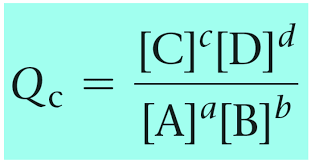
what is the reaction quotient?
can be calculated at any stage during a reaction
when at equilibrium the reaction quotient is equal to the equilibrium constant
what is the equilibrium constant, K?
concentrations of the products divided by the reactants at equilibrium → can only be calculated at equilibrium → fixed temperature
can only be affected by temperature
what are the units of K dependent on?
if you double the coefficients, you square K
if you reverse/flip the reaction then K is the reciprocal
if an equation is halved, you will square root it
when is Q and K used?
Q is used when not at equilibrium
K is used when at equilibrium
if Q<K then there is excess in the reactants and a forward reaction is favoured
if Q>K then there is excess in the products and a backward reaction is favoured
Is equilibrium maintained in a closed system or an open system?
equilibrium can only be maintained in a closed system
what occurs in an open system?
Generally, a gas product is present gas in the open system with the system trying to replace the lost gas by shifting towards the product side, therefore only R → P - non-reversible
what must experimenters consider when producing equilibrium products?
producing at an acceptable rate to meet market demands
ensuring that you maximise yield by using Le Chatliers principle
How do you calculate the initial/final concentrations?
though the “ICE” table
n - mole ratio
I - initial concentration
C - change → consumed = - produced = +
E - concentration at equilibrium
how do reactions occur?
for a reaction to take place the reactants must..
collide
have the correct orientation for bond breaking
have sufficient energy for the reaction to occur - how reactants are turned into products
what is the activation energy?
the minimum energy required by reactants for a chemical reaction to occur
how do you measure reaction rates?
volume of a gas evolved
mass of solid formed
intensity in colour of solution
pH
temperature
what does the CEO acronym stand for?
more successful collision = faster reaction rates
C - collisions must occur
E - enough energy to overcome activation energy
O - orientation
what are reaction rates?
the more frequently reactants collide, the greater the chance of a successful collision → increased reaction rate
for a reaction to occur…
there must be enough acitvationnenergy, they must collide and they must have a favourable orientation
what are the factors that affect reaction rate?
temperature
surface area
concentration
pressure
what is frequency?
the number of collisions
what is proportion?
the number of collision that result in a reaction
what are catalysts?
often transition metals
catalysts temporarily bind the reactants providing an alternate reaction pathway by lowering the activation energy.
the outcome of the product produced is unchanged
what factors causes the proportion of collisions too be more successful?
temperature and catalysts
How do catalysts increase the rate of reactions?
they decrease activation energy which results in a greater proportion of successful collisions
more collisions have the energy to overcome the activation energy
what are they types of catalysts and their qualities?
homogenous: same state as reactants and products
heterogenous: different state to reactants and products
which type of catalyst is preferred?
heterogenous catalysts are generally preferred as they are more easier to remove and can be used at higher temps
what is an open system?
an open system allows matter and energy to be transferred between itself and its surroundings
what is a closed system?
a closed system allows for th transfer of energy, but not matter, between inself and its surroundings
how does temperature affect reaction rate?
the increase in temperature increases the kinetic energy of reaction particles which increases the frequencyy of collision and proportion of collisions with sufficient energy to overcome the activation energy
how does surface area affect reaction rate?
smaller particles have a larger surface area and result in more exposed particles which leads to greater frequency of collisions and successful collisions
how does concentration affect reaction rate?
higher concentration means more particles = resulting in more collisions.
therefore, a greater number of successful collisions and frequency
how does pressure affect reaction rate?
particles come closer together resulting in an increased frequency of collisions and number of successful collisions