8.6 The Shapes of Atomic Orbitals
 Call Kai
 Learn
Learn Practice Test
 Spaced Repetition
 Match
Match Flashcards
 Knowt Play
1/26

There's no tags or description
Looks like no tags are added yet.
Name | Mastery | Learn | Test | Matching | Spaced | Call with Kai | Chat |
|---|
No analytics yet
Send a link to your students to track their progress
27 Terms
probability density
probability (per unit volume) of finding the electron at a point in space
s orbitals
spherically symmetrical

radial distribution function
mathematical function (corresponding to a specific orbital). that represents the total probability of finding an electron within a thin spherical shell at a distance r from the nucleus

radial distribution
The _________________________ function represents, not probability density at a point r, but total probability at a radius r.
0
In contrast to probability density, which has a maximum at the nucleus, the radial distribution function has a value of _ at the nucleus.
probability density function and volume of the thin shell
The shape of the radial distribution function is the result of multiplying together two functions with opposite trends in r:
greatest
In the quantum-mechanical model, you would generally find the electron at various radii, with 52.9 pm having the _________ (least/greatest) probability.
node
2s and 3s orbitals are larger in size than the 1s orbital, and unlike the 1s orbital, they contain at least one ____.
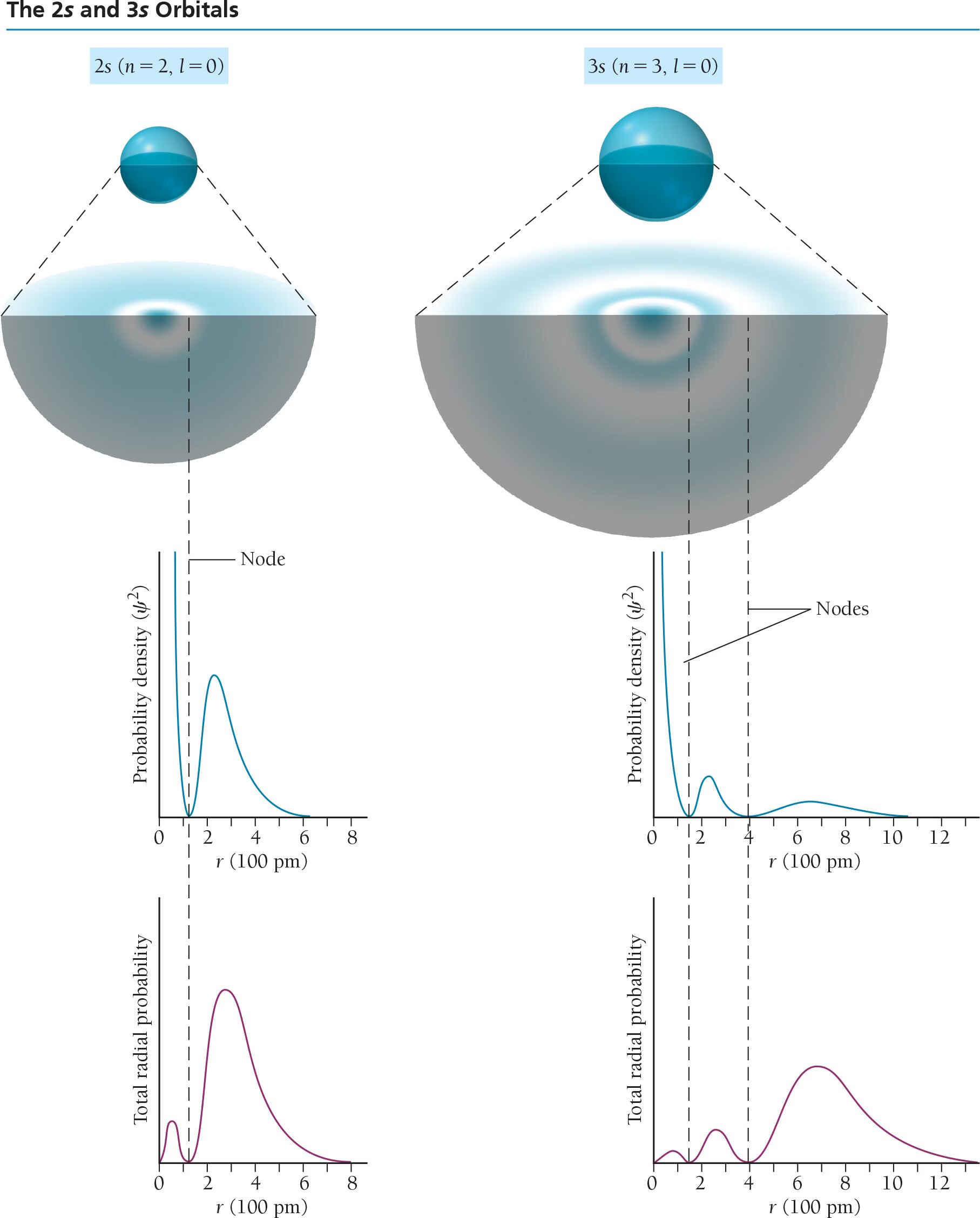
node
a point where the wave function, and therefore the probability density and radial distribution function, all go through zero

0
The probability of finding the electron at a node is _.

p orbitals
not spherically symmetric like s orbitals, have two lobes of electron density on either side of the nucleus and a node located at the nucleus
orientation
The three p orbitals differ only in their ___________ (size/shape/orientation) and are orthogonal (mutually perpendicular to one another).
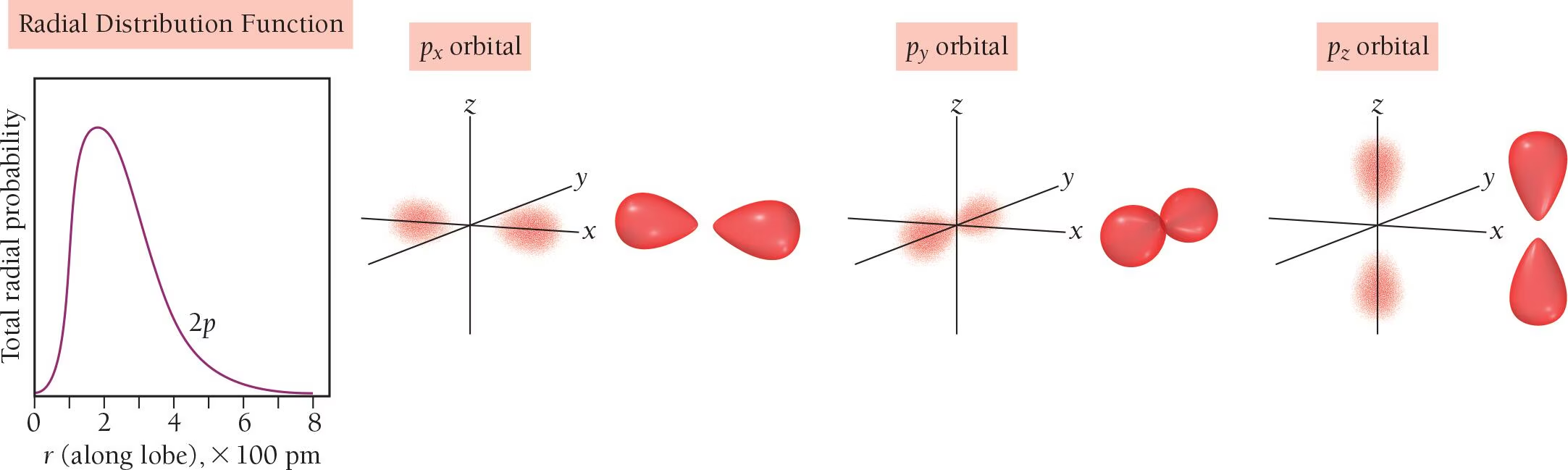
nodes, larger
The orbitals of same angular momentum quantum number (l) but increasing principal quantum number (n) are all similar in shape, but they contain additional _____ (like the higher s orbitals) and are progressively ______ (smaller/larger) in size.
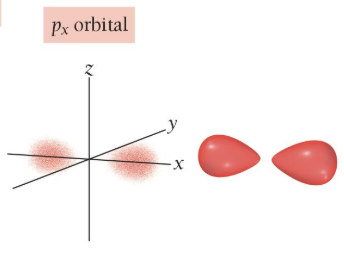
px orbital
two lobes of electron density along the x axis
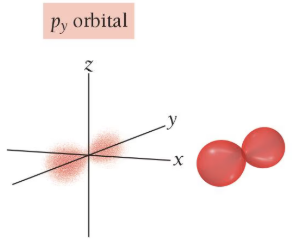
py orbital
two lobes of electron density along the y axis
pz orbital
two lobes of electron density along the z axis

d orbitals
four have clover leaf shape with four lobes of electron density around the nucleus and two perpendicular nodal planes
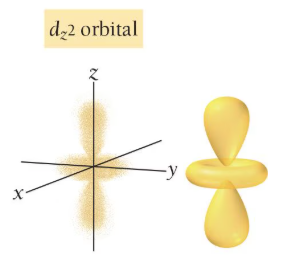
dz2 orbital has two lobes oriented along the z-axis and a donut-shaped ring around the xy plane
dyz orbital
4 lobes of electron density oriented along the yz plane

dxy orbital
4 lobes of electron density oriented along the xy plane

dxz orbital
4 lobes of electron density oriented along the xz plane

dx2-y2 orbital
4 lobes of electron density oriented along the x and y axes (2 lobes each)

dz2 orbital
two lobes oriented along the z-axis, donut-shaped ring along the xy plane
f orbitals
7 orbitals with more lobes and nodes than d orbitals

nodal plane
plane where electron probability density is 0
phase
with regard to waves and orbitals, the sign of the amplitude of the wave, which can be positive or negative
same, opposite
When orbitals interact, their wave functions may be in phase, ____ (same/opposite) sign, or out of phase, ________ (same/opposite) sign
orbitals
The roughly spherical shape of an atom is obtained by superimposing all of its _______.
