AP Psychology: Unit 3
 Call Kai
 Learn
 Practice Test
 Spaced Repetition
 Match
 Flashcards
 Knowt Play
1/28

Earn XP
Description and Tags
Sleep, Perception & Sensation; Modules 16, 17, 20, 21, 22, 23
29 Terms
NREM 1
Initial stage characterized by hypnagogic sensations and hallucinations.
NREM 2
A deeper relaxation, characterized by sleep spindles and EEG patterns showing more synchronized brain activity
NREM 3 and 4
Deep sleep, featuring slow delta waves. Hardest stage to wake from; crucial for physical restoration. Growth hormones are released.
REM
Motor cortex is active but brainstem blocks messages, associated with vivid dreams. Plays a key role in memory consolidation, especially for skills and information learned during the day.

What’s another word for REM sleep?
Paradoxical sleep

What does REM sleep stand for?
Rapid Eye Movement sleep
What are the roles of dreams?
consolidate memories
process emotions
express deep desires
practice confronting potential dangers

Activation Synthesis Theory
Theory that dreams are the brain’s way of making sense of random neural activity

Consolidation Theory
Theory that dreams help process and solidify memories and experiences from the day

Insomnia
Difficulty falling or staying asleep

Narcolepsy
Sudden and uncontrollable “sleep attacks”, often directly into REM sleep
REM Sleep Behavior Disorder
Disorder where people act our their dreams due to lack of muscle paralysis during REM sleep
Mostly older men
Sleep Apnea
Breathing repeatedly stops and starts, disrupting sleep and causing excessive daytime sleepiness.

Somnambulism
Sleepwalking that typically occurs during deep NREM sleep, where individuals walk or perform tasks while still asleep

Suprachiasmatic Nucleus
A pair of small, specialized clusters of about 10,000 neurons each located in the anterior hypothalamus of the brain, directly above the optic chiasm that communicates with the pineal gland to secrete melatonin
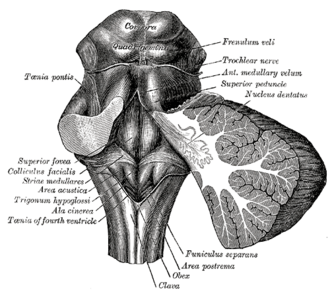
Locus Coeruleus
A tiny, pigmented nucleus located deep in the dorsolateral pons of the brainstem that is activated heavily during stress and autonomic responses

Sensation
The brain receives input from the sensory organs —> nerve impulses

Perception
The brain makes sense out of the input from sensory organs

Bottom-Up Processing
Begins with sensory input, building perception from the smallest pieces of sensory information


Top-Down Processing
Uses prior knowledge, expectations, and experiences to interpret sensory information


Schemas
Mental frameworks that help organize and interpret information

What do we have schemas for?
People, faces, objects, and events that shape our perceptions

Attention
The mental focus on specific stimuli while ignoring others

Selective attention
Focusing on one thing among many distractions
Sensation
The process by which our sensory receptors and nervous system receive and represent stimuli from our environment

Absolute Threshold
The minimum intensity of a stimulus that can be detected 50% of the time
Just-Noticeable Difference (JND or Difference Threshold)
The smallest detectable change in a stimulus, indicating the sensitivity of our sensory perception.

Weber’s Law
The principle that the size of the JND is proportional to the intensity of the stimulus
Sensory Adaptation
When constant exposure to a stimulus leads to decreased sensitivity over time as the sensory receptors become less responsive.