Zoology Chp 38- Skeletal system
 Call Kai
 Learn
 Practice Test
 Spaced Repetition
 Match
 Flashcards
 Knowt Play
1/106

There's no tags or description
Looks like no tags are added yet.
107 Terms
hydrostatic skeleton, exoskeleton, endoskeleton
List the three major types of skeletons found in animals
exoskeleton
hard outer covering
endoskeleton
internal support structure- made of bone and/or cartilage
hydrostatic skeleton
what kind of skeletal system do these organisms have?
soft-bodied invertebrates: earthworms, jellyfish, sea anemones, and nematodes
exoskeleton
what kind of skeletal system do these organisms have?
insects, crustaceans, spiders, and many mollusks (shells)
endoskeleton
what kind of skeletal system do these organisms have?
echinoderms and vertebrates (fish, amphibians, reptiles, birds, and mammals)
made of chitin (arthropods) or calcium carbonate (some mollusks)
exoskeleton is made up of…
protects against predation and desiccation
advantages of an exoskeleton
limits the maximum body size and must be molted to allow growth
limitation of an exoskeleton
endoskeleon
grows with the organism
protects internal organs
provides strong support for large body size
allows complex movement
support, protection, movement, production of blood cells, storage of mineral and fats (lipids)
5 major functions of the skeletal system
axial and appendicular
what are the two major division of the human skeleton
axial skeleton
forms the central axis of the body
appendicular skeleton
bones attached to axial skeleton
axial skeleton
protects the brain, spinal cord, heart and lungs
axial skeleton
provides attachment for muscles
supports posture
performs respiratory movements
appendicular skeleton
grasping and manipulating objects
movement and locomotion
weight bearing
skull, ossicles, hyoid bone, thoracic cage, vertebral column
the structures of the axial skeleton
hyoid bone
bone that lies below the mandible at the front of the neck
connected to the muscles of the jaw, larynx, and tongue
acts as a movable base for the tongue
controls opening of airway and gut
in the axial skeleton
ossicles
located in the middle ear
transmits sounds from the air as vibrations to the fluid-filled cochlea
in the axial skeleton
malleus (hammer), incus (anvil), stapes (stirrups)
auditory ossicles
vertebral column
surrounds/protects the spinal cord
supports head
acts as an attachment point for ribs and muscles of the back and neck
in the axial skeleton
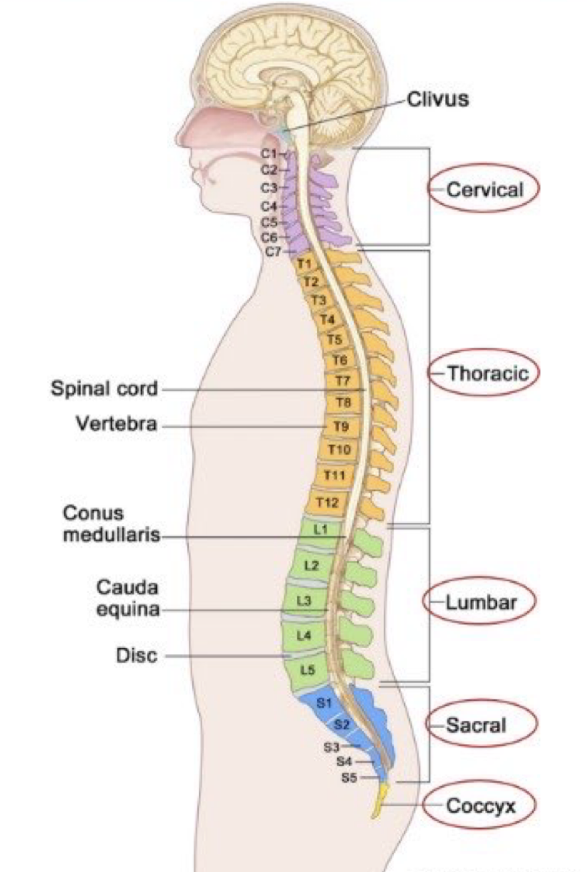
cervical, thoracic, lumbar, sacral, coccyx
regions of the vertebral column
7
how many vertebrae does the cervical spine have?
12
how many vertebrae does the thoracic spine have
5
how many vertebrae does the lumbar spine have
5 fused into 1
how many vertebrae does the sacral have
3-4 fused into 1
how many vertebrae does the coccyx have
intervertebral discs
allows some movement and acts as a cushion
ribs, sternum, costal cartilage
structures of the thoracic (rib) cage
costal cartilage
attachment points
allows for expansion for breath
found in the thoracic cage
rib cage
protects internal organs
attachment site for diaphragm, muscles of back, chest, neck, and shoulders
provides support for shoulder girdles and upper limbs
enables breathing
in the axial skeleton
pectoral girdle, arm, hand, pelvic girdle, leg, and foot
structures of the appendicular skeleton
pectoral girdle (shoulder)
includes clavicles and scapulae
provides an attachment point for the upper limbs
shoulder, arm, forearm, wrist, and hand
bones of the upper limbs (upper extremities)
pelvic girdle
responsible for bearing the weight of the body and locomotion
attached to axial skeleton by strong ligaments
in the appendicular skeleton
pelvis, femur, patella, tibia, fibula, and the bones of the foot
bones of the lower limbs
bone
mineralized connective tissue (osseous tissue)
mineral salts (calcium phosphate crystals), collagen fibers, cells
bones contain…
calcification
the process of depositing mineral salts in collagen fibers
crystalize and hardens tissue
long, short, flat, irregular, sesamoid
5 main types of bone
long bone
the femur, humerus and tibia are what type of bone
long bone
bones that are longer than they are wide
short bone
bones that are nearly equal in length and width
flat bones
the sternum, ribs and scapula are what kind of bone
flat bones
thin, flattened bones that are often curved
irregular bones
vertebrate, facial and pelvic bones are what type of bone
irregular bones
bones that are complex/unusual shapes
sesamoid bone
what type of bone is the patella
sesamoid bone
small, round bones that are embedded in tendons
diaphysis, epiphysis, articular cartilage, medullary cavity, periosteum, endosteum
structures of a long bone
diaphysis
part of the long bone
shaft
contains medullary cavity (endosteum → contains yellow bone marrow)
outside lined with periosteum walls made of compact bone
epiphysis
part of the long bone
poximal and distal ends
expanded regions at ends
contains spongy bone (red bone marrow)
covered by third layer of compact bone
articular cartilage
in long bone
lines ends of epiphysis
provides cushion and support in joints
periosteum
outer covering in the long bone
endosteum
inner lining of the long bone
compact and spongy
what are the two types of bone tissue
compact bone
forms diaphysis and outer part of epiphysis
dense tissue
solid and smooth in appearance
provides strength and protection
spongy bone
tissue inside the epiphysis
looks lacy and delicate but firm and strong

osteon
basic structural unit of compact bone
cylindrical structure that runs parallel to the bone shaft
compact bone
highly organized bone tissue that is composed of osteons

central (haversian) canal
located in the center of each osteon
contains blood vessels and nerves

volkmann’s (perforating) canals
run perpendicular to central canals
connect blood vessels between osteons
link central canals to periosteum and medullary cavity

lamellae
concentric rings in the osteon made of mineralized bone matrix

lacunae
in the osteon
small spaces between lamellae
contains osteocytes

canaliculli
in the osteon
tiny channels connecting lacunae
connect osteocytes to each other and central canal
allows nutrients and waste exchange

osteocytes
mature, living bone cells
maintain the bone matrix
located inside lacunae

endosteum
thin membrane lining central canal
contains osteoblasts and osteoclasts
osteoprogenitor cells, osteoblasts, osteocytes, osteoclasts
4 main types of bone cells
osteoprogenitor cells
type of bone cell
located in periosteum and endosteum
stem cell that gives rise to osteoblasts
osteoblasts
type of bone cell
found on bone surfaces
builds new bone matrix
becomes osteocytes when trapped in matrix
osteocytes
type of bone cell
mature bone cells trapped in matrix
located in lacunae
maintain bone tissue
osteoclasts
large, multinucleated cells
found on bone surface
breaksdown (“crashes”) bone
osteoblast
bone-forming cell
osteoclasts
bone-resorbing cell
bone remodeling
continuous process where old bone replaced by new bone
keeps the skeleton strong and balanced
bone remodeling
the process of getting rid of old bone and forming new bone
long
what kind of bone are phalanges, metacarpals, and metatarslas
short
what type of bone are carpals and tarsals
they break down bone to release calcium and phosphate into blood
role of osteoclasts in remodeling
makes new bone matrix
role of osteoblasts in remodeling
joint
areas where two or more bones meet
responsible for movement and stability
structure and function
what are the two ways to classify joint
fibrous, cartilaginous, synovial
structural classification of joints
synarthrosis, amphiarthroses, diarthroses
functional classification of joints
synarthrosis
functional classification of joints that are immovable
amphiarthroses
functional classification of joints that allow slightly movable
diarthroses
functional classification of joints that allow free movement
fibrous joints
connected by dense connective tissue
no joint cavity
very little or no movement
bones held tightly together
fibrous joints
sutures of the skull, ankle joint, and tooth in the socket are examples of what type of joint
cartilaginous joints
connected by cartilage
no joint cavity
slight movement allowed
strong but flexible
cartilaginous
intervertebral discs, pubic symphysis, and epiphyseal (growth) plates are example of what kind of joints
synovial joints
most movable type
have a joint cavity
contain synovial fluid
surrounded by a joint capsule
ends of bone covered with articular cartilage
synovial
the knee, shoulder, elbow, and hip is what kind of joint
medullary cavity
the central hollow space within the shaft (diaphysis) of long bones, such as the femur or humerus.
yellow bone marrow
the medullary cavity in a long bone contains…