BIOL233 Nutrition - Module 10: Metabolism (PowerPoint)
 Call Kai
 Learn
 Practice Test
 Spaced Repetition
 Match
 Flashcards
 Knowt Play
1/129

There's no tags or description
Looks like no tags are added yet.
130 Terms
Carbohydrates, Fats, Protein, Alcohol
Cells get energy from chemical energy held in the molecular bonds of: (4 things)
sun
Chemical energy in foods originates as light energy from ____
Photosynthesis
Green plants use light energy to make carbohydrate
half, heat
When the body extracts energy from food and converts it to a form it can use, ______ of the total food energy is lost as ______
Stage 1: Digestion, absorption, and transport
Stage 2: Breakdown of molecules
Stage 3: Transfer of energy to a form cell can use
What are the 3 stages of transferring food energy to cellular energy?
Cellular respiration
Our need to breathe is related to what?
The body breaks down food into amino acids, monosaccharides, and fatty acids
What happens in the first stage of energy extraction from food?

Cells degrade these molecules to a few simple units, such as acetyl coA, that are pervasive in metabolism
What happens in the second stage of energy extraction from food?
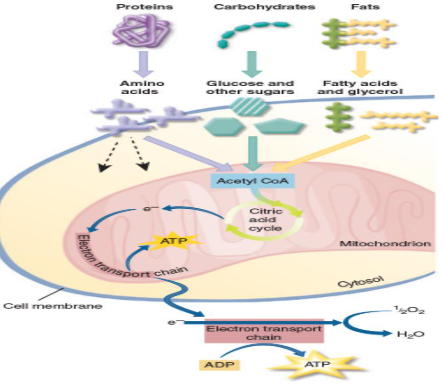
The oxygen-dependent reactions of the citric acid cycle and electron transport chain liberate large amounts of energy in the form of ATP
What happens in the third stage of energy extraction from food?

Metabolism
General term encompassing all chemical changes in living organism
Catabolism and anabolism
What does the metabolic pathway include?
Catabolism
Reactions that break down compounds into small units
Anabolism
Reactions that build complex molecules from smaller units
Catabolic Reactions
Break down molecules and release energy and other products
Anabolic Reactions
Consume energy as they assemble complex molecules
metabolic
The cell is the ____ processing center
Nucleus and cytoplasm
There are 2 major parts of the cell, what are they?
Mitochondria
What is the source of many energy pathways?
Cytosol and organelles
What does the cytoplasm contain?
Speed up chemical reactions
What is the role of enzymes?
True
True or false: Many enzymes are inactive unless combined with coenzymes (ex: B vitamins and/or cofactors, magnesium, zinc, copper, etc.)
True
True or false: ATP is the body’s energy currency
Adenosine triphosphate
What does ATP stand for?
ATP has 2 high-energy bonds, ADP has 1, and AMP has none
What is the difference between ATP, ADP, and AMP?
True
True or false: ATP and ADP are interconvertible
False, AMP is interconvertible
True or false: AMP is convertible with both ADP and ATP
high
Your body can readily use the energy in ____-energy phosphate bonds
phosphate
During metabolic reactions, _____ bonds form or break to capture or release energy
Motion, active transport, biosynthesis, and signal amplification
Break down of ATP releases energy to power:
The oxidation of energy nutrients
Formation of ATP captures energy from what?
captures
When extracting energy from nutrients, the formation of ATP from ADP + Pi _____ energy
phosphate, releases
Breaking a ______ bond in ATP to form ADP + Pi _______ energy for biosynthesis and work
Transport shuttles; hydrogen and electron carries that shuttle energy to ATP production sites
What are the jobs of NADH and FADH2?
Is the energy shuttle for biosynthesis; hydrogen and electron carrier that shuttles energy for anabolic processes
What does NADPH do?
NADH and FADH2
What are the hydrogen and electron carriers that shuttle energy to ATP production sites?
NADPH
What is the hydrogen and electron carrier that shuttles energy for anabolic processes?
Energy carried by NADH primarily produces ATP and energy carried by NADPH drives biosynthesis
What is the difference between NADH and NADPH?
Both are energy carriers
What do NADH and NADPH have in common?
specific enzyme
Almost every reaction in metabolism or a metabolic pathway is catalyzed by a _____ _______
Glycolysis, Conversion of pyruvate to acetyl CoA, Citric Acid Cycle, Electron Transport Chain
The complete oxidation of glucose uses 4 major metabolic pathways:
Cytosol
Where does glycolysis take place?
Mitochondria
Where do the other major metabolic pathways (Conversion og pyruvate to acetyl coA, citric acid cycle, and ETC) take place?
Anaerobic
Is Glycolysis an aerobic or anaerobic process?
Splits glucose into 2 pyruvates and transfers electrons to NADH
What does glycolysis do?
Rapid but produces small amount of ATP
Is glycolysis fast and how much ATP does it produce?
Some steps are irreversible
Are some or none steps of glycolysis irreversible?
Aerobic
Is the conversion of pyruvate to acetyl coA aerobic or anaerobic?
Produces CO2 and transfers a pair of high-energy electrons to form NADH
What does the conversion of pyruvate to acetyl coA do?
True
True or false: Conversion of pyruvate to acetyl coA is a one-way (irreversible) process
Aerobic
Is the citric acid cycle aerobic or anaerobic?
Releases CO2, produces GTP (like ATP), and transfers electrons to NAD and FAD
What does the citric acid cycle do?
Krebs or TCA Cycle
What is another name for the Citric Acid Cycle?
Aerobic
Is the Electron Transport Chain aerobic or anaerobic?
Accepts electrons from NAD and FAD; produces large amounts of ATP; produces water
What does the electron transport chain do?
ATP, water, and CO2
What are the end products of glucose catabolism from ETC?
Electron Transport Chain
What pathway produces the most of the ATP from glucose?
Water
What is the final product of the ETC?
Glycolysis
Which out of the 4 pathways (Glycolysis, Pyruvate to acetyl coA, Citric Acid Cycle, ETC) is the only one that is anaerobic?
Glycolysis
A series of reactions that convert one glucose molecule to 2 pyruvate molecules
Pyruvate to acetyl coA
Pyruvate from glycolysis combines with coenzyme A to form acetyl coA while releasing carbon dioxide
Citric Acid Cycle
This cycle of reactions degrades the acetyl portion of acetyl coA and releases the coenzyme A portion; this cycle releases carbon dioxide and produces most of the energy-rich molecules, NADH and FADH2, generated the breakdown of glucose
Electron Transport Chain
As the electrons from NADH and FADH2 pass along this chain of transport proteins, they release energy to power the generation of ATP; oxygen is the final electron acceptor and combines with hydrogen to form water
From foods other than sugar
Glucose is not the only option to get energy! Cells also get energy from where?
Splits triglycerides into glycerol and fatty acids; takes place in mitochondria; consumes energy equivalent of 2 ATP; carnitine shuttle where it transports fatty acids from the cytosol into mitochondria
How does the process of extracting energy from fat work?
Beta-Oxidation
Breaks apart fatty acids into acetyl coA and transfers electrons to NAD and FAD
Clips the two-carbon end off a fatty acid until it is degraded entirely
What do beta-oxidation reactions do?
Acetyl coA from beta-oxidation enters TCA cycle and then the citric acid cycle + electron transport chain complete energy extraction from fatty acids and lastly, fat burns in a flame of carbohydrate
What is the process for completing fatty acid breakdown (extracting energy from fat)?
Deamination splits off amino group, leaving “carbon skeleton” and is converted to ammonia and then urea for excretion
How does body split protein into amino acid (extracting energy from protein)
Where it enters the catabolic pathways
What does the carbon skeleton structure determine?
Liver
In deamination, the ____ converts the amino group to ammonia and then to urea
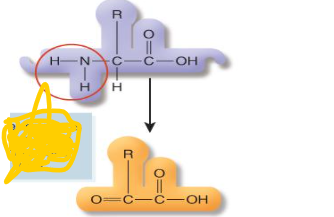
Amino
A deamination reaction strips the ____ group from an _____ acid
where
The structure of the remaining carbon skeleton determines _____ it can enter the energy-producing pathways

entrances
Extracting Energy from Amino Acids: The carbon skeletons of amino acids have several ____ entrances to the breakdown pathways
amino acids
Extracting Energy from Amino Acids: Compared with glucose and fatty acids, _______ _______ yield much smaller amounts of energy (ATP)
Alcohol
What takes priority over macronutrient breakdown? It metabolizes and is removed quickly?
Alcohol → Acetaldehyde
Metabolizing small amounts of alcohol: What is alcohol dehydrogenase?
Acetaldehyde → Acetate
Metabolizing small amounts of alcohol: What is aldehyde dehydrogenase?
acetyl coA; fatty acids
Metabolizing small amounts of alcohol: Acetaldehyde, acetate is converted to ________ _______ and what are they built into?
citric acid cycle; fat
The metabolism of alcohol inhibits the _____ ______ _____ and primarily forms ______
Overwhelms alcohol dehydrogenase system
What happens when metabolizing large amounts of alcohol occurs?
Microsomal ethanol-oxidizing system (MEOS)
What is the route to primary overflow pathway for metabolizing large amounts of alcohol?
To metabolize drugs and detoxify “foreign” substances
What is MEOS (Microsomal Ethanol-Oxidizing System) used for?
Microsomal Ethanol-Oxidizing System
Large amounts of alcohol can overwhelm its typical metabolic route so excess alcohol enters an overflow pathway
active
Breakdown and biosynthetic pathways are _____ at all times
breakdown
Breakdown and biosynthetic pathways: When body needs energy, ____ prevails
biosynthesis
Breakdown and biosynthetic pathways: When excess nutrients are present, _____ dominates
Pyruvate, lactate, glycerol, and certain amino acids
What does gluconeogenesis use?
liver and muscle
For storing carbohydrates, _______ and ______ make glycogen from glucose
Acetyl coA from fat, amino acids, alcohol, and glucose
What does lipogenesis (making fat) use?
adipose
Storing fat (triglyceride) is stored in ______ tissue
burning
Excess carbohydrate does not readily become fat, but can reduce fat ____
False, though they share many reactions in the reverse direction, gluconeogenesis must detour around the irreversible steps in glycolysis
True or false: Gluconeogenesis is a simple reversal of glycolysis
False, it is normal
True or false: Small amounts of ketone bodies is not normal
Potent signaling molecules
What exactly are ketone bodies?
Acetyl coA when there is inadequate glucose in cells
What are ketone bodies made from?
Provide emergency energy to all body tissues (except RBCs)
What do ketone bodies do?
Via kidneys or exhaled
How are excess ketone bodies excreted?
Ketosis
Accumulation of ketone bodies in blood; promoted by a high-fat, low carbohydrate diet
Diet, protein breakdown, and cell synthesis
What are the amino acid pool supplied from?
Biosynthesis
Different pathways used to build amino acids from carbon skeletons