Agonists & Antagonists
 Call Kai
 Learn
 Practice Test
 Spaced Repetition
 Match
 Flashcards
 Knowt Play
1/55

There's no tags or description
Looks like no tags are added yet.
56 Terms
What’s an adrenergic receptor?
A receptor on a cell that responds to the neurotransmitters noradrenaline and adrenaline.
What are the different types of adrenergic receptors?
α receptors: α1 and α2.
β receptors: β1, β2, and β3
What is the signalling mechanism of α1 adrenoreceptors?
Noradrenaline binds to the α1 receptor
This activates Gq
Gq activates an enzyme called phospholipase C (PLC)
PLC produces 2 signalling molecules: IP3 and DAG
IP3 increases calcium inside the cell
In smooth muscle, increased intracellular calcium causes contraction. For example, blood vessel smooth muscle contracts, causing vasoconstriction.
What is the signalling mechanism of α2 adrenoreceptors?
Noradrenaline binds to the α2 receptor
This activates Gi
Gi inhibits an enzyme called adenylate cyclase
This decreases the production of cAMP
Reduced cAMP means less activation of PKA
This contributes to reduced noradrenaline release from the nerve ending. α2 receptors are often found on presynaptic nerve endings. Their activation inhibits further noradrenaline release.
What is the signalling mechanism of β adrenoreceptors?
Noradrenaline or adrenaline binds to a β receptor.
The receptor activates Gs.
Gs stimulates adenylate cyclase.
This increases the production of cAMP.
Increased cAMP activates PKA.
What is the effect of α1 receptor stimulation?
Constriction of most smooth muscle
Relaxation in the GI tract
What is the effect of α2 receptor stimulation?
α2 receptors can have different effects depending on where they are located
Presynaptic α2 receptors can cause vasodilation in directly. They are located on the nerve ending that releases noradrenaline. Noradrenaline stimulates α2 receptors, inhibiting further noradrenaline release. Less noradrenaline means less noradrenaline is available to stimulate α1 receptors on blood vessels, and that means less vasoconstriction. Presynaptic α2 receptors causes presynaptic inhibition of neurotransmitter release from sympathetic and parasympathetic neurons.
Postsynaptic α2 receptors can cause vasoconstriction. They’re located on vascular smooth muscle. Noradrenaline stimulates α2 receptors on the blood vessel, causing the smooth muscle to contract.
What is the effect of β1 receptor stimulation?
Increases heart rate and force of cardiac contraction.
It does this via increase in intracellular Ca²⁺ in cardiac muscle cells, increasing contractility and pacemaker activity in the SAN. This increases heart rate and force of contraction.
What is the effect of β2 receptor stimulation?
It causes smooth muscle relaxation and dilation.
This happens because β2 stimulation:
Decreases intracellular Ca²⁺
Inhibits myosin light-chain kinase
This reduces smooth muscle contraction, causing relaxation.
What is the effect of β3 receptor stimulation?
Thermogenesis (heat production) in skeletal muscle.
What are adrenergic agonists?
They are drugs that bind to and activate α and β receptors, producing a response.
Adrenergic agonists are also called sympathomimetics.
Adrenergic agonists can act in 2 ways:
Direct agonist
Indirect agonist
What are direct sympathomimetics?
These drugs bind directly to α or β receptors and activate them.
Give some examples of direct sympathomimetics:
Phenylephrine
Clonidine
Dobutamine
Adrenaline
Noradrenaline
Isoprenaline
Salbutamol
What are indirect sympathomimetics?
Drugs that do not directly activate the receptors. Instead, they increase the availability of noradrenaline in the synapse to stimulate the receptors.
They are structurally similar to NA but do not activate receptors.
What are some examples of indirect sympathomimetics?
Amphetamines
Ephedrine
Pseudoephedrine
Cocaine
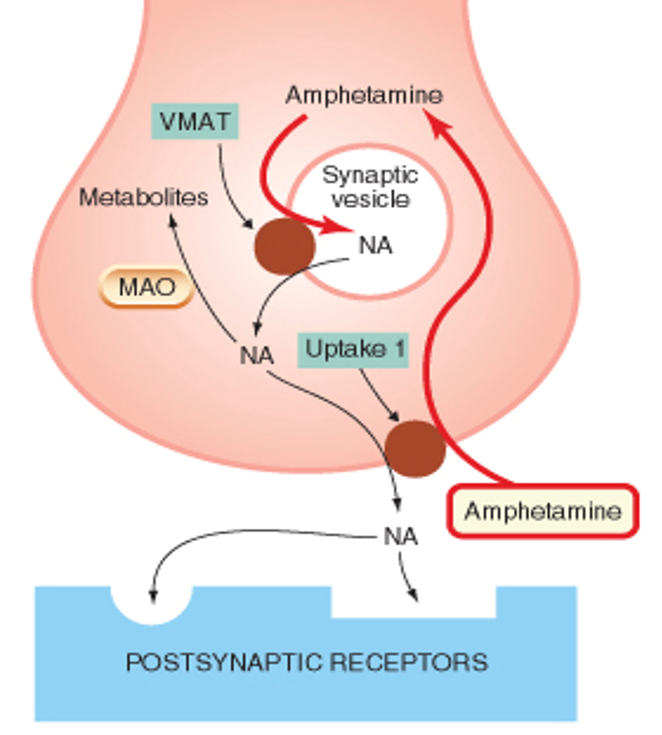
What is the mechanism of action of amphetamines?
Amphetamine enters the presynaptic nerve ending through NET and enters storage vesicles through VMAT
It causes NA to move out of the storage vesicles and into the cytoplasm
Amphetamine inhibits MAO, reducing the breakdown of noradrenaline inside the nerve ending
Increased NA accumulates in the cytoplasm
Amphetamine then promotes the movement of NA out of the nerve ending through NET
More NA is released into the synaptic cleft, allowing it to stimulate adrenergic receptors.
What’s the mechanism of action of ephedrine and pseudoephedrine?
They reverse the direction of NET, promoting the transport of noradrenaline out of the nerve ending and into the synapse.
How does cocaine increase noradrenaline in the synapse?
Cocaine inhibits NET, preventing noradrenaline reuptake into the presynaptic nerve ending.
This increases NA in the synapse.
Phenylephrine
- Direct or indirect sympathomimetic?
- Which receptor does it act on?
- What does it do?
- What is its indication?
- What are its unwanted effects?
- Direct sympathomimetic
- Selective α1-receptor agonist
- Stimulates α1 receptors, causing vasoconstriction, increasing blood pressure
- Treats acute hypotension, glaucoma, and is a nasal decongestant
- Unwanted effects: Hypertension, reflex bradycardia
Clonidine
- Direct or indirect sympathomimetic?
- Which receptor does it act on?
- What does it do?
- What is its indication?
- What are its unwanted effects?
- Direct sympathomimetic
- Selective α2 receptor agonist
- Prevents noradrenaline release and hence reduces blood pressure
- Treats hypertension
- Unwanted effects: Drowsiness, oedema
Noradrenaline
- Direct or indirect sympathomimetic?
- Which receptor does it act on?
- What are its unwanted effects?
- Direct sympathomimetic
- α agonist
- Unwanted effects: hypertension, vasoconstriction, tachycardia (or reflex bradycardia), dysrhythmia
Adrenaline
- Direct or indirect sympathomimetic?
- Which receptor does it act on?
- What is its indication?
- What are its unwanted effects?
- Direct sympathomimetic
- β agonist
- Used to treat anaphylactic shock, acute severe asthma attack, cardiac arrest
- Unwanted effects: hypertension, vasoconstriction, tachycardia (or reflex bradycardia), dysrhythmia
Dobutamine
- Direct or indirect sympathomimetic?
- Which receptor does it act on?
- What is its indication?
- What are its unwanted effects?
- Direct sympathomimetic
- β1 receptor agonist
- Used to treat cardiogenic shock
- Unwanted effects: dysthymia
Salbutamol
- Direct or indirect sympathomimetic?
- Which receptor does it act on?
- What is its indication?
- What are its unwanted effects?
- Direct sympathomimetic
- β2 receptor agonist
- Used to relax bronchial smooth muscle and treat asthma
- Unwanted effects: Tachycardia, dysrhythmia
Isoprenaline
- Direct or indirect sympathomimetic?
- Which receptor does it act on?
- What is its indication?
- What are its unwanted effects?
- Direct sympathomimetic
- β receptor agonist
- Treats asthma (now obsolete)
- Unwanted effects: Tachycardia, dysrhythmia
Tyramine
- Direct or indirect sympathomimetic?
- What is its action?
- What is its use?
- What are its unwanted effects?
- Indirect sympathomimetic
- It stimulates NA release
- No clinical use
- Unwanted effects: hypertension, vasoconstriction, tachycardia (or reflex bradycardia), dysrhythmia
Amphetamine
- Direct or indirect sympathomimetic?
- What is its action?
- What is its use?
- What are its unwanted effects?
- Indirect sympathomimetic
- NA release from vesicles and MAO inhibitor
- CNS stimulant – narcolepsy. Paradoxical use in hyperactivity
- Unwanted effects: Hypertension, tachycardia, insomnia, psychosis & dependence
Ephedrine
- Direct or indirect sympathomimetic?
- What is its action?
- What is its use?
- What are its unwanted effects?
- Indirect sympathomimetic
- NA release. Weak direct activity on receptor
- Decongestant
- Unwanted effects: Hypertension, tachycardia, insomnia, psychosis & dependence
Cocaine
- Direct or indirect sympathomimetic?
- What is its action?
- What is its use?
- What are its unwanted effects?
- Blocks NET, so synaptic NA is increased
- Abuse
- Unwanted effects: Hypertension
What are adrenergic antagonists?
Drugs that bind to adrenergic receptors but do not activate them, preventing agonists (such as noradrenaline) from binding.
NA is normally synthesised (made) inside sympathetic nerve endings.
If a drug interferes with NA synthesis, less NA is available to be released.
This means less stimulation of adrenergic receptors, so sympathetic activity is reduced.
What are some examples of adrenergic antagonists?
α-blockers: prazosin, doxazosin.
β-blockers: propranolol, atenolol.
Dual α/β blockers: labetalol, carvedilol.
What are phenoxybenzamine and phentolamine?
Non-selective adrenoceptor antagonists
Phenoxybenzamine
- α antagonist
- Long lasting action
- Binds covalently and irreversibly to α receptors.
- Also blocks other classes of receptors, so it is less selective.
- New receptors need to be produced to restore receptor activity. Your slide gives approximately 24 hours.
- Treats Phaeochromocytoma, by blocking α-adrenoceptors and reducing catecholamine effects.
Phentolamine
- More selective α antagonist.
- Binds reversibly, so its effects are shorter-lasting (approximately 4 hours).
- Treats Phaeochromocytoma, by blocking α-adrenoceptors and reducing catecholamine effects.
What are the unwanted effects of α antagonists?
Hypotension and postural hypotension (due to a1 blockade prevents vasoconstriction, causing a reduction in blood pressure)
Induced tachycardia / arrhythmia (a2 blockade leads to increased sympathetic output)
What can selective α1 antagonists treat?
Hypertension
Prostate disease
How do selective α1 antagonists treat hypertension?
α1 receptor stimulation causes vasoconstriction.
α1 antagonists block α1receptors, causing vasodilation and reducing arterial blood pressure.
Give examples of selective α1 antagonists used to treat hypertension.
Prazosin and doxazosin.
What are the unwanted effects of selective α1 antagonists?
Postural hypotension
Headaches
Does not cause tachycardia because selective α1 antagonists do not block α2 receptors, so inhibition of noradrenaline release is maintained (non-selective α antagonists blocks α2 receptors, which increases noradrenaline release, increasing sympathetic output).
How do selective α1 antagonists treat urinary retention associated with prostate disease?
They block α1 receptors, relaxing the bladder neck and prostate capsule to improve urine flow.
Give examples of selective α1 antagonists used to treat prostate disease.
Tamsulosin
Name a selective α2 antagonist.
Yohimbine
- Yohimbine has vasodilator and stimulant effects
- Use is still being researched
- Unwanted effects: Hypertension
Name the non-selective α-blockers.
Phentolamine
Phenoxybenzamine

Name the selective α1 blockers
Prazosin
Doxazosin
Tamsulosin

Name the selective α2 blockers
Yohimbine

What do β-blockers (β-adrenoceptor antagonists) do?
Decrease heart rate and force of cardiac contraction.
Reduce cardiac output and myocardial oxygen demand.
Reduce blood pressure over several days by decreasing cardiac output and renin release.
Can prevent skeletal muscle tremors.
What do β-blockers (β-adrenoceptor antagonists) treat?
- Angina
- Hypertension
- Cardiac dysrhythmias
- Migraine prevention (propranolol)
- Tremor
- Glaucoma (timolol eye drops)
Give some examples of β-blockers (β-adrenoceptor antagonists)
Propanolol
Atenolol
Other “-olol” drugs
Timolol
Propanolol
β-antagonist
Used to treat angina, hypertension, cardiac dysrhythmia, tremor, glaucoma
Adverse effects: Bronchoconstriction, cardiac failure, cold extremities, fatigue, depression, hypoglycaemia
Atenolol (and other ‘-olol’ drugs)
β1-antagonist
Used to treat angina, hypertension, dysrhythmias
Adverse effects: Bronchoconstriction, cardiac failure, cold extremities, fatigue, depression, hypoglycaemia
Timolol
β1-antagonist
Used to treat glaucoma (topical)
Adverse effects: Bronchoconstriction, cardiac failure, cold extremities, fatigue, depression, hypoglycaemia
Give some examples of dual α / β blockers
Labetalol
Carvedilol
Labetalol
α / β antagonist
Used to treat hypertension in pregnancy
Adverse effects: Bronchoconstriction, postural hypotension
Carvedilol
α / β antagonist
Heart failure
Adverse effects: Bronchoconstriction, postural hypotension, renal failure
Drug names that end is -azocin are ___?
α1-adrenoceptor antagonists
Drug names that end is -olol are ___?
β-adrenoceptor antagonists