Procedures Unit 1 - Week 1, Course Orientation
 Call Kai
 Learn
 Practice Test
 Spaced Repetition
 Match
 Flashcards
 Knowt Play
1/51

Earn XP
52 Terms
Where does most of the technologist's occupational exposure come from?
Compton scattering
The national council on radiation protection and measurements (NCRP) recommends an annual occupational effective dose equivalent limit of _______ rem.
5
Which of the following radiographic procedures routinely require a single AP projection is taken,
femur or pelvis?
pelvis
Define ossification
the biological process of laying down new bone material and forming bone tissue
What is the primary center of ossification?
Diaphysis
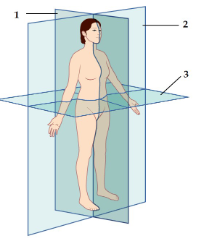
Identify Each Imaging Plane:
Sagittal Plane
Coronal Plane
Transverse/Horizontal/Axial Plane
Define Epiphysis
the rounded end of a long bone
Everything that is likely to be affected by body habitus:
The size and shape of organs
The position of organs
The position of the diaphragm
What is not affected by body habitus?
bone porosity
The outer shell of a long bone is composed of _____ bone.
Cortex/Compact
Define Hyaline Cartilage
The most common type of connective tissue
Provides smooth surfaces for joint movement
Define Articular cartilage
A smooth type of hyaline cartilage that covers the ends of bones in synovial joints
In a growing bone, what is the area of cartilage between the epiphysis and the diaphysis?
Epiphyseal plate (or physis)
The secondary center of ossification in long bones is the:
Epiphysis, near the ends of the bones
List examples of synovial joints
Gliding (ex: intercarpal)
Pivot (ex: C1 + C2)
Saddle (ex: base of thumb)
Bicondylar (ex: between metacarpals)
Hinge (ex: elbow)
Condylar (ex: wrist)
Ball and socket (ex: hip)
What mobility class do synovial joints fall under? (except for the SI joints)
Diarthrodial (freely moveable)
What type of joint articulations lack a cavity?
Fibrous joints
Cartilaginous joints
What is the fatty tissue that occupies the medullary cavity of the adult long bone body?
Yellow bone marrow
List the parts of the axial skeleton
skull, hyoid, vertebra, thorax
How many bones are in the axial skeleton?
80
Parts of appendicular skeleton:
Shoulders, upper limbs, lower limbs, pelvic girdle
How many bones are in the appendicular skeleton?
126
What information must be included on an x-ray for it to be considered legal?
Pt name or ID #
Physical marker (L or R)
Date
Hospital / Institution
Classification of bones:
Long, Flat, Short, Irregular
Name the Irregular bones
Vertebra
Facial
• Base of
cranium• Pelvic bones
Where are the short bones located and how many?
Wrist and Ankles
8 carpal (16 total)
7 tarsal (14 total)
Name the flat bones
• Skull cap -calvaria
• Sternum
• Ribs
• Scapula
Where are long bones located?
limbs
toes
fingers
Define the 'metaphysis' in the context of bone development.
The portion of a long bone where cartilage is replaced by bone during growth.
Define Periosteum
a dense, specialized layer of tissue that completely covers the outer surfaces of bones, except at joint articular surfaces
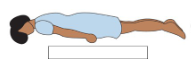
Position?
Prone
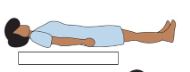
Position?
Supine
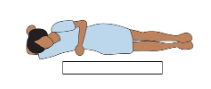
Position?
Right Lateral Recumbent
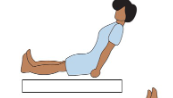
Position?
Fowler’s
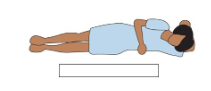
Position?
Left Lateral Recumbent
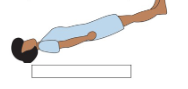
Position?
Trendelenburg
Medial
Toward midline
Lateral
Away from midline
Proximal
Near the source (point of attachment)
Distal
Away from source (point of attachment)
Cephalic
Toward the head
Caudal
Toward the feet
Superficial
Near the surface
Deep
Farther from surface
Name all 10 body systems
Endocrine
Respiratory,
Digestive,
Reproductive,
Integumentary,
Muscular,
Nervous,
Circulatory (Cardiovascualr and Lympatic),
Urinary,
Skeletal
Sesamoid Bones
Bones embedded in tendons, sometimes referred to as ‘free-floating’, ex. base of first toe, bas of thumb, and patellae
Largest ones are the patellae
Tangential Projection
CR skims a body body
ex Sunrise Patella
Common for sesamoid bones but not limited to
Define Projection
direction or path of the xray beam as it passes through the patient, ex. PA

Identify the body habitus characterized as very thin with a long, narrow body frame.
Asthenic

Which body habitus type is considered the 'average' build?
Sthenic

Describe the physical characteristics of a hypersethnic body habitus.
Broad frame and above average in size
The body habitus described as slender or 'below average' is known as _____.
Hyposthenic