Plant physiology
 Note
Note Call Kai
 Learn
Learn Practice Test
 Spaced Repetition
 Match
Match Flashcards
 Knowt Play
1/64

There's no tags or description
Looks like no tags are added yet.
Name | Mastery | Learn | Test | Matching | Spaced | Call with Kai | Chat |
|---|
No analytics yet
Send a link to your students to track their progress
65 Terms
What are 5 characters that might define a good model plant for understanding genetics and physiology
Economic value - are cheaper
small size - easier to store
short generation time - can see results quicker
high fecundity - ability to produce a lot of offspring
easy to manipulate
extras : resilience, change in morphology
What are 3 features of cells that are distinctive and typical of plants
two cells walls
chloroplast
Vacuole
Plasmodesmata
What is Apoplast
this pathway involves the movement of water outside of the protoplast cell walls from cell to cell via spaces in the cellulose cell walls
Symplast
this pathway involves the movement of molecules through the cytoplasm from cell to cell via plasma membrane and plasmodesmata
Which is a better system to conduct water
Apoplast
Which is a better system to conduct large bodies of water
Symplast
it is more tightly regulated and specific, in apoplast they spread everywhere and waste energy
What are the three major kinds of plant tissues
Dermal tissue
ground tissue
vascular tissue
What is the function of the dermal tissue
provides protection through epidermis, cuticle, guard cells and root hairs
What is the function of ground tissue
structural and mechanical support and metabolic processes
What is the function of vascular tissue
functions in conduction of water and nutrients (xylem) and in conduction of sugars and signal molecules (phloem)
How many species of angiosperms are there
400,000
How many species of gymnosperms
1100
What kind of diversity in growth forms
Trees, shrubs, herbs, climbers
What kind of diversity in physiology
exhibit different metabolism such as C3, C4, CAM photosynthesis
in nutrient and pigment concentrations, hormones sensitivity
in all aspects of structure: wide variation in cell sizes in each tissue, leaf size and colors
What kind of diversity in adaptation to different habitats
Irrance habitats: plants thriving from <1% to 100% full daylight
moisture supplies: plants exist on chronically dry soil, on ever-wet soil or submerged in water
Temperature range: plants can exist where temp reaches < -40 C and greater than 40C
Three reasons plants need water
Transpiration
plant growth
photosynthesis
Transpiration
this accounts for the bulk of water being used. It cools the plants by dissipating heat energy via evaporation of water. Opens stomata to access CO2, but loss of water as a side effect (side effect of photosynthesis.
Plant growth
tissue expansion via turgor pressure, structural support
Photosynthesis
Insufficient water will close stomata and prevent photosynthesis. Water is also important to crop yields and cools the leaf
Why is transpiration cooling effective
The evaporation of water utilizes a high heat vaporization and a high specific heat. thus it takes alot of energy to increase the temperature of water. This allows the plants to stay under bright sunlight and be a few degrees cooler than air.
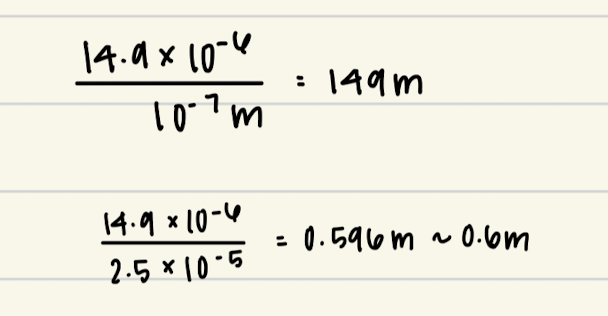
Capillary rise = (14.9 ×10^-6 m²)/ radius
how high can water rise in cell wall pore capillaries (radius = 100nm)
How high in xylem vessels (radius = 25 um)
Water is a supersolvent
due to small size of molecules and to its polar nature. H- bonds between water molecules and ions stabilize the ions and increase their solubility. great solvent for sugar and proteins with polar groups in plants
water has a high specific heat
because of hydrogen bonding, water has high specific heat. we do not want the plant to burn (will denature proteins, DNA, etc)
Water has high tensile strength
cohesion gives water a high tensile strength, pull a continuous column of water can withstand before breaking allowing water to be pulled like a rope. is responsible for transpiration pulling water from the roots to the leaves.
Water has high surface tension
because of hydrogen bonding water molecules are strongly attracted to each other (cohesion). high surface tension leads to a minimizing air-water interface which minimizes water surface area and pulls the rest of the water upward.
what are the three forms of water transport
Diffusion
Bulk flow
Osmosis
Diffusion
Ficks law: Flow = -Dx (𝚫C/𝚫x) → driving force is concentration gradient (𝚫C/𝚫x).
diffusion is important for transpiration from leaves to air, movement of solutes within cells, and movement of signal molecules across plasmodesmata, etc
occurs in leaves and stomata
Bulk Flow
Darcy’s Law: Flow = Khx (𝚫⍦p / 𝚫x)
poiseuilles law defines Kh = (pi r^4)/ 8n
The driving force is pressure gradient (𝚫⍦p / 𝚫x). Bulk flow is important for movement of sap in xylem and phloem, through roots, stems and leaves, and for movement of water in the soil
occurs in xylem conduits and soil
Osmosis
Flow = Lp x 𝚫⍦
the driving force is water potential gradient (𝚫⍦). Cell membrane are selectively permeable water crosses membranes by diffusion through the lipid bilayer.
For a tree in the garden, there are five times as many xylem conduits in a branch than in a petiole, and the conduits in the branch are twice as wide as those in the petiole. About how many times higher is the hydraulic conductance in the branch?
poiseuilles law defines Kh = (pi r^4)/ 8n
80 times higher because the branch as 5x the conduits (which are 2x wide) so 5 x (2r)^4
= 5 x (16r) = 80r

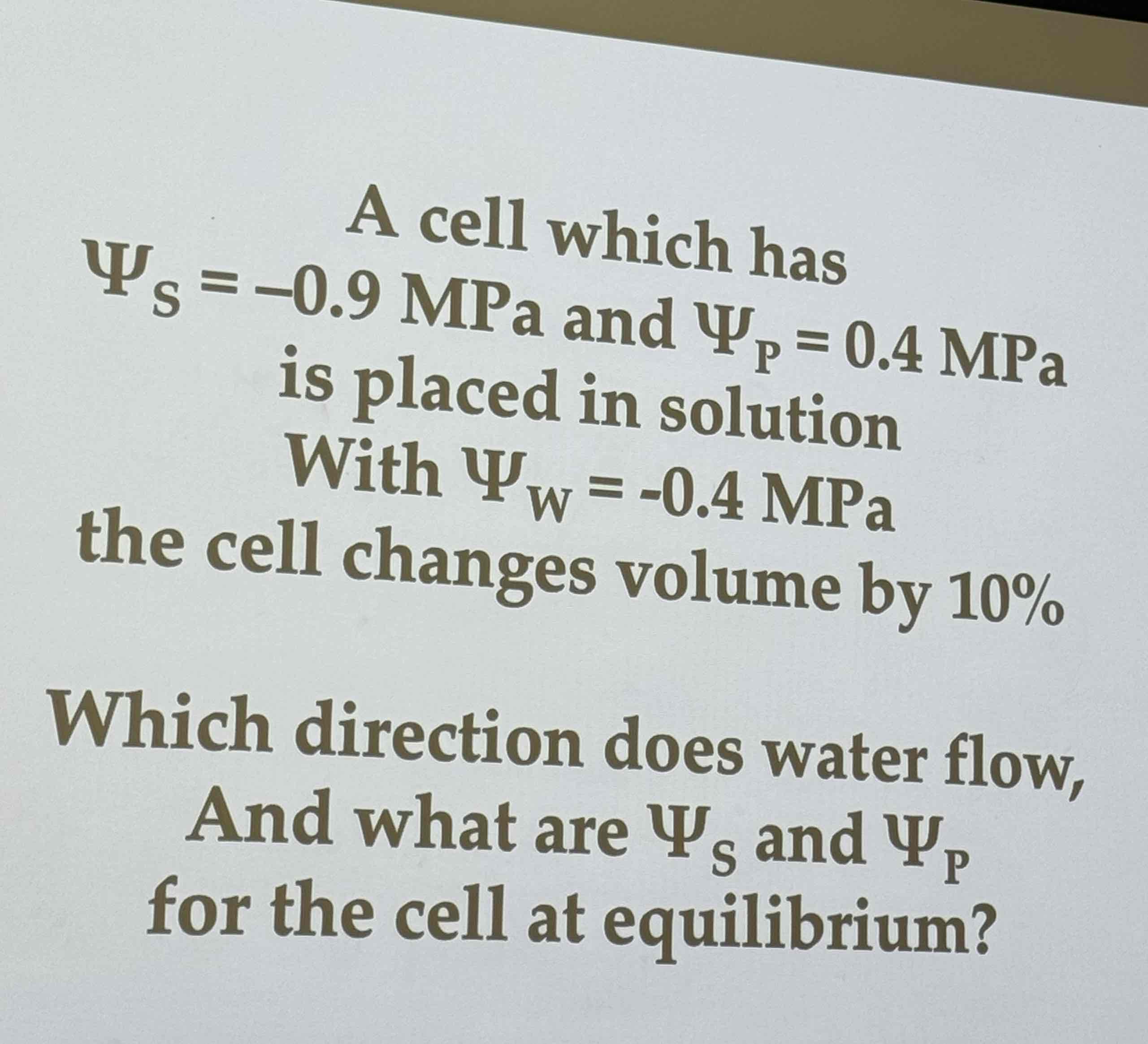
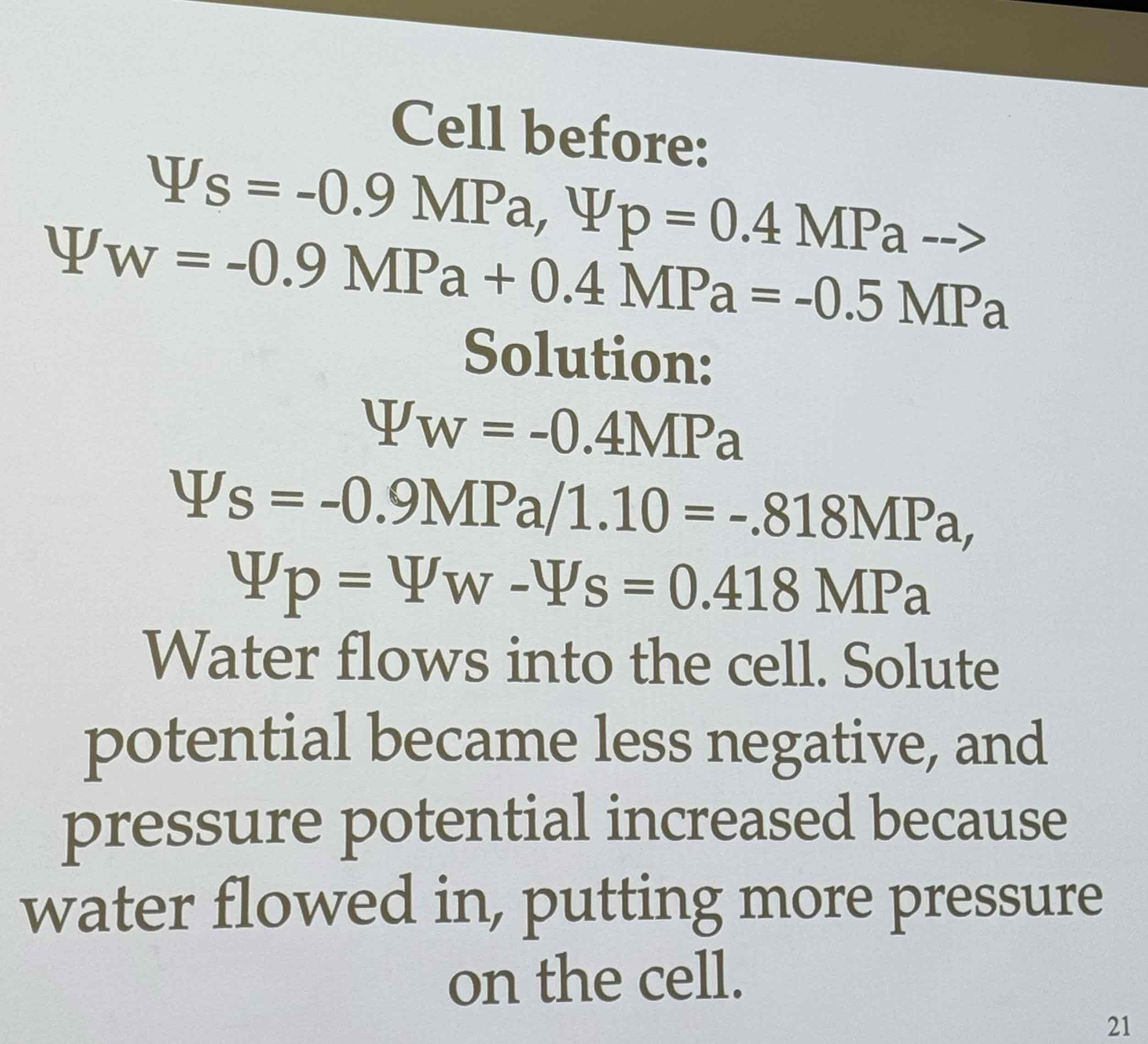
Which direction does the water flow? and what are s and p for the cell at equilibrium
Water flows into the cell. Solute potential became less negative, and pressure potential increased because water flowed in, putting more pressure on the cell
In which direction does water flow?
Water flows from cell B → A, because water flows to the more negative pressure
What are two concepts/ approaches to measure plants water statues?
Relative water content:
Water potential
What is an advantage of Relative water content
RWC = (fresh mass - dry mass)/ (saturated mass - dry mass) * 100%
advantage is that it is an easy and simple technology requiring minimal equipment, and is easy to understand
What is an advantage of Water potential
an index of cell and tissue water status
very scalable and can measure directly, many ways of measuring, gives you driving forces for water movement.
What are the leaf pressure volume curve parameters
Osmotic potential at full turgor: intercept of ⍦’s versus RWC. It is an index of the saltiness of cell sap in hydrated tissue
Osmotic potential at turgor loss point. Is the leaf water potential corresponding to ⍦p = 0, or when ⍦leaf = ⍦s. This predicts cell, leaf and plant drought tolerance
Modulus of elasticity: the slope of ⍦p versus RWC and index of rigidity of leaf cell walls. Some drought-tolerant plants have high elastic modulus values
Apoplastic fraction (af): the x-intercept of -1/leaf water potential vs RWC curve, and represents the % of water stores in the apoplast in a hydrated leaf
Which is thought to be the most directly related to a species drought tolerance
TLP: turgor loss point
Why is it difficult for plants to withdraw water from dry soil
Air water menisci in sand particles is larger and are dried out with larger distortions; hence, there is less tension compared to smaller clay particles
more dry soil = the more negative pressure gets = the lower the soil water potential = the harder it gets for plants to get to the water
Dry soil:
what is the type of water transport, driving force and transport coefficient
driving force is the negative water potential, water transport is the bulk flow, transport coefficient is hydraulic conductivity
Dry soil:
How does the driving force depend on the soil moisture
driving force depends on the soil moisture because drying the soil makes the driving force decline - soil becomes more negative and water potential goes down
Dry soil:
How does the transport coefficient depend on the soil moisture
transport coefficient depends on soil moisture because soil hydraulic conductivity declines as soil dries
the pathway that the soil can move are declining( sediments dry faster than clay)
What is the role of the Casparian strip in water uptake and ion uptake in the root
What is the name of this tissue involved
How does water cross this tissue? why do plants invest in such a tissue
Casparian strip is waterproofed with lignin and suberin in order to stop water transport at the inner core of the root to only tolerate what the plant needs
stops wrong liquids from going to the xylem where it can spread everywhere
Endodermis, water crosses it through aquaporins (must also have special ion transport channels) - through osmosis
As an extreme filter to control what gets in the plant because until the endodermis, anything can get through
How does water move from the soil to the root xylem
water moves through soil by bulk flow, driven by pressure gradients and dependent on the soil hydraulic conductivity (depends on soil type and structure and how wet the soil is)
Water moves from soil into the root by 3 pathways
symplast pathway
Apoplastic pathway
Transmembrane pathway
symplast pathway
water enters root via cell wall (no boundary). Water goes into one cell and then can move through plasmodesmata to the endodermis
Apoplastic pathway
water moves into the cell wall and through the endodermis
Transmembrane pathway
water moves across cell wall, across cell membrane, through the cell, out of the cell, back to cell wall, into next cell and so forth
*symplast and transmembrane involve water entering with no boundary, once water enters the xylem, it moves by bulk flow
Suppose that a pine tree has tracheids of 10um diameter and a sunflower has vessels of 50 um diameter
Kh is higher for the sunflower by up to how many times? (assuming everything but conduit diameter is the same)
5/10 = 5
(5)^4 = 625
> 600 times
Tracheid
a type of conduit of the xylem that is seen in vascular plants
vessel
made up of stacked up vessel elements that are only found in angiosperms (ex. flowering plants have vessels in addition to tracheids)
pits
where the water moves out of the vessels; in vascular plants, pits have primary and secondary walls while conifers only have primary cell walls
Poiseuille’s law
used for finding the Kh (the transport coefficient in bulk flow)
Kh = pi * r^4/ 8n
hydraulic conductance
a measure of the efficiency of bulk flow
conduit radius
the measure of how much water is in contact with the sides, depends on the pipe size
cohesion tension theory
water is pulled up because of cohesion and water is pulled through tension because of negative pressure
cavitation
the moment the air gets in before air spreads to block the xylem
influence transpiration rate
:larger stomatal aperture
increases and stomata resistance decreases
wider stomata → lower stomatal resistance → higher conductance (g)
influence transpiration rate
: Higher temp
Increases (VPD increases b/c saturation vapor pressure goes up)
influence transpiration rate
: Lower relative humidity
increases (VPD and RH are inverse)
influence transpiration rate:
Slower windspeed
decreases b/c boundary layer resistance goes up → g goes down
influence transpiration rate
large leaf
decreases b/c boundary layer thicker (higher resistance) → lower g