ceutics transdermal 1
 Call Kai
 Learn
 Practice Test
 Spaced Repetition
 Match
 Flashcards
 Knowt Play
1/64

There's no tags or description
Looks like no tags are added yet.
65 Terms
transdermal drug delivery is a discrete dosage form which when applied to INTACT skin will deliver the drug at a ________ rate to _____________
controlled rate; systemic circulation
transdermal drug delivery advanatges
First pass metabolism avoided
Frequency of dosing reduced
Controlled delivery (reliable blood levels)
Compliance
Termination is possible
Self medication
"facts"
transdermal drug delivery maintains therapeutic levels for _________ days
1-7 days
for transdermal devices, a daily dose of more than _____mg may not be possible
20mg
t/f: drugs requiring high blood levels are unsuitable for transdermal devices
true
drugs with a _______ half life can not be formulated for transdermal devices
long
characteristics of drugs not suitable for transdermals
1. greater than 20mg
2. if needed in high blood levels
3. long half life drugs
4. high molecular weight compounds
drugs that are continuously infused into the skin (aka transdermals) must have a _________ half life
short
t/f: TDD is usually reserved for drugs that are extremely potent
true (thus requiring less mg)
the largest daily dose of a drug from a patch is
21 mg nicotine patch
5 layers of epidermis
1. stratum corneum (horny cell)
2. stratum lucidum (clear)
3. stratum granulosum (granular)
4. stratum spinosum (prickly)
5. stratum germinativum
Come Lets Get Some Grub
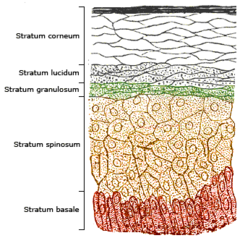
which 3 layers of the epidermis are the "thicker parts" and result in increased permeability if removed
lucidum, granulosum, spinosum (middle 3)
describe thickness of stratum corneum and what chemical bonds are present
10-15 micrometers thick
-keratin (cysteine disulfide bridges)
-glycine and alanine (H bonds)
*primary permeability barrier
describe the model used for the stratum corneum
"brick and mortar model"
brick= squamous cells of corneum
mortar= lipid matrix

while the stratum corneum is made up of keratin, the dermis is made of _______
collagen
what is responsible for skin elasticity
COLLAGEN fibers in DERMIS with uniform thickness
t/f: the dermis is supplied by blood
true. it is supplied by blood to provide nutrients, remove waste, and regulate body temp
in which region of the skin is drug well absorbed and why
the dermis; it is supplied by blood
subcutaneous tissue: location? histology?
fat with areolar tissue; attaches dermis to underlying structure (hypodermis)

describe sweat gland characteristics and function
sweat pH 4-6.8
absorbs drugs, secretes proteins, lipids, antibodies
fcn: control heat
hair follicles have _______ glands which produce _____ containing glycerides, cholesterol, and squalene
sebaceous glands; sebum
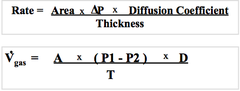
what mechanism regulates transdermal absorption
diffusion-> fick's law
3 routes of drug absorption through skin
1. trans follicular= hair/shunt
2. trans epidermal= intracellular
3. intercellular = between cells [highest amount]
which route of percutaneous drug absorption is most prevalent
intercellular= between cells through lipid matrix
(for lipophilic drugs)
which drugs prefer the trans follicular route
water-soluble drugs
describe how hydrophilic drugs diffuse through skin
prefer transfollicular route
- sweat glands and hair acts as shunt
- diffuses through rate limiting ST corneum
t/f: residence time of drug in the dermal layer is short, less than a minute
true. dermal layer has many capillaries, promoting drug absorption
describe how prodrugs enhance transdermal drug delivery
- promoiety increases partition coefficient and solubility
=> transport through stratum corneum
-epidermis: esterases release active drug
pro moieties increase __________ of a drug
partition coefficient and solubility (to get pass s. corneum)
where is a prodrug "released"
epidermis via esterases
factors affecting transdermal permeability
1. API= solubility, pH, concentration
2. DDS= release, excipients, permeation enhancer
3. skin= lipid film, skin hydration, temp, injury
4. biological= skin age, s. corneum thickness, skin condition
which layer of skin has greatest influence on transfer of drug from vehicle to skin
s. corneum
t/f: solubility of drug influences its ability to penetrate the skin
true
__________ determines drug concentration presented to absorption site
drug solubility
skin permeation can be enhanced by increasing the ____hydrophilic or lipophilic?___ character of drug
lipophilic (so that it penetrates s. corneum but not epidermis)
t/f: drug which is both lipid and water soluble is favored for transdermal DDS
true
what pH is favorable for skin absorption
moderate pH (too low or too high can destroy skin)
compare concentration vs solubility levels to produce a drug reservoir
at higher concentrations than solubility, excess solid drug will act as reservoir
_________ of drug in vehicle determines release rate
solubility
which compound would be more absorbed by the skin: methyl salicylate (ph= 7.5) or salicylic acid (ph 2.4)
methyl salicylate as it is unionized and more LIPOPHILIC= more absorption
removal of skin's lipid film would _______ TD absorption
decrease
something that dehydrates the skin would ___________ drug absorption
decrease
how does skin age affect absorption
children and elders= more permeable
adults= less permeable
which layer of skin is metabolically active
epidermis
4 components of transdermal DDS
1. polymer matrix
2. drug
3. permeation enhancer
4. excipients
criteria for selecting polymer for TDDS
1. molecular weight allows drug diffusion
2. non-reactive, inert, non-toxic, inexpensive polymer
3. not decompose over time or w drug
examples of polymers used in TDDS
cellulose derivs, gelatin, gums, rubber, PVC, PVP, poly etc.
properties of drug chosen for TDDS
1. weigh less than 1000 daltons
2. both lipophilic and hydrophilic
3. LOW melting point (easy to be liquid)
4. POTENT (few mg/day)
5. short half life
6. non irritating
How do penetration enhancers work?
1. interact with polar head groups (hydrogen/ionic bonding)
2. provide moisture/ increase hydration
3. protein modification= open up dense keratin

describe characteristics of backing membrane of transdermal DDS
1. impermeable membrane, protects product
2. compatible with formulation (non adsorptive)
3. flexible, good bond to drug reservoir
examples of backing membrane of TDDS
metallic plastic laminate, plastic backing with adsorbent pad adhesive foam pad
t/f: drugs in TDDS can be liquid, semi-solid, or non-flowing
true
types of TDDS platforms
1. monolith: slabs, reservoir, film, reservoir matrix
2. films: natural vs synthetic, porous vs nonporous
3. adhesives: permanently tacky
TDDS adhesive must be permanently "tacky". what does this mean
sticks to skin without any pressure
what are the 5 types of transdermal control release systems
1. polymer membrane permeation
2. polymer matrix diffusion
3. adhesive dispersion
4. gradient controlled
5. microreservoir/microsealed

polymer membrane permeation system:
-describe makeup
-counseling
-example
1. drug in reservoir + rate controlling polymer membrane + adhesive layer
2. break in membrane= dose dumping
3. ex: nitroglycerin

which TDDS could potentially have dose dumping
polymer membrane permeation controlled system
Adhesive dispersion type system:
- makeup?
- examples
1. drug directly dispersed in adhesive layer
-adhesive polymer: polyisobutylene and polyacrylet
2. ex: isosorbide dinitrate, verapamil

gradient controlled TDDS
3 gradient layers with drug reservoirs-> diffuses down into skin
ex: nitroglycerin
polymer matrix diffusion controlled TDDS
-drug dispersed homogenously in polymer matrix; in contact with skin (adhesive rim)
ex: nitro-dur 1 and 2

Microreservoir/microsealed dissolution controlled TDDS
a. MOST STABLE DEVICE
b. NO DOSE DUMPING
c. Drug dispersed first in water soluble polymer and then lipid soluble polymer= forms microscopic spheres of drug reservoir
d. Cross linking= constant SA and fixed thickness
e. Ex: nitro-disc
f. ZERO ORDER

which TDDS is most stable
microreservoir/microsealed dissolution controlled
which TDDS is controlled by a drug getting past a nonporous or porous membrane
polymer membrane permeation controlled system

which TDDS has a drug dispersed in a matrix in contact with the skin
polymer matrix diffusion system

which TDDS follows zero order kinetics and involved dissolution
Microreservoir/microsealed dissolution
