3.2 Decision Trees
 Call Kai
 Learn
Learn Practice Test
 Spaced Repetition
 Match
Match Flashcards
 Knowt Play
1/10

Earn XP
Description and Tags
Section 3.2 of Exam MAS-II
Name | Mastery | Learn | Test | Matching | Spaced | Call with Kai | Chat |
|---|
No analytics yet
Send a link to your students to track their progress
11 Terms
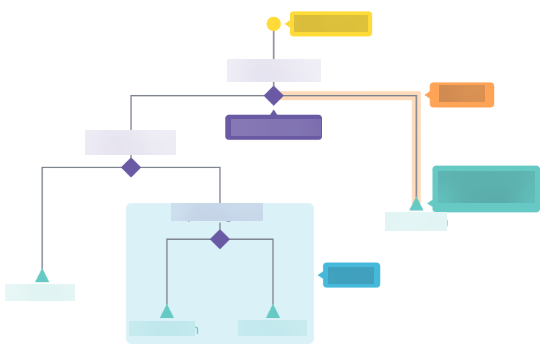
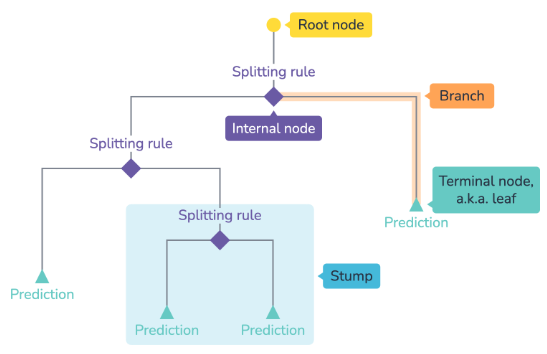
Root node |
Terminal nodes or leaves |
Internal nodes |
Parent nodes |
Child nodes |
Branches |
Stump |
Terminal nodes |
Internal nodes |
The node before any splits occur. It contains all observations. |
The partitions of the predictor space. |
Points along the tree where splits occur. |
Nodes where splits occur. |
Nodes produced by a split. |
Lines that connect any two nodes. |
A decision tree with only one internal node. |
Do not have child nodes. |
Have child nodes. |
Decision Tree Algorithm
Construct a large tree using recursive binary splitting.
Obtain a sequence of best subtrees, as a function of , using cost complexity pruning.
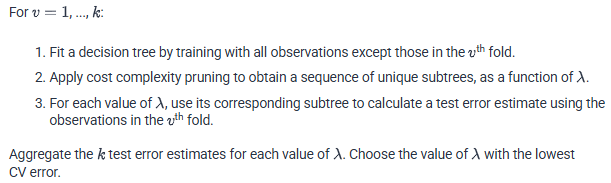
Choose by applying -fold cross-validation. The that results in the lowest cross-validation error is selected.
The best subtree is the subtree created in step 2 with the selected value.
Tree Construction:
Recursive binary splitting partitions the predictor space into ______
The resulting regions are _____
Recursive binary splitting partitions the predictor space into as many regions as possible while subject to stopping criteria.
The resulting regions are high-dimensional rectangles, or boxes.
Tree Construction:
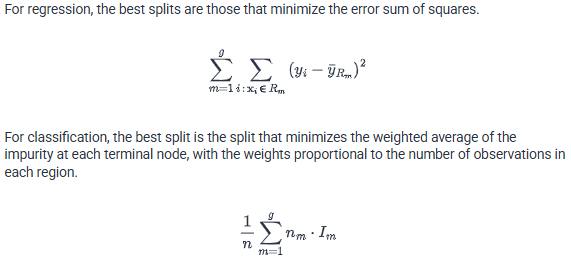
For regression, the best splits are _____. (describe equation)
For classification, the best split is the split that _____. (describe equation)
Classification Tree Construction: Impurity Measures and Equations
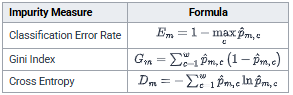
Classification Tree Construction:
If a node is relatively pure, then it contains observations that are
The Gini index and cross entropy are sensitive to _____. They are favored in _____.
The classification error rate is not sensitive to _____. It is favored in _____.
If a node is relatively pure, then it contains observations that are mainly from the same class.
The Gini index and cross entropy are sensitive to node purity. They are favored in tree-growing.
The classification error rate is not sensitive to node purity. It is favored in tree-pruning.
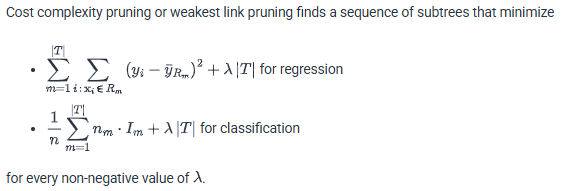
Tree Pruning: What’s it called and what does it minimize for regression and classification
Cross Validation
The number of terminal nodes is directly related to ______.
Decision trees will outperform linear regression when the chosen functional form _____ approximates the true relationship between the response and explanatory variables.
The number of terminal nodes is directly related to flexibility.
Decision trees will outperform linear regression when the chosen functional form poorly approximates the true relationship between the response and explanatory variables.
Advantages of Trees (4)
Disadvantages of Trees (2)
Advantages of Trees
Easy to interpret and explain
Can be presented visually
Manage categorical variables without the need of dummy variables
Mimic human decision-making
Disadvantages of Trees
Not robust
Do not have the same degree of predictive accuracy as other statistical methods