L17: Physical geography as resource and hazard
 Call Kai
 Learn
 Practice Test
 Spaced Repetition
 Match
 Flashcards
 Knowt Play
1/49

Earn XP
Description and Tags
Given by: Prof. Simon Mudd
50 Terms
Renewable resources
‘Natural’ resources that are, or can be, replenished over a relevant (human) timescale
What are four examples of renewable resources?
Animals and plants
Energy
Fisheries
Water (surface)
What two types of resources pose an issue for over-exploitation?
Non-renewable resources and partially renewable resources
Non-renewable resources
Natural resources that cannot be replenished over a relevant (human) timescale
What are three examples of non-renewable resources?
Fossil fuels
Minerals
Nuclear fuels
Partially renewable resources
Those that can be replenished in part, but which are not renewed naturally or over a relevant (human) timescale
What are two examples of partially renewable resources?
Groundwater and soil
Who first described the idea of the ‘Tragedy of the Commons’?
Rev. W.F. Lloyd (1832)
The Tragedy of the Commons scenario
Some herdsmen each own some cattle which graze on pasture open to all, each herdsman has an incentive to increase their number of cattle, which eventually gets to the point where there is no pasture left for grazing, and thus no cattle can be supported
The Tragedy of the Commons conclusion
Optimising the self for the short-term is not optimal for anyone in the long-term
What are four different property-rights systems used to regulate common-pool resources?
Open access
Individual property
Group property
Government property
Open access
Absence of enforced property rights
Individual property
Resource rights held by individuals (or firms) who can exclude others
Group property
Resource rights held by a group of users who can exclude others
Government property
Resource rights held by a government that can regulate or subsidize use

What does this diagram show?
Peak global population (now projected for 2084)
What are the three major types of ‘natural’ phenomena known as natural hazards?
Biological phenomena
Extra-terrestrial geo-physical phenomena
Terrestrial geo-physical phenomena
What are two examples of biological phenomena as natural hazards?
Crop and livestock disease, and human disease (pandemics, etc.)
What are two examples of extra-terrestrial geo-physical phenomena as natural hazards?
Cosmic radiation bursts (including solar flares) and impacts by asteroids, comets, and meteors, etc.
What are five examples of terrestrial geo-physical phenomena as natural hazards?
Catastrophic mass movement (landslides, etc.)
Coastal and river flooding
Earthquakes
Extreme meteorological conditions (drought, extreme heat, hurricanes, and tornadoes, etc.)
Tsunamis
What two factors determine the severity of episodic/catastrophic change?
Frequency and magnitude
What is the trend between frequency and magnitude when it comes to episodic/catastrophic change?
High frequency = low magnitude, and low frequency = high magnitude
What are two examples of physical events that follow the ‘frequency = magnitude’ trend?
Earthquakes and floods
Example: a risk of extremely high magnitude, but very low frequency
An asteroid of 50-80 m hit a forest in Tunguska, central Serbia, Russia (1908)
K-T (or Cretaceous-Tertiary) asteroid
The asteroid that slammed into Earth 66 million years ago, driving the famous extinction of the dinosaurs

What does this diagram show?
The magnitude and frequency trend of earthquakes
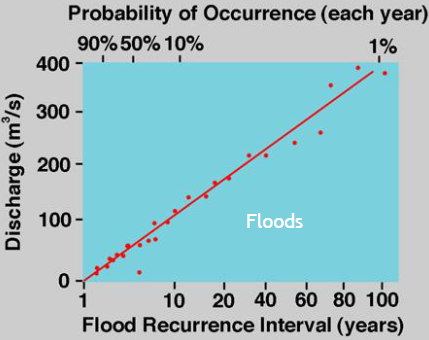
What does this diagram show?
The magnitude and frequency trend of floods
Case study: Global Geophysical Event (GGEs) of an earthquake
East Anatolian Fault Zone, Türkiye (2023)
East Anatolian Fault Zone, Türkiye (2023)
An earthquake of 7.8 and 7.5 magnitude
East Anatolian Fault Zone, Türkiye (2023) mortality rate
>33,000 deaths
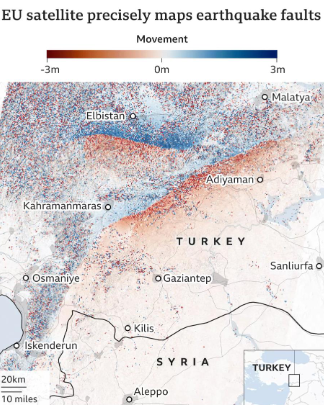
What does this diagram show?
East Anatolian Fault Zone, Türkiye (2023)
Case study: Global Geophysical Event (GGEs) of an underwater volcanic eruption
Hunga Tonga-Hunga Ha’apai, South Pacific Ocean (2022)
Hunga Tonga-Hunga Ha’apai, South Pacific Ocean (2022)
An underwater volcanic eruption with a column of 57 km in height
What two risks did the Hunga Tonga-Hunga Ha’apai, South Pacific Ocean (2022) underwater volcanic eruption pose?
Volcanic ash (tephra) and due to the magma interreacting with the surrounding seawater, the volcanic eruption was extra explosive
What followed the Hunga Tonga-Hunga Ha’apai, South Pacific Ocean (2022) underwater volcanic eruption?
A tsunami of 93 m, caused by the collapse of a volcano hit on Tongan Island, which travelled across the pacific
Cascading hazard
A (natural) hazard that is caused by and follows behind a previous hazard
What is interesting about the shockwave caused by the Hunga Tonga-Hunga Ha’apai, South Pacific Ocean (2022) underwater volcanic eruption?
The shockwave travelled around the world four times, even being heard from Alaska (9,000 km away)

What does this diagram show?
The location of the Hunga Tonga-Hunga Ha’apai, South Pacific Ocean (2022) underwater volcano
How long was the fault rupture that caused the Japan tsunami in 2011?
At least 500 km
Case study: Global Geophysical Event (GGEs) of a volcanic eruption
Eyjafjallajökull, Iceland (2010)
Eyjafjallajökull, Iceland (2010)
A volcanic eruption causing a disruption to air travel worth US$ 5 billion

What does this diagram show?
The pattern of the Eyjafjallajökull, Iceland (2010) volcanic eruption ash cloud
What equation is given to the concept of natural hazards as social construct?
Risk = hazard x vulnerability
Why is vulnerability important for the concept of natural hazards as a social construct?
This human element must be incorporated as it is cruical to mitigate the impact/risk of natural hazards
Example: a natural hazard with a high vulnerability
Hurricane Katrina, USA (2005)
Hurricane Katrina, USA (2005)
The most vulerable to this natural hazard were the poorest of New Orleans, Georgia, with 1/3 of the population living below the poverty line, as they were concentrated in the lowest lying land South of Lake Pontchartrain
Example: the social context of natural hazards
The Great Famine of 1315-1317
The Great Famine of 1315-1317
Major famines were common in Medieval Europe, including in Britain, resulting in millions of deaths, infanticides, and cannibalism
What caused the Great Famine of 1315-1317?
Several years of unfavourable weather; prolonged cold temperatures and torrential rainfall
What are four key points between the contrasting impacts of natural hazards on developed and developing countries?
Developed: suffer short-term economic losses / developing: suffer setbacks to long-term economic and social developments
Developed: have mechanisms to avoid or reduce loss-of-life / developing: lack of resources for early warning systems and poor infrastructure
Developed: have immediate emergency and medical relief / developing: high casualties due to a lack of relief infrastructure and resources
Developed: insurance against property and infrastructure losses / developing: forced to divert funds from development programmes to emergency relief and recovery