NEURO UNIT 4!
 Call Kai
 Learn
 Practice Test
 Spaced Repetition
 Match
 Flashcards
 Knowt Play
1/200

There's no tags or description
Looks like no tags are added yet.
201 Terms
What is the hypothalamus?
A portion of the brain containing many small nuclei with a variety of functions
A diencephalic structure
One of its most important functions is linking the nervous system to the endocrine system through the pituitary gland (hypophysis)
What basic physiological needs are regulated by the hypothalamus?
Body temperature
Blood pressure and electrolyte concentration
Energy metabolism
Reproduction
Emergency responses to stress
Biological rhythms, clocks, and sleep
How does the hypothalamus help maintain homeostasis?
receives a wealth of sensory info from own internal sensors AND the nucleus of the solitary tract (autonomic)
compares sensory info with biological set points
integrates behavioral (somatic), visceral (autonomic), and endocrine responses
makes adjustments to restore homeostasis, through:
a. behavioral responses (somatic)
b. ANS responses (visceral)
c. endocrine responses (hormonal)
What three types of responses can the hypothalamus use to restore homeostasis?
Behavioral responses = somatic
ANS responses = visceral/autonomic
Endocrine responses = hormonal
Where is the hypothalamus located?
Medial and inferior/ventral
Located around the third ventricle
How is the hypothalamus organized?
Contains many functional groups of neurons (nuclei)
Different nuclei have different functions
What is the function of the suprachiasmatic nucleus (SCN)?
Involved in sleep
Helps maintain the internal biological clock
Receives direct input from the retina
What functions are associated with the hypothalamus? The Nucleus Accumbens? The Dorsal Striatum?
Dorsal Striatum (Motor Control)
Nucleus Accumbens (Reward/Motivation)
Hypothalamus (neuroendocrine control of feeding, reproduction, etc.)
What is the sexually dimorphic nucleus of the preoptic area (SDN)?
A sexually dimorphic hypothalamic nucleus
Involved in male copulatory behavior, among other functions
Larger in males than females in the example shown
What nervous-system principle does the sexually dimorphic nucleus illustrate?
Structure is associated with function
AKA localization of function
Where is the pituitary gland located relative to the hypothalamus?
Ventral/inferior to the hypothalamus
Literally hangs below the hypothalamus
Located next to the optic chiasm
What is the difference between the anterior and posterior pituitary in their origins?
Anterior pituitary = non-neural origin
Posterior pituitary = neural origin
What are the two important groups of hypothalamic neurosecretory neurons?
Magnocellular neurosecretory neurons
Parvocellular neurosecretory neurons
Magnocellular neurosecretory neurons: Where do they extend their axons? CNS or PNS? Function? Examples?
Extends axons to the posterior pituitary
The posterior pituitary is a diencephalic structure (i.e., CNS)
Function: release neurohormones into the circulatory system
Neurohormone examples: oxytocin, vasopressin
What are major functions of oxytocin?
Relevant to pair-bond formation and social behavior in the CNS
Uterine contractions
Milk-related functions after pregnancy
What are major functions of vasopressin?
Relevant to social behavior in the CNS
Helps regulate blood volume and salinity
Acts on the kidneys
How can the same hormone have several different functions?
Different receptor types
Different localization of receptors in different tissues/organs
Parvocellular neurosecretory cells: Where do they extend their axons? CNS or PNS? Function? Examples?
Extends axons to the the pituitary stalk
The anterior pituitary is a gland! (NOT CNS)
Function: release hormones into the portal circulation to act on cells in the anterior pituitary – to cause these cells to increase or decrease hormone release
Examples of parvocellular hormones: GNRH, somatostatin, CRH (also stress hormone in CNS)
Anterior Pituitary Hormones: Growth hormone, luteinizing hormone, follicle stimulating hormone
Why is the parvocellular-anterior pituitary pathway considered a two-step process?
Step 1: hypothalamic parvocellular neurons release a hormone into portal circulation
Step 2: anterior pituitary cells respond by releasing another hormone into the blood
What is the HPG axis? What does it do?
What hormones are involved in the HPG axis?
Hypothalamus → pituitary → gonads
Regulates gonadal hormone production
Hormones:
Hypothalamus → GnRH
Anterior Pituitary → LH and FSH
Gonads → androgens and estrogens
What is the HPA axis?
Hypothalamus → pituitary → adrenal cortex
An endocrine stress-response pathway
What is the hormone sequence of the HPA axis?
Periventricular hypothalamus → CRH
Anterior pituitary → ACTH
Adrenal cortex → cortisol
What are the major effects of cortisol?
Mobilizes energy reserves
Suppresses the immune system
Helps the organism “carry on” in the face of stress
Steroid hormones like cortisol readily cross the blood-brain barrier because they are lipophilic
Why are ACTH and cortisol release relatively slow?
Hormones must travel through the bloodstream
Multiple steps/synapses are involved
ACTH begins increasing about 15 seconds after the initial stimulus
Cortisol rises minutes after the initial stimulus
How is the HPA axis shut down after a stress response?
Cortisol produces negative feedback
Negative feedback reduces further activity of the hypothalamus and pituitary
Why can chronic activation of the HPA stress system be harmful?
Cortisol continually mobilizes energy
Can continually suppress immune function
Long-term activation has physiological costs
What is a diffuse modulatory system?
A system in which a relatively small number of neurons influence very large numbers of neurons
Allows widespread changes in brain state/function
What are the major characteristics of diffuse modulatory systems?
Relatively few neuron cell bodies, often only thousands
Cell bodies located in one or a few nuclei, usually in or near the brainstem/midbrain
Individual neurons form widespread axonal connections
One neuron may form enormous numbers of synapses
Usually act through metabotropic receptors
Named for their primary neurotransmitter
What are the four major diffuse modulatory systems?
Dopamine (DA)
Serotonin (5-HT)
Norepinephrine (NE), also called noradrenaline
Acetylcholine (ACh)
What are the two major dopaminergic systems?
Substantia nigra pars compacta (SNpc)
Ventral tegmental area (VTA)
What is the major function and projection of the substantia nigra pars compacta dopamine system?
Important for movement
Nigrostriatal projection
Projects to the dorsal striatum/caudate-putamen
What is the major function of the VTA dopamine system?
Reward and motivation
Sends mesocorticolimbic projections
What is the mesocortical dopamine projection?
Originates in the VTA
Targets the prefrontal cortex
What is the mesolimbic dopamine projection?
Originates in the VTA
Major target is the nucleus accumbens
Travels through the medial forebrain bundle
What is motivation?
A change in behavioral response to a constant stimulus due to a change in endogenous state
What kinds of behaviors can motivation include?
Feeding
Sex/reproductive behaviors
Affiliative behaviors
Drug seeking
Many other behaviors
What is appetitive behavior?
Anticipatory/instrumental phase
Search phase
More variable and spontaneous
What is consummatory behavior?
More stereotyped phase
Results in termination/completion of a behavioral sequence
What is the nucleus accumbens?
Part of the ventral striatum
Located in the basal forebrain area in humans
Important for reward and motivation
What dopamine receptors are expressed in the nucleus accumbens (NAc)?
D1 receptors
D2 receptors
Similar to the dorsal striatum
What are the two major parts of the nucleus accumbens?
Core
Shell
They have different functions and anatomical projections
Both receive dopamine and express D1/D2 receptors
The nucleus accumbens is often called a nexus between the ____ and ____ systems.
The nucleus accumbens is often called a nexus between the limbic and motor systems.
Receives information related to higher processing, memory, motivation, and reward
Can influence motor-related output
Helps translate motivated/internal-state information into behavior
What pathway releases dopamine into the nucleus accumbens?
Mesolimbic pathway
VTA → medial forebrain bundle → nucleus accumbens
What is intracranial self-stimulation?
An animal can activate an implanted brain electrode by performing a behavior such as pressing a lever
If the electrode activates the reward/motivation system, the animal repeatedly performs the behavior
Where are intracranial self-stimulation electrodes often placed for the strongest reward effect?
Medial forebrain bundle (MFB)
Contains mesolimbic dopamine axons from the VTA to nucleus accumbens
Why does stimulating the medial forebrain bundle often work better than stimulating the VTA directly?
MFB stimulation more directly activates mesolimbic dopamine axons
Stimulating the VTA can also activate other local neurons such as GABAergic interneurons
What behavior can animals show during strong intracranial self-stimulation?
Repeated lever pressing
May continue for very long periods
May work very hard or overcome obstacles for stimulation
Stimulation does not show normal satiation like food or water
What was the basic goal of the “roborat” experiment?
Train a rat through brain stimulation to:
turn/walk right on command
turn/walk left on command
Training used positive reinforcement rather than forcing movement
What three stimulating electrodes were used in the roborat experiment?
Right primary somatosensory cortex in the whisker representation
Left primary somatosensory cortex in the whisker representation
Medial forebrain bundle/mesolimbic projection
How does stimulation of right/left somatosensory cortex guide the roborat?
Makes the rat perceive a touch on the LEFT
Rat tends to turn RIGHT away from that perceived touch
Opposite effect for left
Which roborat electrode provides positive reinforcement?
Medial forebrain bundle electrode
Activated when the rat performs the correct action
Produces reward/satisfaction signaling
What did the roborat experiments demonstrate?
Freely moving rats could be remotely guided through complex environments
Used microstimulation of somatosensory cortex for commands and MFB stimulation for reinforcement
How do VTA dopamine neurons respond before conditioning when an unexpected reward occurs?
No expectation of reward
Reward occurs
Dopamine neuronal activity increases at the time of the reward
How do VTA dopamine neurons respond after a reward-predicting conditioned stimulus is learned?
Dopamine activity shifts to the predictor/conditioned stimulus
Little or no extra increase occurs when the expected reward itself arrives
What happens to VTA dopamine activity when an expected reward does NOT occur?
Dopamine activity decreases at the time when the reward should have occurred

Name the drugs
How does cocaine affect the mesolimbic dopamine system?
Blocks dopamine reuptake by the dopamine transporter
Increases dopamine remaining in the synaptic cleft
How does amphetamine affect the dopamine transporter?
Reverses the dopamine transporter
Causes dopamine to move into the synaptic cleft rather than being removed
How does PCP affect the mesolimbic system?
Blocks glutamate receptors in the nucleus accumbens
Includes glutamatergic projections from the amygdala
How does nicotine affect the mesolimbic dopamine system?
Acts on nicotinic acetylcholine receptors
These receptors are present on dopamine-related terminals/cells in reward pathways
How do opiates such as heroin increase VTA dopamine activity?
Inhibit neurons that release GABA onto VTA dopamine neurons
Less GABA inhibition → VTA dopamine neurons become more active
How does alcohol affect the mesolimbic reward pathway?
Effects are complex
Includes inhibition of GABAergic neurons that normally inhibit VTA dopamine neurons
How can MDMA affect the mesolimbic dopamine system?
May block dopamine reuptake
May inhibit GABAergic neurons in the VTA
How can cannabinoids affect the VTA?
Can increase excitatory input into the VTA
Cocaine versus amphetamine transporters
Cocaine BLOCKS dopamine transporter action
Amphetamine REVERSES dopamine transporter action
What is pimozide?
Antagonist of D2 dopamine receptors
How does pimozide affect intracranial self-stimulation behavior?
Impairs the ability of stimulation to sustain responding
Animals may initially begin normally
Over trials, speed and lever pressing decrease and latency increases
What happened after animals given pimozide received a 10-minute timeout?
They could initiate responding normally again
But responding was not well maintained
What does the pimozide experiment suggest about reward behavior?
Different phases are mediated by different neural mechanisms
Includes initiation of behavior
Includes maintenance/sustaining of behavior
Where does the serotonin diffuse modulatory system originate?
Raphe nuclei
Especially the dorsal raphe
Located in the brainstem
What functions are associated with serotonin?
General arousal
Sleep/wake cycles
Mood
Especially aggression
Emotion
Depression/anxiety-related behavior
What major system is heavily innervated by serotonin?
Limbic system
What brain systems are important in the neural basis of emotion?
Limbic system
Hypothalamus
Amygdala
Serotonin diffuse modulatory system
What are the two components of emotion?
Emotional expression = measurable physiological changes
Emotional experience = feeling and cognitive aspects
Where does the norepinephrine diffuse modulatory system mainly originate?
Locus coeruleus
Other brainstem nuclei can also produce norepinephrine
What functions are associated with norepinephrine?
General arousal
Sleep/wake
Attentiveness
Fight-or-flight responses
Cognition
What major regions produce acetylcholine for the diffuse modulatory system?
Basal forebrain complex
Pontomesencephalo-tegmental (PMT) complex
Medial septal nuclei
What functions are associated with the acetylcholine diffuse modulatory system?
Arousal
Sleep/wake
Learning
Memory
Where can acetylcholine also be synthesized locally?
Many brain areas
Includes the striatum
Includes the nucleus accumbens
What is pharmacology?
Study of drug action
Includes factors such as dose, route of administration, receptors, and drug effects
What general principles determine drug actions?
Receptors dictate drug actions
Chemical structure affects binding, location, affinity, and strength of response
Timing and route of administration affect response strength
Drugs can disrupt homeostasis of neurochemical signaling
What are the three basic neurotransmitter categories discussed in the neuropharmacology lecture?
- Amino acids
- Amines
- Peptides
What are amino acid neurotransmitters?
- Small organic molecules
- Stored in vesicles
- Examples: glutamate, glycine, GABA
What are amine neurotransmitters?
- Small organic molecules
- Stored in vesicles
- Examples include dopamine, acetylcholine, histamine, and norepinephrine
What are peptide neurotransmitters?
- Short amino acid chains/proteins
- Stored in secretory granules/dense-core vesicles
- Examples include dynorphin, enkephalins, and substance P
What is a drug according to this lecture?
- An exogenous substance
- Comes from outside the body
- Binds to receptors in the body
- Can mimic or block actions of endogenous neurotransmitters
What determines the action of a drug once it is in the body?
- Which receptors it can bind to
- Chemical structure
- Binding location
- Affinity
- Efficacy
- Dose and route of administration
What drug-binding sites are shown on the GABAA receptor?
- GABA
- Benzodiazepines
- Barbiturates
- Ethanol
- Neurosteroids
Why can mixing alcohol with benzodiazepines or barbiturates be dangerous?
- They can all enhance GABAA receptor-mediated inhibition
- Combined effects can produce excessive CNS depression
Are “natural” drugs inherently safer than synthetic drugs?
- No
- Natural drugs can be dangerous
- Synthetic drugs can also be dangerous
- Safety depends on the specific drug and its actions in the body
What examples of naturally derived drugs are given?
- Opium from poppy plants
- Alcohol from fermentation
- Nicotine from tobacco
- Cocaine from coca plants
- Cannabinoids from Cannabis sativa
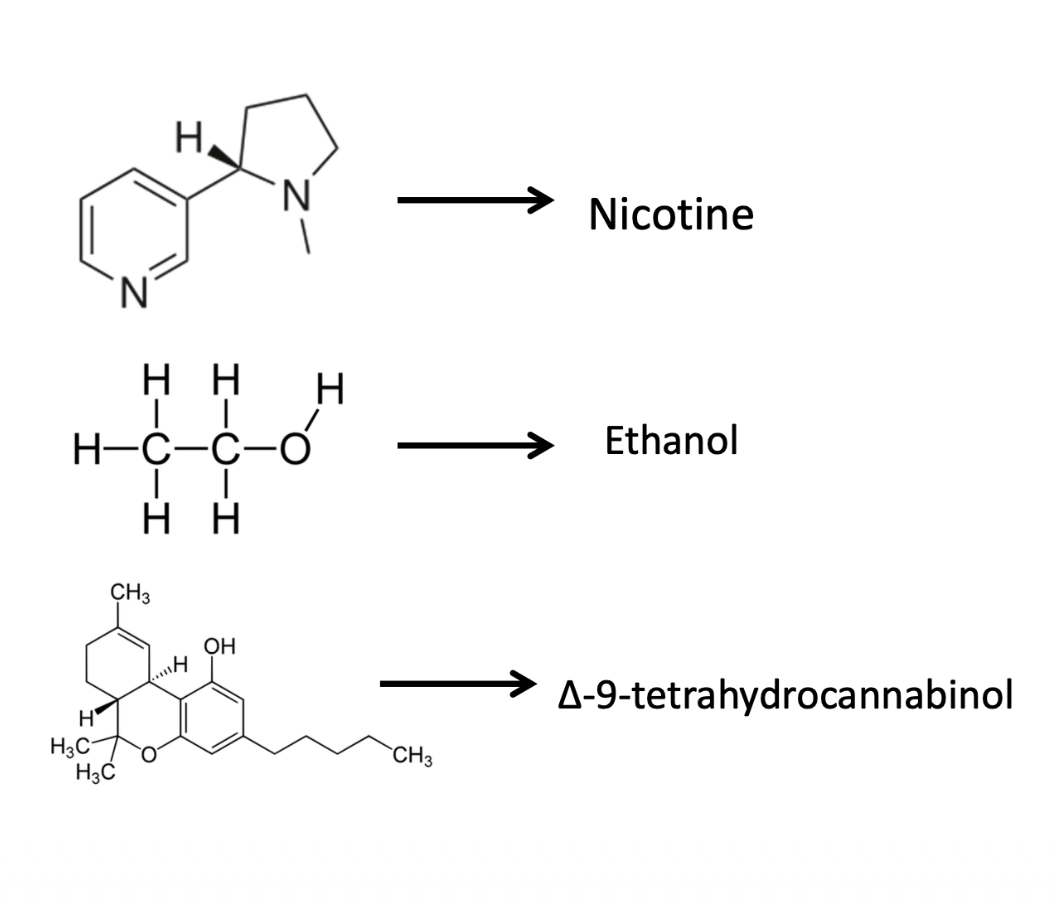
What three example drug structures are shown early in the lecture?
- Nicotine
- Ethanol
- Δ9-tetrahydrocannabinol
What is pharmacodynamics?
- The functional relationship between a drug and its target
- How a drug produces its effects
What is binding affinity?
- Degree of chemical attraction between a ligand and a receptor
- Higher affinity = more likely to bind
- Lower affinity = less likely to bind
What is efficacy or intrinsic activity?
- Ability of a bound ligand to activate the receptor
Can affinity and efficacy differ independently?
- Yes
- A drug can have low affinity but high efficacy
- A drug can have high affinity but low efficacy
What is a competitive ligand?
- Binds to the same receptor site as the neurotransmitter
What is a noncompetitive ligand?
- Binds to a different/modulatory site on the receptor
- Does not bind to the neurotransmitter’s normal binding site
Can competitive and noncompetitive ligands be agonists or antagonists?
- Yes
- Either type of ligand can act as an agonist or antagonist
What is an agonist?
- Mimics or promotes the natural action of a neurotransmitter
- Activates/stimulates the receptor