Computer Networks Module 7 and 8 Flashcards
 Call Kai
 Learn
 Practice Test
 Spaced Repetition
 Match
 Flashcards
 Knowt Play
1/41

There's no tags or description
Looks like no tags are added yet.
42 Terms
An enterprise network does not use SDN. It carries a wide range of equipment: routers, switches and many middleboxes, such as firewalls, network address translators (NATs) and load balancers. Its operators find the network hard to manage, even when every device works as designed.
Which property of this network makes it hard to manage?
A. Operators configure the devices from one central console, so one mistake spreads across the network.
B. Vendors share one configuration language, but each device interprets its commands in its own way.
C. Each device runs closed vendor software with its own interface, so operators configure each one alone.
D. Each router computes its routes alone, and without a network-wide view the chosen paths are often wrong.
C. Each device runs closed vendor software with its own interface, so operators configure each one alone. Each device runs closed vendor software with its own interface, so every policy is configured device by device. No central console configures the devices, and vendors have no shared configuration language.
An enterprise network uses SDN, and its controller maintains a current view of the whole network. A core link in the network is congested, and the network's operator wants to reroute web traffic around it. The change affects 40 of the network's 200 switches.
How does the controller's network-wide view help with this change?
A. It turns the change into one script that the operator runs on each of the 40 switches.
B. It sends the new paths to the hosts, which put the path into each packet's header.
C. It computes new rules for all 40 switches at once and installs them on each switch.
D. It reroutes only new web flows, and existing flows stay on the congested link.
C. It computes new rules for all 40 switches at once and installs them on each switch. The controller sees the whole network, so it computes new rules for every switch on the new paths and installs them itself, all at once.
Consider an SDN network of 300 routers from three vendors. A remote controller computes the forwarding table of each router and sends it to that router. The network's operator makes two changes. The first change introduces a new routing algorithm. The second change replaces the routers of one vendor with routers from a fourth vendor. The new routers forward packets faster. They also take their forwarding tables from the controller.
Which devices need new software or new hardware for each change?
A. The controller and the routers for the first, and for the second as well
B. The routers alone for the first, and the routers alone for the second
C. The controller alone for the first, and the controller and routers for the second
D. The controller alone for the first, and the routers alone for the second
D. The controller alone for the first, and the routers alone for the second. A new routing algorithm is controller software. Faster routers are data plane hardware that the vendor-neutral interface already supports.
A campus network is a traditional network, in which each router runs its own control plane. The campus operator plans to replace it with an SDN network, and their planning document lists seven claimed advantages of the move.
Which claims are true advantages of the SDN network over the traditional one? Select all that apply.
A. A new routing algorithm can be deployed by updating the controller, with no change to the switches.
B. Each switch forwards packets faster, because SDN switches use faster hardware than routers.
C. Switches and control software can come from different vendors, since an open interface connects them.
D. Routing and firewall applications work from one shared network view, not a separate view on each device.
E. Hosts need no IP addresses, since the controller identifies each flow by its switch port instead.
F. Control capacity and forwarding capacity can grow separately, by adding servers or adding switches.
G. Logical centralization runs the controller on one physical server, with no state replicas to manage.
A. A new routing algorithm can be deployed by updating the controller, with no change to the switches.
C. Switches and control software can come from different vendors, since an open interface connects them.
D. Routing and firewall applications work from one shared network view, not a separate view on each device.
F. Control capacity and forwarding capacity can grow separately, by adding servers or adding switches.
New algorithms are controller software, each plane can come from a different vendor, applications share one network view, and the two planes scale separately. A logically centralized controller can run on several servers, and hosts still use IP addresses.
Forwarding and routing are the two functions of the network layer. A traditional router performs both of them inside one box. SDN splits them between the switches and a logically centralized controller.
Which statement describes where each function runs in an SDN network?
A. Forwarding runs on the controller, network-wide; routing runs on each switch, locally.
B. Forwarding runs on each switch, locally; routing runs on the controller, network-wide.
C. Both run on each switch, locally, using rules and routes that the controller sends to it.
D. Both run on the controller, network-wide, and each switch relays packets to the controller.
B. Forwarding runs on each switch, locally; routing runs on the controller, network-wide. Forwarding is a per-packet decision made locally in switch hardware. Routing computes paths across the whole network, and SDN moves it into software on the controller.
Consider a router in an ISP network. It runs OSPF inside the ISP and BGP with neighboring ISPs. The eight operations below take place on this router.
Which operations belong to the data plane? Select all that apply.
A. Running Dijkstra on the OSPF link-state database to compute shortest paths
B. Decrementing the TTL of a packet and updating its header checksum
C. Announcing a new prefix to a neighboring ISP in a BGP update message
D. Finding the longest prefix that matches a packet's destination address
E. Copying one incoming multicast packet to each of three output ports
F. Recomputing routes after an OSPF update reports that a link failed
G. Holding a packet in an output queue until its output link is free
H. Building the forwarding table from the routes that OSPF and BGP chose
B. Decrementing the TTL of a packet and updating its header checksum
D. Finding the longest prefix that matches a packet's destination address
E. Copying one incoming multicast packet to each of three output ports
G. Holding a packet in an output queue until its output link is free
Lookup, TTL rewriting, replication and queueing act on each packet locally, in hardware. Running Dijkstra, announcing prefixes, recomputing routes and building the forwarding table decide what the table contains.
Router R sits inside an ISP network. Its route processor runs OSPF and BGP and computes R's routes. Its forwarding hardware forwards each packet using the forwarding table. At 10:00, the route processor crashes, and it stays down until 10:02. The forwarding hardware keeps running and maintains the forwarding table as it was at 10:00. At 10:01, the link between two other routers in the ISP, X and Y, fails. Some paths in R's forwarding table cross that link.
Which statement describes router R between 10:01 and 10:02?
A. R keeps forwarding with its 10:00 table, and paths across the failed link are not rerouted.
B. R stops forwarding all packets, since each table lookup needs the route processor.
C. R keeps forwarding and reroutes around the failed link, since its hardware computes paths.
D. R keeps forwarding but stops decrementing TTLs, since the route processor rewrites headers.
R keeps forwarding with its 10:00 table, and paths across the failed link are not rerouted.
Lookup, TTL rewriting and forwarding run in the forwarding hardware with the 10:00 table, so they continue. Rerouting needs the route processor, so paths across the failed link stay stale until 10:02.
Consider an SDN network with a controller and OpenFlow switches S1 to S8. Each switch maintains a pipeline of flow tables, numbered from table 0. The five operations below take place in this network.
Which operations belong to the control plane? Select all that apply.
A. Matching a packet from 10.0.0.5 to TCP port 80 against the rules in table 0
B. Computing a path from host H1 to host H2 across the current topology
C. Sending a packet out of port 3, as the action of its matching rule instructs
D. Recomputing paths after S1 reports that its link to S2 is down
E. Discarding a packet from 10.0.0.9 because its matching rule's action is drop
Computing a path from host H1 to host H2 across the current topology and Recomputing paths after S1 reports that its link to S2 is down.
Computing and recomputing paths are control plane work: network-wide decisions made in software on the controller. Matching, forwarding and discarding act on each packet with the rules already in the table, which is data plane work.
A firewall sits between an enterprise network and the Internet. The split between the data plane and the control plane applies to this middlebox as it does to routers and switches. The firewall maintains a table of rules, and each rule has a pattern, an action and a counter. The firewall performs four operations:
1. It matches the five-tuple of each arriving packet against the rules. It then drops or forwards the packet as the action of the matching rule specifies.
2. It adds one to the counter of the rule that each packet matches.
3. It installs the rules of a new security policy that the firewall's administrator sends.
4. It deletes the rules of an old policy that the administrator withdraws.
Which operations belong to the firewall's data plane?
A. Operation 1 only
B. Operations 1 and 2
C. Operations 1, 2 and 4
D. Operations 1 and 3
Operations 1 and 2
Matching, dropping or forwarding, and counting act on each packet with the rules already in the table, so they are data plane work. Installing and deleting rules changes the table itself, so it is not data plane work.
Consider a server load balancer in front of a pool of web servers. Clients send their requests to the load balancer's public address, and the load balancer maintains a server table that lists the servers in the pool. Besides rewriting the headers of the packets it handles, the load balancer also sends packets of its own. It performs four operations:
1. It hashes the five-tuple of each arriving client packet to pick a server from the table. It then rewrites the packet's destination address to that server's address.
2. It rewrites the source address of each server reply to the public address.
3. Every few seconds, it sends a test request to each server, and it removes from the table any server that does not reply.
4. It adds a new server to the table when the load balancer's administrator adds that server to the pool.
Which operations belong to the load balancer's data plane?
A. Operation 2 only
B. Operations 1 and 3
C. Operations 1, 2 and 3
D. Operations 1 and 2
Operations 1 and 3
Rewriting client packets and server replies acts on each packet with the existing table, so it is data plane work. Health checks send packets, but they decide which servers the table lists, so they are not data plane work.

Consider an SDN network of 40 routers and one remote controller. The controller computes the forwarding table of each router and sends it to that router. The routers maintain no backup paths. A router that loses contact with the controller continues to use the table it maintains, and its entries do not expire. Some traffic crosses the link between routers R1 and R2. The controller then goes down, and it stays down for ten minutes. During those ten minutes, the link between R1 and R2 fails.
While the controller is down, what happens to the traffic whose path uses the link between R1 and R2?
A. R1 and R2 compute a new path around the failed link and use it at once.
B. It is dropped at R1 or R2 until the controller returns and sends new tables.
C. Its packets loop among other routers until their TTL expires, as the tables are stale.
D. It still gets through, since the table entries that use the link do not expire.
It is dropped at R1 or R2 until the controller returns and sends new tables.
Routers maintain only the tables they were given and cannot compute around the failure, so the traffic is dropped until the controller returns.
Consider an enterprise network that uses SDN. Its functions are divided into a management plane, a control plane and a data plane. The enterprise's operator wants to stop guest devices from reaching the payroll servers. The following four actions take place:
1. The enterprise's security team defines the policy "guest devices may not reach the payroll servers" in a policy application.
2. The controller turns the policy into drop rules and installs them on the edge switches.
3. An edge switch drops a packet that a guest laptop sends to a payroll server.
4. A monitoring service polls the controller every minute for its load and for the number of rules it maintains.
Which actions is the management plane responsible for?
A. Action 1 only
B. Actions 1 and 2
C. Actions 2 and 4
D. Actions 1 and 4
Actions 1 and 4
Defining the policy and monitoring the controller are management plane work. Installing rules is control plane work, and dropping packets is data plane work.
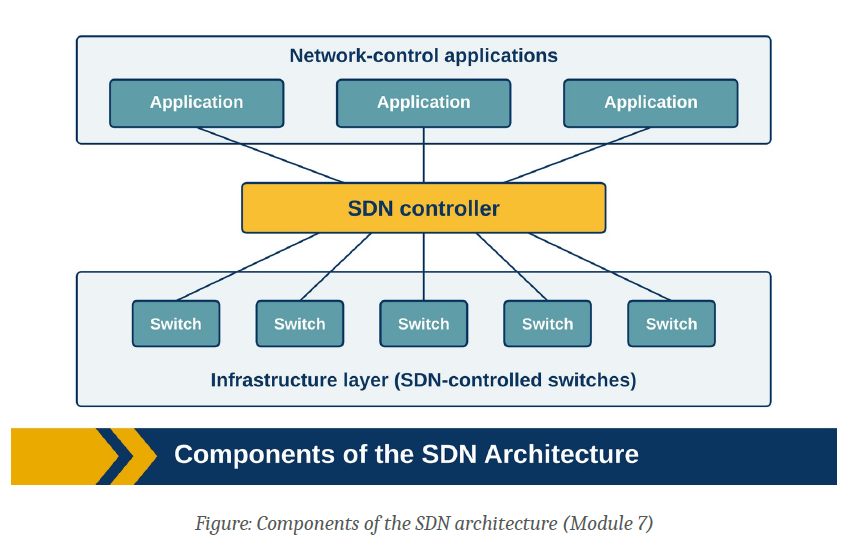
Consider an SDN network with three layers: network-control applications at the top, an SDN controller in the middle, and SDN-controlled switches at the bottom. The switches form the infrastructure layer.
What is the infrastructure layer responsible for?
A. Forwarding packets based only on their destination IP address, by longest prefix match
B. Computing its own forwarding rules from operator policy, on each switch's processor
C. Maintaining the network state, including copies of the flow tables, for the controller
D. Forwarding packets according to rules that the control plane computes and installs
D. Forwarding packets according to rules that the control plane computes and installs
The infrastructure layer forwards packets according to rules the control plane computes and installs. It computes no rules, and the controller, not the switches, maintains the network state. Its rules can match many header fields.

In a company's SDN network, a traffic-engineering application runs on SDN controller X. The application calls a REST API that controller X offers to applications. The company then replaces controller X with controller Y. Controller Y is developed by a different software project. Controller Y also offers a REST API to applications. After the change, the company's network operator observes three things.
1. The switches communicate with controller Y and provide it with events and flow statistics.
2. Controller Y installs rules on the switches for its own routing application.
3. Every call that the traffic-engineering application makes to controller Y fails.
Which cause explains all three observations?
A. Controller Y sets its own API for applications, and that API differs from the API of X.
B. The standard REST interface for SDN applications changed between controllers X and Y.
C. The switches run a different OpenFlow version from controller Y and reject its rules.
D. Controller Y has not yet learned the network state, so it refuses the application's calls.
Controller Y sets its own API for applications, and that API differs from the API of X.
The northbound interface, the API a controller offers to applications, has no standard, so an application written for X's API fails on Y's. The southbound side, between switches and controller, still works.
In an SDN network, the controller runs on a single server. To remove this single point of failure, the network's operator moves the controller to a cluster of three servers. Applications still see one logically centralized controller, and the controller is built to tolerate crash failures.
Which statement describes what the cluster gains and what it costs?
A. The control plane stays available when one server crashes, but the servers must keep the network state consistent.
B. The control plane stays available when a server installs wrong rules, but each application must pick one server.
C. The control plane stays available when one server crashes, but each switch must now maintain three copies of its flow table.
D. The control plane stays available when one server crashes, but the switches stop forwarding packets while the servers recover.
The control plane stays available when one server crashes, but the servers must keep the network state consistent.
A cluster survives a server crash, at the cost of keeping the network state consistent across servers.
Consider a distributed SDN controller of four nodes, N1 to N4. Each node controls its own group of switches. The controller is built to tolerate crash failures only. Node N2 stops and does not restart. Node N3 keeps running, but a software fault makes it install wrong rules on its switches.
After these two faults, a neighboring node controls the switches of N2, and N3 still sends instructions to its own switches.
True
False
True
A crashed node is replaced by a neighbor. A node with an arbitrary failure keeps control of its switches, because the controller tolerates only crash failures.
Consider an SDN network of 200 bare-metal switches. The controller runs on three servers. The switches forward the packets of known flows without delay. A known flow is one that the switches have already seen. The first packet of each new flow now waits several seconds at the controller.
Adding bare-metal switches provides this network with the capacity that it lacks.
True
False
False
Packets of known flows are forwarded without delay. The slow part is the controller setting up new flows, so the network lacks control plane capacity.
An SDN network has 200 switches and a controller cluster of three servers. The switches forward the packets of known flows without delay. A known flow is one that the switches have already seen. The first packet of each new flow waits several seconds at the controller.
Adding servers to the controller cluster addresses this delay.
True
False
True
The delay comes from the controller setting up new flows, which is control plane work. Adding servers adds control plane capacity, and the two planes scale separately.
An OpenFlow switch has two rules in its flow table:
1. A rule for flow F forwards the packets of flow F out of port 2. This rule never expires.
2. A default rule sends every packet that matches no other rule to the controller.
The switch loses its connection to the controller, but it retains both rules. A packet of flow F then arrives.
The switch forwards this packet out of port 2 without contacting the controller.
True
False
True
The packet matches an installed rule, so the switch forwards it on its own. Forwarding with installed rules needs no controller, and only packets that reach the default rule depend on it.
An OpenFlow switch has two rules in its flow table:
1. A high-priority rule matches destination address 192.0.2.8 and TCP destination port 22. Its action drops the packet.
2. A low-priority rule matches destination prefix 192.0.2.0/24. Its action forwards the packet out of port 5.
Two packets arrive for 192.0.2.8: one for TCP port 22 and one for TCP port 80.
The switch handles the two packets differently, even though they have the same destination address.
True
False
True
OpenFlow rules can match transport-layer fields as well as addresses. The port 22 packet matches the drop rule, and the port 80 packet matches only the prefix rule, so it leaves through port 5.
An OpenFlow 1.3 switch has no default rule installed. A packet arrives that matches no rule in any of the switch's flow tables.
What does the switch do with the packet?
A. The switch applies the rule whose match comes closest to the packet.
B. The switch floods the packet on all of its other ports.
C. The switch discards the packet at the end of the lookup.
D. The switch holds the packet until a matching rule is added.
The switch discards the packet at the end of the lookup.
In OpenFlow 1.3, a packet that matches no rule follows the default rule, and with no default rule the switch discards it. That is why operators install a default rule that sends such packets to the controller.
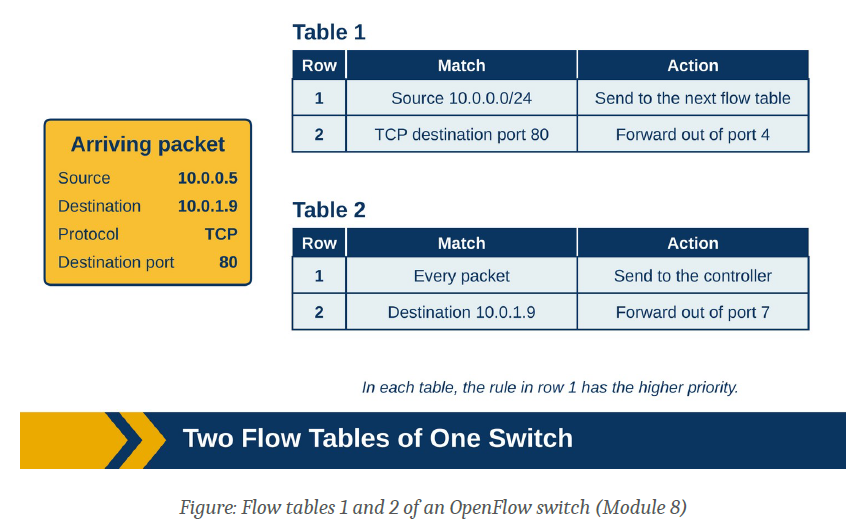
Consider an OpenFlow switch with two flow tables in its pipeline. A TCP packet arrives with source address 10.0.0.5, destination address 10.0.1.9 and destination port 80.
Table 1 contains two rules. The rule in row 1 matches source addresses in 10.0.0.0/24, and its action sends the packet to the next flow table. The rule in row 2 matches TCP destination port 80, and its action forwards the packet out of port 4.
Table 2 contains two rules. The rule in row 1 matches every packet, and its action sends the packet to the controller. The rule in row 2 matches destination address 10.0.1.9, and its action forwards the packet out of port 7.
In each flow table, the rule in row 1 has the higher priority.
What happens to the packet?
A. The packet leaves through port 4 only.
B. The packet leaves through port 7 only.
C. The packet goes to the controller only.
D. The packet goes to the controller and to port 7.
The packet goes to the controller only.
In each table, the rule in row 1 has the higher priority. Table 1 sends the packet to table 2, and table 2 sends it to the controller.
Consider an enterprise network that replaces its border router and its firewall with one OpenFlow switch. The switch maintains one table of rules, and each rule has a priority. Telnet traffic uses TCP destination port 23. The enterprise's operator wants to block all Telnet traffic into the network, except the Telnet sessions of one administrator's host, 198.51.100.7. The administrator's Telnet sessions are meant to pass through a logging host on switch port 3. The operator installs the following three rules:
1. A high-priority rule matches TCP destination port 23. Its action drops the packet.
2. A medium-priority rule matches source address 198.51.100.7 and TCP destination port 23. Its action forwards the packet out of switch port 3.
3. A low-priority rule matches destination prefix 203.0.113.0/24. Its action forwards the packet out of switch port 2.
The administrator's host opens a Telnet session to server 203.0.113.20.
What happens to the first packet of this session?
A. The packet leaves through switch port 3.
B. The packet is dropped at the switch.
C. The packet leaves through switch port 2.
D. The packet goes to the controller.
The packet is dropped at the switch.
The packet matches all three rules, and the highest-priority rule, the drop rule, is the one applied.
An OpenFlow switch communicates with the controller and provides it with information through three mechanisms: packet-in messages, event-based messages and flow statistics.
Situation 1: A packet arrives from a new flow that the switch has no rule for, so the default rule sends it to the controller.
Situation 2: A QoS application needs the traffic volume of each flow on a link, once a minute.
In each situation, which mechanism does the switch use to communicate with the controller and provide it with information?
A. A packet-in for situation 1, and flow statistics for situation 2
B. An event-based message for situation 1, and flow statistics for situation 2
C. A packet-in for situation 1, and one packet-in per packet for situation 2
D. Flow statistics for situation 1, and event-based messages for situation 2
A. A packet-in for situation 1, and flow statistics for situation 2
A packet whose matching rule sends it to the controller travels as a packet-in. Per-flow volumes come from flow entry counters, reported as flow statistics. Event-based messages report port changes.
Consider an Open Network Operating System (ONOS) cluster of three instances that controls five switches. Each instance is the master for a group of the switches. The network then grows to fifty switches, and the control load exceeds what three instances can handle.
How does ONOS handle the higher load?
A. The busiest switches get a second master, and the two masters split their work.
B. ONOS adds instances to the cluster and spreads the switches over more masters.
C. Each instance moves to a larger server and retains the same group of switches.
D. ZooKeeper takes over some of the switches and writes their rules on their behalf.
ONOS adds instances to the cluster and spreads the switches over more masters.
ONOS scales out: new instances join the cluster, and the switches are spread over more masters, with one master per switch. ZooKeeper tracks which instance is the master of each switch, and it writes no rules.
Consider an Open Network Operating System (ONOS) cluster of three instances that controls five switches. Each switch is connected to all three instances, and one of them is its master. One instance fails. It was the master for two of the switches.
What happens to those two switches?
A. The switches run their own control logic until an operator restarts the instance.
B. The switches wait without a master until the failed instance is restarted.
C. For each switch, a consensus election picks a new master from the running instances.
D. Each switch then accepts rules from both running instances, and no new master is chosen.
For each switch, a consensus election picks a new master from the running instances.
A consensus election picks a new master for each orphaned switch from the running instances it is already connected to.
Consider an Open Network Operating System (ONOS) cluster that controls a network of switches. An application needs a connection between host A and host B. The application requests this connection through the ONOS intent framework.
The application computes the path from host A to host B and provides ONOS with the forwarding rules for each switch on that path.
True
False
False
Under the intent framework, the application states what it wants, and ONOS chooses the path and the rules.
OpenFlow 1.0 matched packets on 12 header fields. Less than four years later, OpenFlow 1.4 matched on 41 header fields.
Which problem with the growing number of header fields led to P4?
A. Each added field slows the lookup, so the switches can no longer forward at line rate.
B. Each vendor added its own fields, so the interface stopped being vendor-agnostic.
C. Each version dropped older fields, so rules written for earlier versions broke.
D. Each new encapsulation needs more fields, so each one forces a new version.
Each new encapsulation needs more fields, so each one forces a new version.
Each new encapsulation needed new header fields and a new OpenFlow version. P4 replaces this cycle of new versions with programmable parsing and matching.
In an SDN network, P4 and OpenFlow are both used between the controller and the switches.
How are the two related?
A. P4 configures the parser and tables; OpenFlow-style APIs populate them with rules.
B. P4 replaces OpenFlow as the southbound API, since a P4 program also contains the rules.
C. P4 is a routing protocol, like BGP, that runs in the control plane above OpenFlow.
D. OpenFlow configures the parser and tables; P4 populates them with rules.
P4 configures the parser and tables; OpenFlow-style APIs populate them with rules.
P4 configures the parser and tables. APIs such as OpenFlow then populate those tables with rules.
A P4 program for an SDN network runs correctly on a software switch in a test lab. The network's operator then wants to run the same program, without rewriting it, on hardware switches from two different vendors.
Which property of P4 allows this, and how?
A. Protocol independence: the program defines its own parser, so it fits any switch.
B. Target independence: a compiler maps the program onto each vendor's switch.
C. Reconfigurability: the controller changes how each switch parses packets
D. Disaggregation: an open interface lets each vendor supply its own controller.
Target independence: a compiler maps the program onto each vendor's switch.
Target independence: a compiler maps one P4 program onto each device. Protocol independence concerns which headers the program defines.
The switches of an SDN network must handle a new tunnel header and forward packets based on the tunnel ID inside it. The network's operator writes one P4 program for this.
This one program defines both the parser that extracts the tunnel ID and the match+action table that forwards on it.
True
False
True
A P4 program defines the parser, which extracts header fields, and the match+action tables that act on them. Populate operations then fill the table with entries.
Consider a network of P4 switches controlled by an SDN controller. The network's operator wants the switches to forward packets according to a field in a new protocol header. The switches do not support this protocol yet.
Which sequence of operations lets the switches forward packets based on that field?
A. Populate operations only, which add entries to the tables already set up
B. A configure operation first, then populate operations that add entries
C. A configure operation only, since the parser decides each packet's output port
D. Populate operations first, then a configure operation for the parser
A configure operation first, then populate operations that add entries
A configure operation must first set up the parser and a stage for the new field. Populate operations then add the entries that match on it.
A network replaces its P4 switches with OpenFlow switches. On each P4 switch, two match+action tables run in parallel. One table matches the source IP address, and the other matches the TCP destination port. Neither table depends on the result of the other. OpenFlow supports both match fields, and the controller installs both tables on each OpenFlow switch.
The OpenFlow switches still apply the two tables in parallel.
True
False
False
OpenFlow chains tables only in series, so the lookups run one after the other.
A routing application on an SDN controller computes a path from host A to host B.
How does the application get the path installed on the switches?
A. It instructs the controller, which installs the rules on the switches along the path.
B. It connects to each switch on the path and writes the forwarding rules itself.
C. It is compiled into the switches' hardware, where it computes the path per packet.
D. It sends a packet along the path, and each switch learns the route from that packet.
It instructs the controller, which installs the rules on the switches along the path.
Applications do not talk to switches. The application instructs the controller, which installs the rules.

Consider a Software Defined Internet Exchange Point (SDX) at which three ASes, AS A, AS B and AS C, exchange traffic. The SDX provides each participant AS with its own virtual SDN switch. The virtual switch connects the border router of the AS to every other participant.
Why is this abstraction useful?
A. Each AS runs its own controller, which installs the AS's rules on the fabric directly.
B. Each AS writes its own policies as if it were alone, and the SDX combines them.
C. Each AS gets a fixed share of the fabric's capacity, which protects it from congestion.
D. Each AS can change how the other participants forward traffic on their own switches.
Each AS writes its own policies as if it were alone, and the SDX combines them.
Each AS writes policies as if it were the only participant, and the SDX combines them into one switch policy.

Consider a Software Defined Internet Exchange Point (SDX) at which AS A, AS B and AS C exchange traffic. AS A writes this outbound policy in Pyretic:
(match(dstport = 80) >> fwd(B)) + (match(dstport = 443) >> fwd(C))
A packet from AS A has destination port 22. Consider this policy on its own. Ignore the SDX default that sends unmatched traffic along the BGP-selected route.
What does the policy do with this packet?
A. It forwards the packet to B, since the sub-policy for B comes first.
B. It sends one copy to B and one to C, since + sends it to both.
C. It drops the packet, since neither sub-policy matches port 22.
D. It sends the packet to the controller as a packet-in for a decision.
It drops the packet, since neither sub-policy matches port 22.
The + operator returns only what each sub-policy matches. Neither matches port 22, so the output is empty and the packet is dropped.
At a Software Defined Internet Exchange Point (SDX), AS A writes an outbound policy that sends its port 80 traffic to AS B. AS D writes an outbound policy that sends its port 80 traffic to AS E.
How does the SDX handle the two policies?
A. It drops the port 80 traffic of A and D until the two ASes resolve the conflict through BGP.
B. It installs whichever policy arrived first and rejects the other as a conflict.
C. It hands the port 80 traffic of A and D to the route server, which picks a path.
D. It combines the two into one switch policy, and each covers only the traffic of its AS.
It combines the two into one switch policy, and each covers only the traffic of its AS.
An outbound policy covers only its own AS's traffic, so the two never conflict and the SDX combines them.
Consider a Software Defined Internet Exchange Point (SDX). At the SDX, a participant's policy can send traffic to a neighbor AS that never advertised a route for that traffic.
True
False
False
The SDX applies a policy only to traffic for which the chosen next-hop AS has advertised a route.
Consider a Software Defined Internet Exchange Point (SDX) at which AS A, AS B and AS C exchange traffic. The following facts hold:
1. AS C has advertised a BGP route for the prefix 10.1.0.0/16.
2. AS A writes an outbound policy at the SDX: send its traffic for TCP port 443 to AS C.
3. A host in AS A sends traffic to TCP port 443 on a server at 10.1.2.3, an address inside 10.1.0.0/16.
The SDX forwards this traffic to AS C.
True
False
True
An SDX applies a policy only to traffic for which the chosen next-hop AS has advertised a route. AS C advertised 10.1.0.0/16, so the policy applies and the traffic goes to AS C.
A large ISP wants its web traffic to pass through a firewall and then a load balancer. Today the ISP steers traffic to a fixed set of middleboxes by manipulating internal BGP. The ISP also connects to a Software Defined Internet Exchange Point (SDX).
What does the SDX offer instead?
A. It matches exactly the desired traffic and sends it through the chosen middleboxes in order.
B. It adds middleboxes at each of the ISP's edge sites, so traffic is not redirected.
C. It sends web traffic through both middleboxes in parallel, so their order no longer matters.
D. It redirects the traffic of whole destination prefixes through the chosen middleboxes.
It matches exactly the desired traffic and sends it through the chosen middleboxes in order.
An SDX matches exactly the traffic wanted and steers it through a chosen sequence of middleboxes. Internal BGP moves whole prefixes.
A web service runs on servers at several locations. Client traffic for the service enters through a Software Defined Internet Exchange Point (SDX). The service wants the SDX to balance the load across its servers.
To do this, the SDX relies on the service's DNS server to return a different server address to each client.
True
False
False
The SDX gives the service one anycast address and rewrites each packet's destination to the chosen server at the exchange. DNS caching therefore cannot leave clients on a stale or failed server.
AS B connects to a Software Defined Internet Exchange Point (SDX) through two ports, B1 and B2. AS B wants to choose which port each flow of incoming traffic uses. It installs forwarding rules at the SDX to do this.
These rules can match only the destination IP address of each packet, as BGP does.
True
False
False
An SDX rule can also match the source IP address and source port, so AS B picks the entry port directly. BGP routes only on the destination address.