Chapter 16 - Proteins
 Call Kai
 Learn
 Practice Test
 Spaced Repetition
 Match
 Flashcards
 Knowt Play
1/112

There's no tags or description
Looks like no tags are added yet.
113 Terms
Proteins are biomolecules that contain many _____ bonds, formed by joining _______ _______
amide, amino acids
Proteins account for __% of the dry weight of the human body
50
How are proteins different from lipids and carbohydrates?
proteins are not stored, so they must be consumed daily
What is the current recommended daily intake of protein for adults?
0.8 grams of protein per kg of body weight
What is the function of hemoglobin?
transport protein that carries oxygen in the blood
What kind of protein are collagen and keratin?
fibrous
What is the backbone of an amino acid made up of?
an amino group (NH2), a carboxyl group (COOH), and a hydrogen.
pKa of the amino group
9
pKa of the carboxyl group
2
Which carbon is the amino group attached to?
alpha carbon
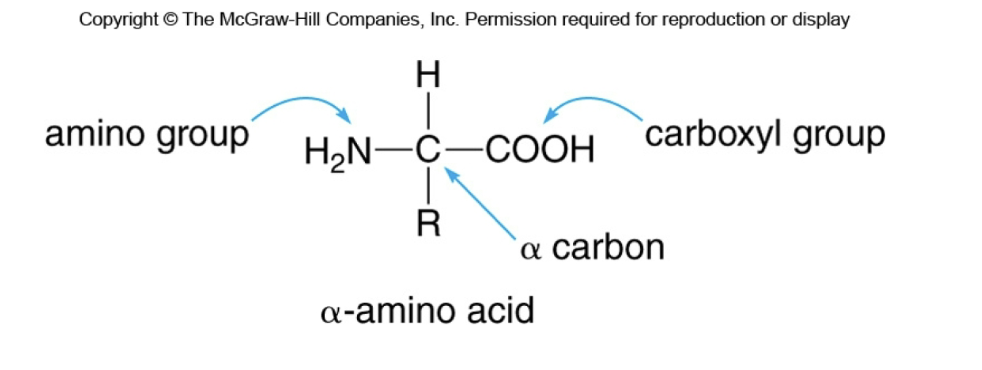
What is the R group?
the residue, also called the side chain
What determines the identity of the amino acid?
the R group
What is the simplest amino acid? Why?
glycine because it’s R-group is a hydrogen
How many amino acids are there?
20
How many out of the 20 amino acids can be synthesized by humans?
10 can be made by humans, 10 have to be consumed through diet
Which amino acids are non-polar and neutral (use your study guide, without any labels.)
glycine, alanine, valine, leucine, isoleucine, proline, phenylalanine, methionine
Which amino acids are polar and neutral (use your study guide, without any labels.)
serine, threonine, asparagine, glutamine, and cysteins
How would you classify tyrosine?
neutral. it can be polar because of the -OH group or non-polar because of the carbon ring.
What are the acidic amino acids?
Aspartic acid and glutamic acid
What are the basic amino acids?
arginine, histidine, and lysine
What charge do the basic and acidic amino acids have (at physiological pH ~7.4)?
basic have a positive charge, and acidic have a negative charge
What is a zwitterion?
when the total net charge is 0
When are the amino acids zwitterions?
when the amino group is protonated (+ charge) and the carboxyl group is deprotonated (- charge), and the R group has 0 charge.
What is chirality?
a carbon atom is attached to 4 different molecules
What is the only amino acid that is not chiral? Why?
glycine because the alpha carbon is attached to 2 hydrogens

L amino acids vs D amino acids
• L amino acids have the –NH3+ group on the left.
• D amino acids have the –NH3+ group on the right.
What is pI?
the pH at which the amino acid exists as a zwitterion
Draw the amino acid serine (R = CH2OH) at pH 1, 7, and 14
look at ur notes for the answer 😋
Peptides and proteins are formed when amino acids are joined together by ____ bonds.
amide/peptide (they are both the same)
Polypeptide vs protein
polypeptide has less than 40 amino acids, protein has more than 40 amino acids
The amino acid with the free NH3+ group is the __-terminal amino acid and it is written on the _____
N, left

The amino acid with the free COO- group is the __-terminal amino acid and it is written on the _____
C, right

What are enephalins and what are their function?
pentapeptides made in the brain that act as pain killers and sedatives by binding to pain receptors
What also binds to the same receptors as enkephalins?
morphine and heroin, which produce a similar physiological response but for longer
Enkephalins are related to a group of polypeptides called _______
endorphins
What are endorphins known for?
their pain reducing and mood enhancing effects
_______ and _______ are cyclic peptide hormones
oxytocin and vasopressin
What is the difference between the sequences in oxytocin and vasopressin?
they have identical sequences, except for 2 amino acids

Oxytocin function
stimulates contraction of uterine muscles, signals milk production, and induces labor
What is vasopressin also known as?
antidiuretic hormone (ADH)
What is the function of ADH?
targets the kidneys and helps to limit urine production to keep body fluids up during dehydration
What are the 4 main types of protein structures?
primary, secondary, tertiary, and quatenary
What is the primary structure of a protein?
the linear sequence of amino acids joined together by peptide bonds.
How many degrees are all the bond angles in primary structure and what kind of appearance does it create?
120 degrees, zigag arrangement

What is secondary structure?
3-D arrangement of localized regions of a protein due to hydrogen bonding of the backbone
Between what atoms in the backbone does hydrogen bonding occur in secondary structure?
between the N—H group of one amide with the C═O group of another.
What are the 2 secondary structures?
alpha-helix and beta-pleated sheet
What does an alpha-helix look like?
spiral`

What does a beta-pleated sheet look like?
two parts of the peptide chains, called strands, line up side by side

T/F: All proteins have either an alpha-helix or a beta-pleated sheet, and no other regions in their secondary structure.
False: most proteins also have regions that cannot be characterized
What is the tertiary structure?
The 3-D shape adopted bythe entire peptide chain
What kind of bonds occur in tertiary/quaternary structure?
non-polar side chains are stabilized by London dispersion forces
Polar functional groups can hydrogen bond to each other
Acidic/basic amino acids have charged side chains that are attracted by electrostatic interactions
Disulfide bonds form covalent bonds using cysteine residues
What is the main difference between secondary vs tertiary/quaternary?
Secondary only involved H-bonding of the backbone, while tertiary/quaternary mostly involve the different bonds that the residues can make with each other
What is the main difference between primary/secondary/tertiary vs quaternary
primary/secondary/tertiary consist of 1 peptide chain, quaternary is a combination of multiple peptide chains
What are 2 examples of proteins with quaternary structures?
insuline and hemoglobin
What is the structure of insulin
two separate polypeptide chains linked by intermolecular disulfide bonds.
What is the structure of hemoglobin
four subunits held together by intermolecular forces into a compact 3-D shape.
How are proteins generally classified?
according to their 3D shapes
What are fibrous proteins composed of?
long linear polypeptide chains that are bundled together to form rods or sheets
What is the main function of fibrous proteins?
structural roles
What is a globular protein?
proteins that are coiled into compact shapes and are water soluble
What is the main difference between fibrous and globular proteins?
Fibrous is insoluble in water, while globular proteins are soluble
Enzymes and transport proteins are ______
globular
alpha-Keratins and Collagen are ______ proteins
fibrous
Where is alpha-Keratins found?
in hair, hooves, nails, skin, and wool.
What are alpha-keratins composed of?
long sections of alpha-helix units, having large numbers of alanine and leucine.
What does collagen require?
3 chains in a superhelix
What helps stabilize the chains in collagen?
vitamin C
Hemoglobin and myoglobin are both _____ and _______ proteins
globular and conjugated
What is a conjugated protein?
they contain both a protein and non-protein component.
What is the non-protein unit of hemo/myoglobin?
a heme, which is an organic complex surrounding a Fe+2 ion.

What does Fe+2 ion bind to?
oxygen in the bloodstream
What happens once the heme binds the oxygen in hemoglobin vs myoglobin?
Hemoglobin transports oxygen to wherever it is needed in the body, while myoglobin stores oxygen in tissues
Myoglobin structure
153 amino acids in 1 polypeptide chain
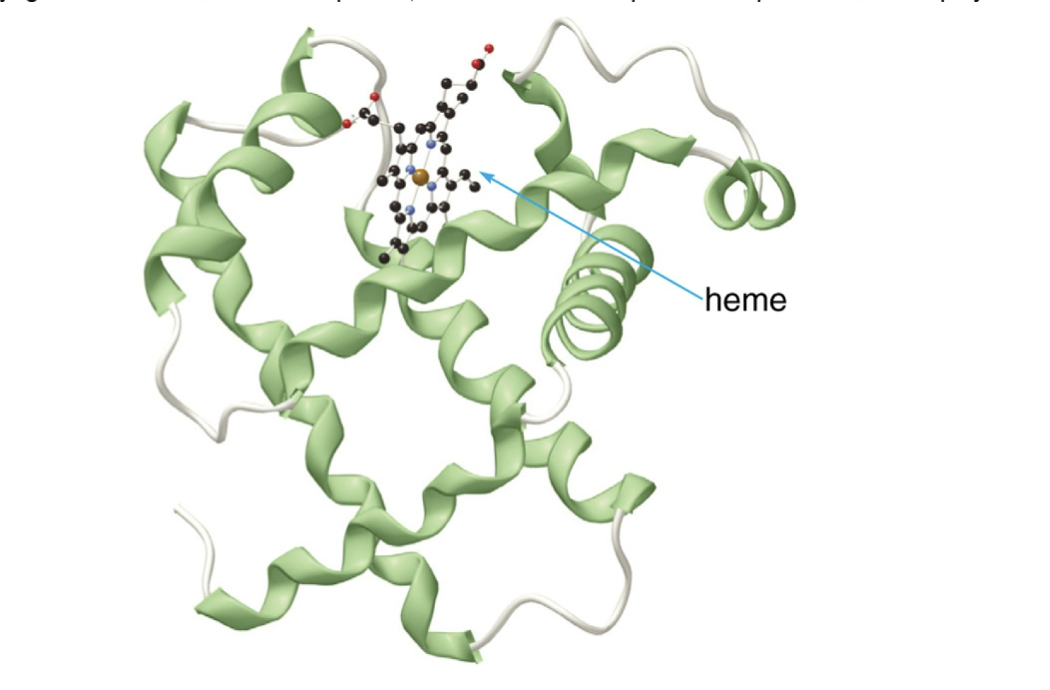
Hemoglobin structure
4 polypeptide chains. 2 are alpha chains and 2 are beta chains. Each unit has its own heme

How many hemes in hemoglobin vs myoglobin?
1 in myoglobin (1 subunit) and 4 in hemoglobin (4 subunits)
Why is carbon monoxide so poisonous?
because it binds 200x more strongly to the Fe+2 than oxygen, so hemoglobin will get filled with CO and cells will die from a lack of oxygen.
What is sickle cell anemia?
a disease where a single amino acid is different in two of the subunits
of hemoglobin.
What happens when red blood cells contain the mutated amino acids which occur when someone has sickle cell anemia?
the units become elongated and crescent/sickle shaped, which rupture capillaries, causing pain and inflammation, leading to organ damage and eventually a painful death
What is protein hydrolysis?
breaking the peptide bond
What are the 3 treatments that can be used to hydrolyze a protein?
aqueous acid, base, or certain enzymes.
Where is pepsin found and what is its function?
found in gastric juice, it cleaves some of the peptide bonds of large
proteins to make smaller peptide chains.
Where is trypsin and chemotrypsin found and what are their function?
the intestines, and their job is to hydrolyze the amide bonds of the remaining amino acids that didn’t get hydrolyzed by pepsin in the stomach
What is denaturation?
the process of altering the shape of a protein without breaking the amide bonds that form the primary structure
Which structure does denaturation disrupt?
secondary, tertiary, and quaternary
What can cause denaturation? How?
High temperature, acid, base, and agitation can disrupt the non-covalent interactions that hold a protein in a specific shape
What effect does denaturation have on globular proteins?
it makes them less water soluble
What is ovalbumin and how is it involved in cooking eggs?
the major protein in egg white.
It is denatured when an egg is cooked, changing from clear to white
Enzymes are _____ that serve as biological _____ for reactions in all living organisms.
proteins, catalysts
What do enzymes do?
they increase the rate of a reaction
T/F: enzymes are permanently changed after they increase the rate of a reaction
false - they remain unchanged.
Enzymes are ______
specific
What does it mean that enzymes are specific?
each enzyme catalyzes a certain reaction or type of reaction only
What suffix do most enzymes have?
“-ase” like peptidase, lipase, and hydrolase.
What is a cofactor?
a metal ion or an organic molecule needed for an enzyme-catalyzed reaction to occur.
What is an active site?
the place on the enzyme where the substrate forms to form the enzyme-substrate complex

What happens once the enzyme binds the substrate and then catalyzes the reaction?
the products are released, and the enzyme goes back to its original form so it can complete another reaction
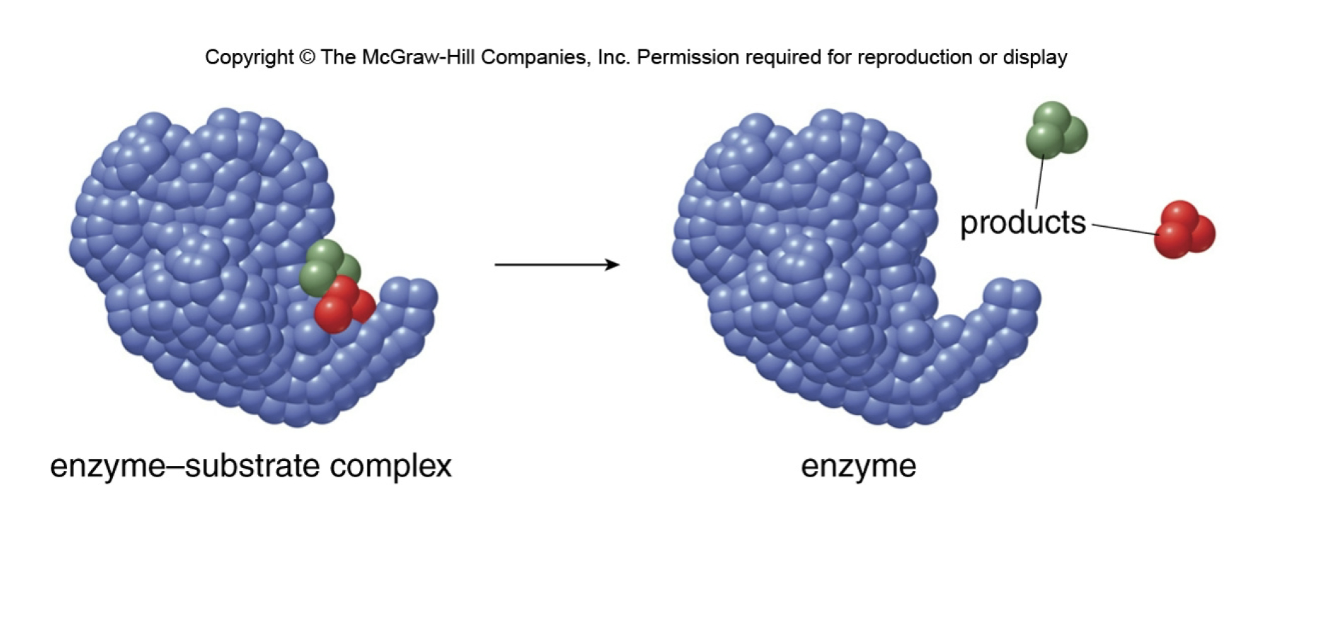
Which 2 models are used to explain the specificity of a substrate for an enzyme’s active site?
lock-and-key model and induced fit model
What does the lock-and-key model state?
that the active site is a rigid cavity; to react, the substrate must exactly match the shape of the active site.
What does the induced-fit model state?
the active site has a flexible shape, which can adjust to fit a variety of substrate shapes.