PSYCH 372 - Chapter 11: Alcoholism
 Call Kai
 Learn
 Practice Test
 Spaced Repetition
 Match
 Flashcards
 Knowt Play
1/25

Earn XP
Description and Tags
lectures form Dr. Kathleen Munley
26 Terms
What is alcoholism/alcohol-use disorder?
impaired ability to stop or control alcohol use despite adverse social, occupational, or health consequences
Lasting changes in the brain caused by alcohol misuse perpetuate AUD, increase vulnerability to relapse
Why is alcoholism difficult to study?
Complicated to study due to its multifarious nature (physiological and psychological components)
Cultural factors, developmental differences, gender effects
What are some stats/epidemiology of alcohol-use disorder?
Alcohol-use disorder is common
Affects 36% of men and 23% of women
Severe AUD affects 18% of men and 10% of women
What are some factors that increase risk of alcohol-use disorder?
Alcohol misuse
Drinking at an early age
Mental health conditions
History of trauma
Genetics and family history
What are some challenges of studying alcohol-use disorder?
Issues of diagnosis
Social consequences
Why is diagnosis a challenge of studying alcohol-use disorder?
Cultural variation in alcohol use
Uncommon or even banned in some countries
Involvement of human volition
Easy/difficult to say no to a drink depending on the person
Cultural stigma
How do social consequences make studying alcohol-use disorder difficult?
AUD often destroys relationships, making family studies difficult
How was a twin study of AUD done in Sweden?
Used Swedish “temperance board” records to obtain twin sample of alcoholism
Physicians, police, and prosecutors legally enjoined to report problems to temperance boards for investigation
Matched to Swedish twin registry
What were the findings of the Swedish twin study on AUD?
48% concordance for MZ twins and 33% for DZ twins
54% heritability estimate for AUD
Genes have a stronger influence than environmental effects

What are the two cross-generational environmental processes that contribute to AUD?
Direct transmission
Indirect transmission
How does direct transmission contribute to AUD?
Social learning - process by which a parent teaches their child a particular behavior or attitude
Child resembles parent due to watching their parent’s behavior
How does indirect transmission contribute to AUD?
Bad parent-child relationships - alcoholic parents are not good parents (pay attention to drinking, not children)
Results in their absence and conflict in the home
What were the findings on adoption studies for AUD?
Risk for AUD in adoptee was 46% higher if a biological parent had AUD and 40% higher if an adoptive parent had AUD
2015 study
What were the findings of a triparental family study of AUD?
Both parental genes and rearing influence offspring risk, and in this study, genes were more important than rearing
What is different about AUD that we don’t see in other psychiatric disorders?
There are good physiological candidate genes for alcohol dependence
What is the physiological explanation that affects risk for AUD?
Differences in how ethanol is metabolized
How is ethanol metabolized?
2 steps:
Conversion of ethanol to acetaldehyde by alcohol dehydrogenases (ADH)
Conversion of acetaldehyde to acetic acid (vinegar) by acetaldehyde dehydrogenases (ALDH)
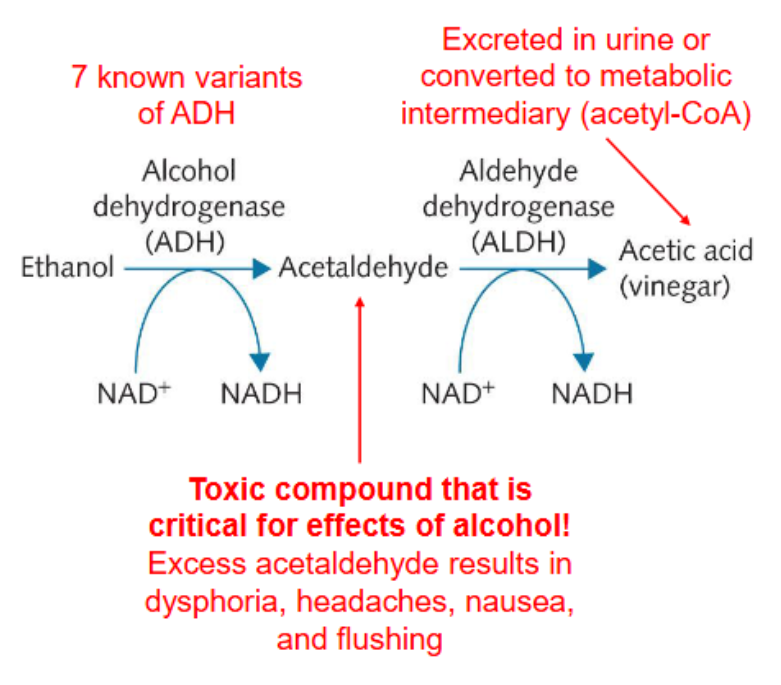
How does ethanol metabolism differ in individuals at greater risk for AUD?
Higher levels of acetaldehyde, can arise in two ways:
Higher ADH activity (produces acetaldehyde too quickly)
Lower ALDH activity (metabolize acetaldehyde too slowly)
How does alcohol affect young animals/humans?
Low alcohol elimination rates because ADH is not yet fully expressed
Increases risk of coma and respiratory problems
What causes “Asian flush”?
In East Asian populations, a substantial portion of people have a form of the ALDH2 enzyme that barely works at all
Individuals with this ALDH2 variant are unlikely to develop AUD
What was the 2014 alcohol dependence GWAS?
Tested >16000 individuals from European-American and African-American populations
Alcohol dependence is an older diagnosis roughly equivalent to severe AUD
What were the notable findings of the 2014 alcohol dependence GWAS?
Genome-wide significant loci in ADH gene complex on chromosome 4
Different variants in ADH gene complex found in European-Americans and African-Americans

What was the 2017 AUD and drinking status GWAS?
Examined drinker/non-drinker status and regular quantity of alcoholic drinks/week in 86,000 individuals of mixed ancestry
What were the notable findings of the 2017 AUD and drinking status GWAS?
Strongest genetic association at ALDH2 variant (found in East Asian populations)
Additional genome-wide significant association at ADH1B variant (present in non-Hispanic and Hispanic subjects)

Do genetic variants that impact alcohol consumption also impact risk for AUD?
The correlation is not perfect
What are some important considerations when it comes to studying AUD?
Asking about current drinking habits does a poor job of assessing AUD
Some people who consume large amounts of alcohol for years never experience major adverse social, medical, or legal problems
In general population samples, most differences in amount of alcohol consumed are between people who drink very little vs. those who drink moderately