Instruments of the Orchestra
 Call Kai
 Learn
 Practice Test
 Spaced Repetition
 Match
 Flashcards
 Knowt Play
1/38

There's no tags or description
Looks like no tags are added yet.
39 Terms
What are the four categories of instruments in an orchestra
1) Strings
2) Woodwinds
3) Bras
4) Percussion
Instrument Classifications- Wind Instruments
Aerophones:Instruments that make sound by way of a vibrating column of air.
Instrument Classification — String Instruments
Chordaphones: Instruments that make sound by way of vibrating
Instrument Classification — Percussion
Objects that are struck
Membranophones: membrane (skin) is stretched over a hollow object, like most drums, and is struck
Idiophones: the entire object vibrates
Classical Music Definition
Classical music is a broad tradition of Western music that emphasizes formal composition, technical skill, and expressive depth, with roots in the liturgical and secular traditions of Europe. It is the art music of the Western world, considered distinct from Western folk and popular music, and sometimes called “art music” or “serious music.” It is often marked by formality and complexity in its structure and harmonic organization, and its earliest surviving manuscripts date from the Carolingian Empire (800-887), when plainchant was unified into Gregorian chant. In the narrow sense, “Classical” refers to the late 18th century, when Haydn, Mozart, Gluck, and the young Beethoven refined a style built on simplicity and clarity of form, melody-led texture, and standardized orchestras and chamber groups. The label is not fully precise: it is sometimes applied to non-Western art music with similarly long-lasting and complex traditions, such as Indian classical music, and scholars note that even “written tradition” doesn’t cleanly separate it from other music.
Classical Music Stylistic Periods/ Musical Eras
Medieval:500-1450
Renaissance: 1450-1600 (instrumental consorts)
Baroque: 1600-1750 (The formation of the orchestra)
Classical: 1750-1820 (The classical Orchestra takes form)
Romantic: 1810-1900 (expansion of the orchestra)
20th Century (Modern Era) (Many new approaches to the orchestra)
The Symphony Orchestra
The symphone (also called an orchestra, or a philharmonic) had its beginnings in the late renaissance and Baroque Eras. It was not until the Classical Era that the ensemble became more standardized.
The standard orchestra of today is comprised of the following four sections, or families
strings
woodwinds
brass
percussion
auxiliary: Piano harpsichord celest, harp, organ
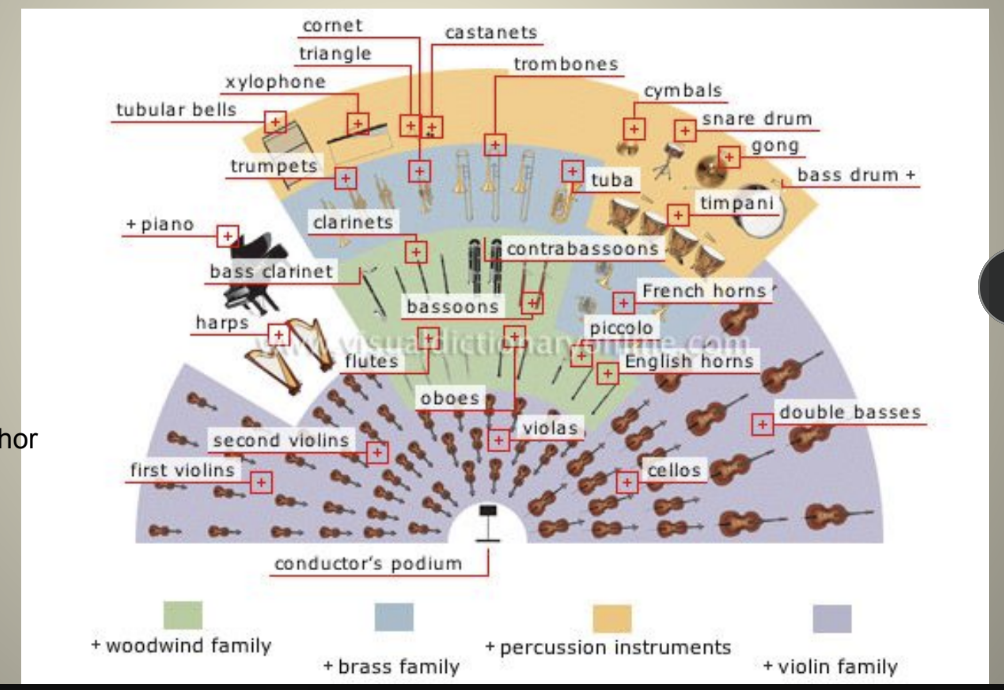

Wind Instruments- Woodwinds
Woodwinds
The woodwinds typically sit just behind the strings in the orchestra
In the picture (in order)
Bassoon
Clarinet
Saxophone
English Horn
Oboe
Flute

Wind Instruments, Brass
The brass Instruments sit behind the Woodwinds
(in order) The French Horn,
Trumpet
Trombone
Tuba
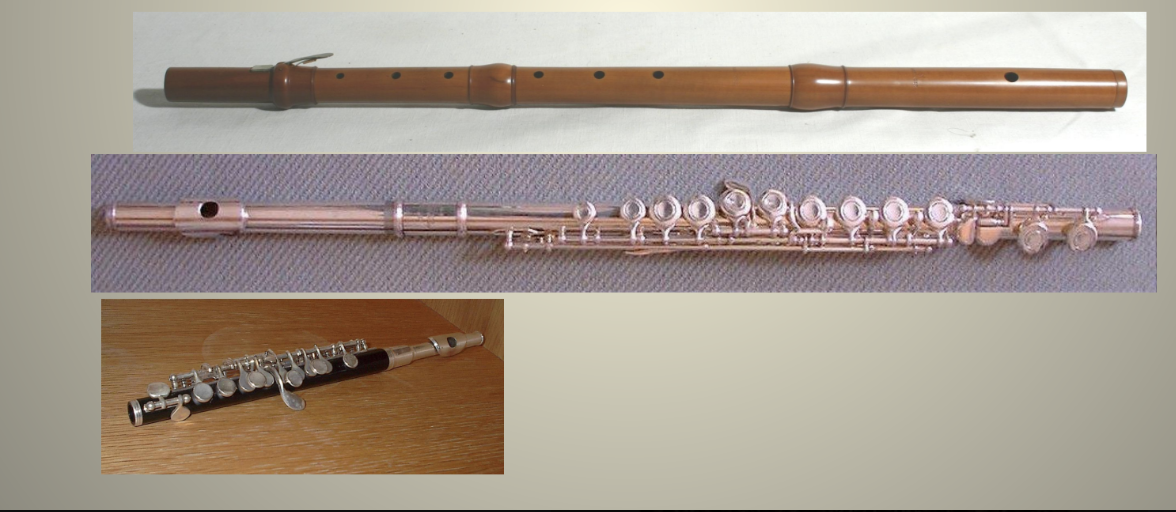
More Woodwinds
The Flute and Piccolo (or Piccolo-flute) are part of the woodwind family. Originally flutes were made out of wood; they are now commonly made of silver. The piccolo is still frequently made from wood, as in the picture.
In order
Baroque Flute
Modern Flute
Piccolo

What woodwind is this?
Recorders
Like the flute but played in front instead of to the side
In German this is called a blockflote. The recorder is made out of a variety of woods.
More Woodwinds Double-Reed Instruments
The double-reed instruments are the Oboe, English Horn, and the Bassoon (The reeds are made by lashing two pieces of cane (reed) together and shaving the cane thin enough to vibrate when blown into. The double-reed instruments have a rich, complex and sometimes raspy timbre. To play these instruments, the reed is placed in the player’s mouth (The bagpipes also use a double-reed that is placed inside of the lead-pipe—the bagpipe player must activate the reed inside the pipe).

Which instrument is this?
The oboe is the highest of the double-reed woodwinds. It is made of grenadilla, a dark African wood. Its tone can be seductively beautiful, or it can be piercing when called upon to play in its highest register.

Which instrument is this?
The English Horn is very similar to the oboe except that it is slightly larger and the bell is shaped differently. The English Horn is pitched 5 steps (a perfect fifth) lower than the oboe and has a huskier tone.


Which Instrument is this?
Bassoon
• Bassoon is a double reed instrument just like the Oboe and English Horn.
• The bassoon has a deep, rich tone with a woody quality

What are woodwinds
• Single Reed Instruments
– Clarinet
– Saxophone

Which instrument is this?
• The clarinet is a single reed instrument with a distinctly pure tone—its timbre is simple in comparison to the double reed instruments like the oboe
• The most familiar clarinets are the Bb and A clarinets, but many times composers also call for a Piccolo Clarinet, an Eb Clarinet or a Bass Clarinet

The Clarinet Family
• Here are a few of the clarinets in the clarinet family:
Bass Clarinet: the two largest clarinets in the photo are bass clarinets
Basset Horn: (the third from left-no mouthpiece in the photo) This instrument is slightly lower than the standard Bb and A clarinets
A Clarinet
Bb Clarinet
Eb Clarinet

Which instrument is this?
Saxophone
• Single reed instrument, like the clarinet. Comes in
various sizes:
Soprano
Alto
Tenor
Baritone

Brass Instruments
Natural Brass Instruments
The “natural” instruments were the predecessors to the modern valved brass instruments.
Trumpet
Bugle
Horn
Modern Brass Instruments
Instruments with a Slide
- Trombone Family
• Instruments with Valves
– Trumpet, Flugelhorn, Cornet
– French Horn
– Tuba


Which instrument is this?
Trumpet
• The trumpet is ideal for bright fanfares, and comes in various sizes. The trumpet to the left is a piccolo trumpet that can play very high.

Which instrument is this?
French Horn
The horn, often informally and inaccurately referred to as the French horn, is a German-descended brass instrument featuring 12–13 feet of coiled tubing ending in a flared bell. While historically played without valves as a natural horn, modern horns use left-hand-operated rotary or piston valves to redirect air into extra tubing and adjust pitch. Despite the International Horn Society's 1971 recommendation to simply call it the horn, "French horn" remains its most popular name in the United States.
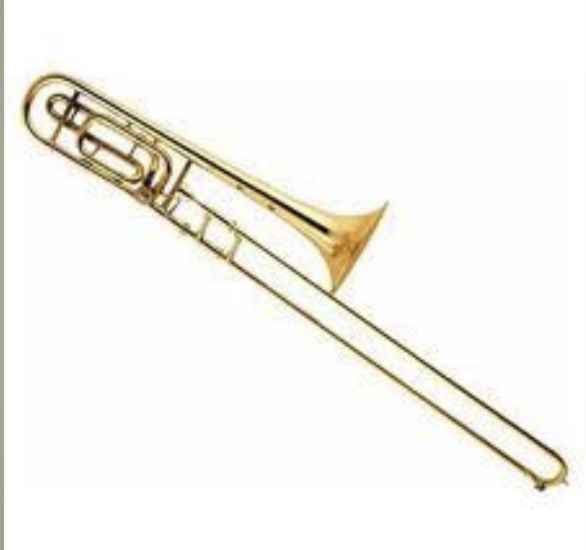
Which instrument is this?
Trombone
The trombone has a rich deep sound and can be very powerful. It changes pitches by use of a slide to change the length of the vibrating column of air.

Which instrument is this?
Tuba
The biggest and lowest pitched instrument of the brass family. This a valved instrument.
String Family/ Violin Family
The Violin Family produces its sound by drawing a bow across the strings. The violin (smallest) and the viola (little larger & lower in pitch than the violin) are held under the chin to play. The cello has a lower range is held between the knees. The Bass is the largest and lowest of the family and is played standing up


String Family, which instrument is this?
Violin
• In an orchestra, there are two groups of violins: the first violin and the second violins. They are the same instruments but the first violin generally play higher pitches and usually carry the melody. The second violins generally play a little lower in pitch and often accompany the melody.
Which instrument is this?
Viola
A little larger & a little lower in pitch than the violin. They usually provide an inner voice to the string section—acting as accompaniment and harmonic support.

Which instrument is this?
Violoncello (Cello)
• The cello is the BEST INSTRUMENT!!! (Warning: do not forget this)
• The cello is the tenor voice of the string family, but it also has the capability to play very high and down into the bass range, making it very versitile. Its rich, beautiful tone makes it a especially appealing as a solo instrument. In the orchestra it helps establish the

Which instrument is this?
Double Bass
(aka: Contrabass, String Bass, Bass Viol)
Lowest member of the string family. The size of the instrument requires the player to stand or sit on a high stool.
• The following is a performance of The Bottesinni Bass Concerto

Which instrument is this?
Harp
• The harp pictured here is a modern concert harp or pedal harp. The pedals adjust the pitches of the strings so that it is possible to change keys. (see Wikipedia link for a more complete explanation)

Percussion
There are literally thousands of instruments that fall into the percussion category:
instruments that are struck, rubbed shaken, etc.
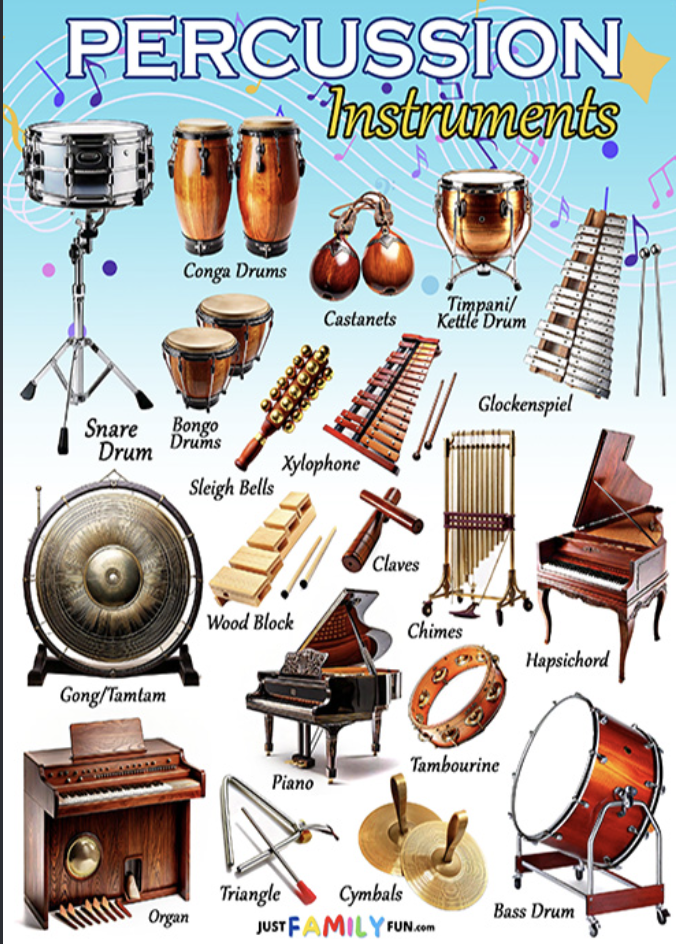
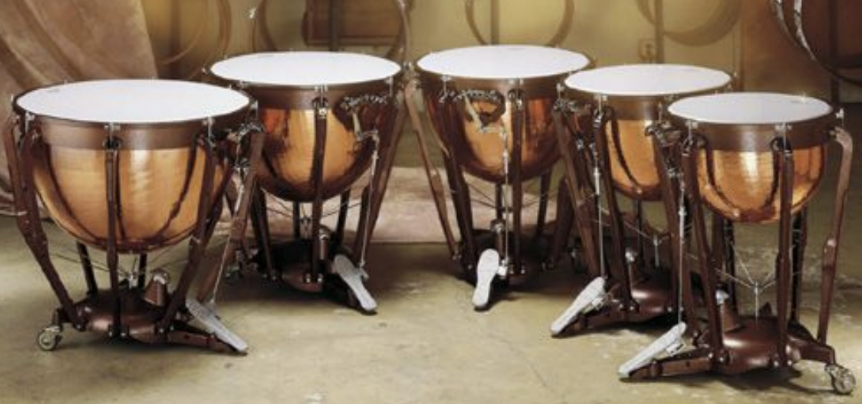
Which instrument is this?
Timpani
Pitched Membranophone
• The Timpani, also sometimes called Kettledrums, are pitched membranophons. This is one of the most important percussion instruments of the orchestra. The timpani are tuned and serve a vital role in the orchestra by reinforcing the bass line and providing rhythmic emphasis. The the drum heads are tightened and loosened to obtain the desired pitch by use of foot pedals. There are typically four or five different size drums used for orchestra. During the Romantic era, composers sometimes increased the number of timpani to 8 or 10 drums.

Percussion Pitched Idiophone: Which instrument is this?
Glockenspiel (bells)
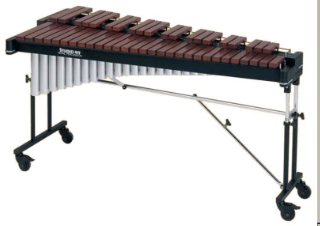
Percussion Pitched Idiophone: Which instrument is this?
Xylophone
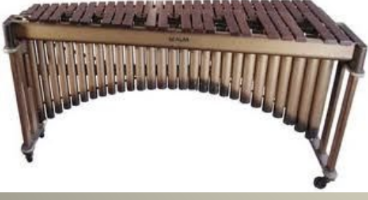
Percussion Pitched Idiophone: Which instrument is this?
Marimba

Percussion Pitched Idiophone: Which instrument is this?
Tube Bells (Chimes)

Keyboard Instrument: Which instrument is this?
Harpsichord: Plucks the strings when keys are pressed down. In use and popular during the late Renaissance and the Baroque period. Its use continued into the Classical period (18th c.) but lost favor to the Piano. It is used today primarily when music form the 16-18c is performed.

Keyboard Instrument: Which instrument is this?
The Organ
The organ produces sound by pushing pressurized air through a series of pipes, each tuned to a specific pitch and tone quality. When a player presses a key on the keyboard (or pedalboard), a mechanical, pneumatic, or electronic signal opens a valve beneath the corresponding pipe, allowing air from a wind chest to rush through and create sound. Organs use multiple sets of pipes, called stops, which the organist can combine to change the instrument's overall volume and sound texture.


Keyboard Instrument: Which instrument is this?
The Piano
The piano is a popular keyboard instrument that produces sound when keys are pressed, triggering felt-covered hammers to strike metal strings inside the instrument. The vibrations of these strings resonate through a wooden soundboard, creating a rich, versatile tone. It can play both soft (piano) and loud (forte) dynamics depending on how hard the keys are struck, allowing a single performer to play intricate melodies, complex harmonies, and rhythm simultaneously. The earliest pianos were developed around 1700 in Italy. The original name was “fortepiano”