wsf IB memorization
 Call Kai
 Learn
Learn Practice Test
 Spaced Repetition
 Match
Match Flashcards
 Knowt Play
1/188

There's no tags or description
Looks like no tags are added yet.
Name | Mastery | Learn | Test | Matching | Spaced | Call with Kai | Chat |
|---|
No analytics yet
Send a link to your students to track their progress
189 Terms
4 parts of investment banks
investment banking, sales and trading, equity reserach, mergers and acquistions
Walk me through the 3 financial statements
“The three financial statements are the Income Statement, Cash Flow Statement, and Balance Sheet.
The Income Statement shows a company’s profitability over a period, ending in net income.
The Cash Flow Statement starts with net income and adjusts for non-cash items and changes in working capital to show actual cash generated.
The Balance Sheet is a snapshot at a point in time showing assets, liabilities, and equity, where assets equal liabilities plus equity.”
How do the 3 statements link together?
Net income from the Income Statement flows into the Cash Flow Statement as the starting point.
After adjusting for non-cash items and working capital, we get the change in cash.
That change in cash flows to the Balance Sheet, updating the cash balance.
Additionally, net income flows into retained earnings on the Balance Sheet, so everything stays connected.”
what is ebitda
What is EBITDA?
“EBITDA stands for Earnings Before Interest, Taxes, Depreciation, and Amortization.
It’s a proxy for a company’s core operating performance because it excludes capital structure, taxes, and non-cash expenses.
It’s commonly used to compare companies across industries and in valuation multiples like EV/EBITDA.”
Enterprise Value vs. Equity Value
“Equity Value represents the value attributable to shareholders, essentially market capitalization.
Enterprise Value represents the value of the entire business, including debt holders and other stakeholders.
The key formula is Enterprise Value equals Equity Value plus Debt minus Cash, since cash is considered non-operating.”
What are the main valuation methods?
“The three main valuation methods are Comparable Company Analysis, Precedent Transactions, and Discounted Cash Flow analysis.
Comps value a company based on how similar public companies are trading.
Precedents look at prices paid in past acquisitions.
DCF values a company based on the present value of its projected future cash flows.”
What is a DCF?
“A DCF, or Discounted Cash Flow analysis, involves projecting a company’s free cash flows into the future and discounting them back to present value using a discount rate, typically the weighted average cost of capital.
You also calculate a terminal value to capture value beyond the projection period.
Adding those together gives you the company’s enterprise value.”
What is working capital?
Working capital is current assets minus current liabilities.
It measures a company’s short-term liquidity and operational efficiency.
In finance, we often focus on operating working capital, excluding cash and debt, because it reflects day-to-day business operations.”
How does $10 of depreciation affect the statements?
“On the Income Statement, depreciation reduces EBIT by $10, which lowers net income.
On the Cash Flow Statement, net income is lower, but we add back the $10 depreciation since it’s non-cash, so cash is only impacted by the tax effect.
On the Balance Sheet, PP&E decreases by $10, cash increases slightly from the tax savings, and retained earnings decrease due to lower net income, keeping everything balanced.”
What happens if inventory increases?
“If inventory increases, the company is spending cash to purchase more inventory.
So on the Cash Flow Statement, it shows up as a cash outflow in working capital.
On the Balance Sheet, inventory goes up and cash goes down by the same amount.”
Why might two similar companies have different valuations?
“Even if two companies look similar, their valuations can differ due to differences in growth expectations, risk, profitability, and capital structure.
Qualitative factors like management quality, competitive positioning, and market sentiment can also play a role.
Ultimately, valuation reflects future expectations, not just current performance.”
Walk me through a DCF.
Project free cash flows, discount them back at WACC, then add the terminal value (using Gordon Growth or exit multiple) to get enterprise value. Subtract net debt to get equity value.
What are the 3 financial statements and how do they link?
Net income from the Income Statement flows into Retained Earnings on the Balance Sheet and is the starting point of the Cash Flow Statement. CapEx flows from the CFS to PP&E on the BS. Depreciation reduces both PP&E and net income.
Enterprise Value vs. Equity Value — what's the difference?
EV is the value of the entire business (debt + equity holders). Equity Value is just what's left for shareholders. EV = Equity Value + Debt + Preferred Stock + Minority Interest – Cash.
What are the main valuation methodologies?
The big three: DCF (intrinsic), Comparable Company Analysis (trading comps), and Precedent Transactions. A football field chart shows all three side by side.
Why is EBITDA useful?
It's a rough proxy for operating cash flow that strips out capital structure (interest), taxes, and non-cash charges — making it easier to compare companies across industries and capital structures.
If depreciation increases by $10, walk through the impact on all 3 statements.
. Assume a 30% tax rate: EBIT falls $10 → taxes fall $3 → net income falls $7. On the CFS, you add back the $10 non-cash charge, so operating cash flow is +$3. On the BS, PP&E is down $10, cash is up $3, and retained earnings is down $7 — it balances.
What is WACC and what goes into it?
Weighted Average Cost of Capital = the blended required return across debt and equity, weighted by their proportions in the capital structure. Components: cost of equity (via CAPM), after-tax cost of debt, and the weights of each.
. When would you use P/E vs. EV/EBITDA?
P/E is an equity-level multiple (affected by leverage and taxes) — useful for financials. EV/EBITDA is a firm-level multiple that's capital-structure neutral — more broadly applicable across industries.
What's the difference between a merger and an acquisition?
In a merger, two companies combine as equals into a new entity. In an acquisition, one company clearly buys and absorbs another. In practice, most deals are acquisitions even if called mergers for optics.
What makes a company a good LBO candidate?
Strong, stable free cash flows to service debt, low existing leverage, a defensible market position, tangible assets (good collateral), and ideally a clear exit path in 3–7 years (re-IPO or strategic sale).
what is LBO
An LBO, or Leveraged Buyout, is the acquisition of a company (often by private equity firms) using a significant amount of borrowed money (debt) to meet the purchase price, rather than using only equity.
what do investment bankers focus on
2 main types of transations
how do investment bankers get money
tehy get an advisory fee thats a small; part of the transaction value
two main types of transactions that IB focuses
capital raises and M&A
what is capital raises
equity deals and debt deals
raising capital/funds from external sources (such as investors) to finance businesses
equity - selling stocks and bonds to investors
debt - getting money through loans or liabilities
example of equity deals and debt deals
equity deals: IPOs, Bonds,
debt deals: bank debt
2nd transaction that IB focuses on and what the two sides are
the sell-side and buy-side.
what side of M&A do IB people prefer
the sell side, because it’s easier to get a share or money than being on the buy side becasue there could be multiple buyers but there’s typically only one seller
bank structure
product and coverage groups
what is a product group in the IB bank structure
focus on one type of “product”, like M&A group and Equity capital markets group, and then you serve multiple different clients focusing on that product
expertise in one type of transactions, lots of industires
what is the coverage group of the IB structure
focus on serving clients in ONE industry, and you do a variety of different transactions
get expertise in one industry and broad range of tranactions
client relationship is strong!
where are the best exit opportunities
the M&A side, harder to get out of equity capital markets
what does M&A consist of
a lot of financial modeling
do all banks have both product and coverage groups
no! coverage groups are more popular than product groups
hierarchy
analysts, associates (double checks the analysts), VP - nebulous, not sure what you’re actually doing a middle, Senior - reviewing everthing, managing director - has the relationship with the clients to bring revenue
5 ways that banks add value - good for why ib? question in interview
maximizing financial outcomes
process management
understanding market climate
connecting companies
industry/product knowldge
maximizing financial outcomes
creates extra value! sets up for companies for success
process managemnet
you get to handle the complex process of financial transactions. all that expert type of advice comes from YOU because companies dont really know how to sell themselves.
understanidng market climate
they understand the market so well at all times, they know the best times to sell or IPO. macroeconmic climate.
connecting compaines
they have relationships with all the top exectives of all the good companies, good connections
industry and product knowldge
lots of expertise, M&A banker will know all the transactions that would be best for the company
bulge brackte
larger banks with a array of services
elite boutique
smaller banks with M&A mainly
more intense and technical
middle market
same as bulge bracket but smaller deals, a few billion at max
small boutique
smaller companies, more limited
best bank for tech
qatalyst! only tech m&a deals
biggest bluge bracket
goldman scahs, JP morgan, morgan stanley
whats important to ask when working
ask why! bc you dont necessairly see the reuskt for a long time but things need to get done. otherwise its kind of isolating
superdays
a part of the interview process, where you get invertiewed by seevral higherups and u probably get hired - the last round?
3 things they look for
technical, personable and reliable everything
tell me about a recent deal that {bank} worked on
behavioral questions to help u think about how to answer

why ib - answer

what do investment bankers do?
Investment bankers act as financial intermediaries and advisors for corporations, institutions, and governments, helping them raise capital (via IPOs or bond issuance) and execute strategic transactions like mergers and acquisitions (M&A).
why is accounting important
language of finance, and 3 statements are used all; the time for modeling
3 statements in accounting
balance sheet (snapshot), statement of cash flow and income statement
GAAP
the generally accepeted accounting principals
textbook of rules of accounting
subsection of the GAAP
the securities and exchange commision
what they do: a watch dog of all the companies and firms in the US, making sure they act honestly and follow all the GAAP rules. Protecting investors and maintaining fairness
IFRS
the international financial reporting standards for the rest fo the world
income statement
income statement
over a period of time
revenues, profits, expenses
cash flow statement
over a period fo time
change in cash based on operational, investing and financing over a period of time
balance sheet
assest = L + SE
snapshot
income statement describes
how much a company earns, spends and profits
financial statement equation for net income
revenue - COGS - EXPENSES = net income
revenue - cogs =
gross profit
gross profit - operating expenses =
ebit (Earnings Before Interest and Taxes)
ebit - internest and taxes =
net income
top line vs bottom line
top line = revenue
bottom line = net income
income statement rules
1) must 100% correspond to the income statement’s PERIOD of time it covers
2) muyst affect the comapny’s taxes / net income
if an item goes to euity (dividents) or liabilities (debt repayment) what happens to the line
the item does NOT appear on the I/S
what must the thing be for it to be on the i/S
revenue, expense, gain or loss
if you see “revenue on the sheet then its the
income statement
accrual accounting vs cash accouning
accrual - record revenue when goods/services are provided, revenue is “earned” by that, or expesnes are “incurred” (doesnt necessarily mean that it’s being paied) - better for big picture
a straightforward method where revenue is recorded only when cash is received and expenses are recorded only when paid.
two aspects of accrual accounting
revenue recognition principle
matching principle

cash is…
king! only cash = cash
why do you adjust your net income with every line item
so you can see how much cash you’re actually making
why does the cash flow exist?
1) non-cash revenue or expenses (A/R, inventory, etc.)
2) inflows and outflows of cash that isnt on the income statement (debt - not an operating activity)
cash is the ___ measure of a company’s value
true!
WHICH STATEMENT IS USED TO MEARUE THE FINANCIAL HEALTH OF A COMPANY
the cash flow statement!!! - gives you a holistic view
cash flow statemnet def
financial sattement that reports the companys actual cash spent over a period of time
operating - doing services/giving goods
investing cash flow
financining cahs flow - getting funds through debt or dividents
whats in the operating cash flow
assets, liabilities
what’s in investing cash flow
assets
what’s in financing cash flow
liabilities, equity
how do you know if you’re looking at the cash flow statement
if NET INCOME is at the top
how do you know if you’re looking at the INCOME STATEMENT
if there’s revenue
amount of cash from operations, that number answers what question?
how much cash does the core business generate?
how do read operating activities on cash flow
net income - adjustments with non cash items - changes in operating working activties
what is involved with cash from operating acvitives (cash flow statement)
changes in assets and liabilities
what is involved with cash from investing activities (cash flow statement)
only changes in assets
what two things affect he cash from financing activities (cash flow statemnet)
changes in liabilities and equity
balance sheet
assets = liabilities + shareholders equity
3 things balance sheet desxribes
what a company owns, what it owes and what owners own
example of current asset
cash, short term investemnet, accounts recibebel to be paied off in a year or less
example of no current assets
more than 1 yeat
long term ivestment
PP&E
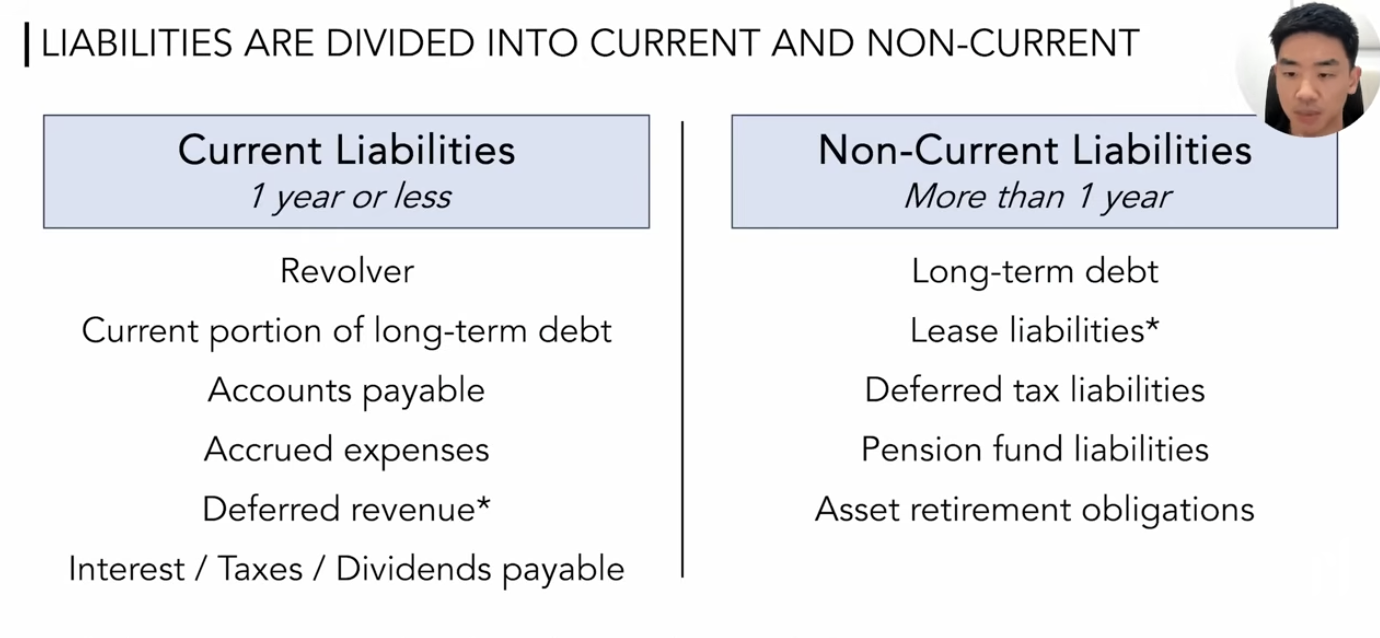
current vs non current liabilities example
what two things does SE show
shows both a source of funding AND a track record of how value has been created or lost over time for a company’s owners.

SE equation
money raised from shareholders + retained earnings - dividends
shareholders equity - line items
common stock, retained earnings
two ways to describe the value of a company
equity value and enterprise value