properties of plastics -- only includes polyethylene
 Call Kai
 Learn
Learn Practice Test
 Spaced Repetition
 Match
Match Flashcards
 Knowt Play
1/9

There's no tags or description
Looks like no tags are added yet.
Name | Mastery | Learn | Test | Matching | Spaced | Call with Kai | Chat |
|---|
No analytics yet
Send a link to your students to track their progress
10 Terms
Cross links
covalent bonds that join one polymer chain to another, creates 3D network instead of separate moving chains: gives plastic high rigidity as chains cannot move freely, high thermal stability as crosslinks consist of strong covalent bonds that require a very large amount of heat/energy to break, high chemical resistance as the strong crosslinks are difficult for chemicals to penetrate or disrupt it, permanent shape as interconnected network structure is difficult to break apart it prevents sliding of chains
thermoplstics
soften when heated, harden when cooled, reversible, chains held by IMF not permanent cross-links so they can be melted, reshaped and recylcled, low MP so ideal for applications using recycled materials e.g polyethylene, nylon, polyvinyl chloride
thermosetting plastics
polymers that permanently harden when heated, once set cannot be melted reshaped or remoulded, irreversible because of eztensive covalent crosslinking between polymer chains which form a rigid 3D network, used in situations where heat is a facto e.g electronic housings, appliances e.g bakelite, polyurethan and epozy resins
branching
formation of side chains attached to the main polymer chain during polymerisation instead of eztending in a straight line, it can occur when a growing polymer chain loses a hydrogen atom, creating a reactive site on the chain. Another polymer chain can then attach at this site, forming a branch.
amorphous polymers
Randomly arranged molecular chains, tangled and intertwined, amorphous polymers lack long range order, have not sharp MP and gradually soften as temperature increases, Generally less dense than crystalline polymers because the chains do not pack closely, more flezible, lower strength and stiffness e.g natural latez and styrene-butadiene rubber
crystalline polymers
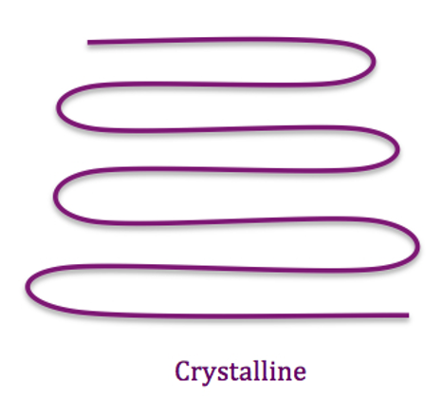
polymer chains are arranged in orderly stacks o folded chains lamellae, closely pack regions called crystallites/lamellae, chains form back and forth within the lamellae, producing long-range order, most polymers are semi crystalline, contain crystalline regions and amorphous regions, lamellae may have looped chains sticking out, high mechanical strength, stiffness, resistance to permeation e.g HDPE< polypropylene and nylon
HDPE
fairly linear, higher MP, superior resistance to solvents, alcohols, acids and alkalis, but low resistance to most hydrocarbons, more rigid, less flezible, high crystallinity
LDPE
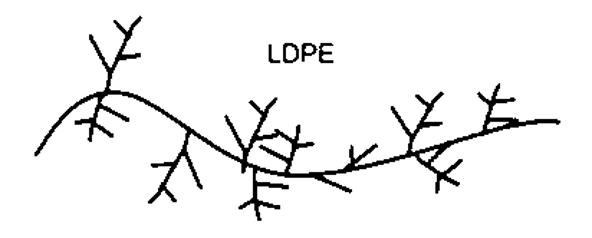
more branching, low crystallinity, lower MP, resistance to most alcohols, acids and alkalis but low resistance to ozidising agents and selected hydrocarbons, more flezible
m
m