atoms, ions and compounds
 Call Kai
 Learn
 Practice Test
 Spaced Repetition
 Match
 Flashcards
 Knowt Play
1/23

There's no tags or description
Looks like no tags are added yet.
24 Terms
protons, neutrons and electrons: the GCSE nuclear model of the atom:
the atom consists of a nucleus made up of 2 types of subatomic particle: protons and neutrons
a third type of subatomic particle, called an electron, occupies a region outside the nucleus. electrons are arranged around the nucleus in shells
properties of protons, neutrons and electrons: mass:
atoms and their subatomic particles have tiny masses. instead of working in grams, chemists compare the masses of subatomic particles using relative masses
proton and neutron masses:
both have the same mass
electron mass:
have negligible mass, about 1/1836 the mass of a proton
charge:
proton = +
electron = -
neutron = neutral
therefore what is the charge of an atom?
natural as the charge on a proton is equal and opposite to the charge on an electron
extra info of charges:

diagrams of the atoms:

where’s nearly all of an atoms mass?
in the nucleus
does an atom contain the same number of protons and electrons?
yes
diagram to show charges and masses of some subatomic particles, relative to the proton:

what are neutrons thought as?
the glue that holds the nucleus together despite the electrostatic repulsion between its positively charged protons
how many neutrons do most atoms contain?
the same number, or slightly more, neutrons than protons
as the nucleus gets larger, more and more neutrons are needed
what identifies the element?
the number of protons in an atom
how many elements are confirmed?
114
facts about elements:
every atom of the same element contains the same number of protons
different elements contain atoms that have different numbers of protons
how does the periodic table list elements?
in order of the number of protons in the nucleus. each element is shown with the number of protons as it’s atomic number
periodic table for the first 18 elements:

isotopes:
every atom of an element has the same number of protons and electrons, but can contain a different number of neutrons
eg. 2 isotopes of hydrogen:

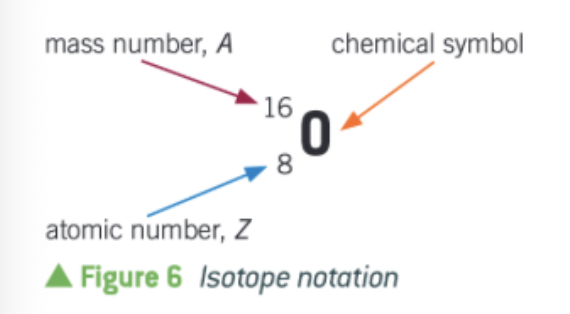
diagram to show isotope notation:
are most elements made up of a mixture of isotopes?
yes