Why do States Build Nuclear Weapons
 Call Kai
 Learn
Learn Practice Test
 Spaced Repetition
 Match
Match Flashcards
 Knowt Play
1/20

There's no tags or description
Looks like no tags are added yet.
Name | Mastery | Learn | Test | Matching | Spaced | Call with Kai | Chat |
|---|
No analytics yet
Send a link to your students to track their progress
21 Terms
The puzzle of nuclear proliferation
WWII - U.S. used 2 nuclear bombs on Japan
‘63 President Kennedy predicted by 1975 some 20-25 countries may possess nuclear weapons
“The greatest possible danger and hazard” facing mankind
Fourth countries - 1957 belief up to 10 countries could be capable to make nuclear weapons within the next decade
9 countries have nuclear weapons today - way less than predicted in the 50s and 60s
1975 - 5 nuclear weapons - US, USSR, UK, France, China (same 5 when Kenndey made his prediction)
Only 4 countries have joined the club 50 years later (India, Pakistan, Israel, North Korea)
Puzzle: Why so few nuclear weapons states? Why do some states seek nuclear weapons while others do not?
Horizontal and Vertical Proliferation
Horizontal Proliferation: When a country that doesn’t already have nuclear weapons gets nuclear weapons (what we talk about in class)
Vertical Proliferation: when states that already have nuclear weapons get more nuclear weapons or better nuclear weapons
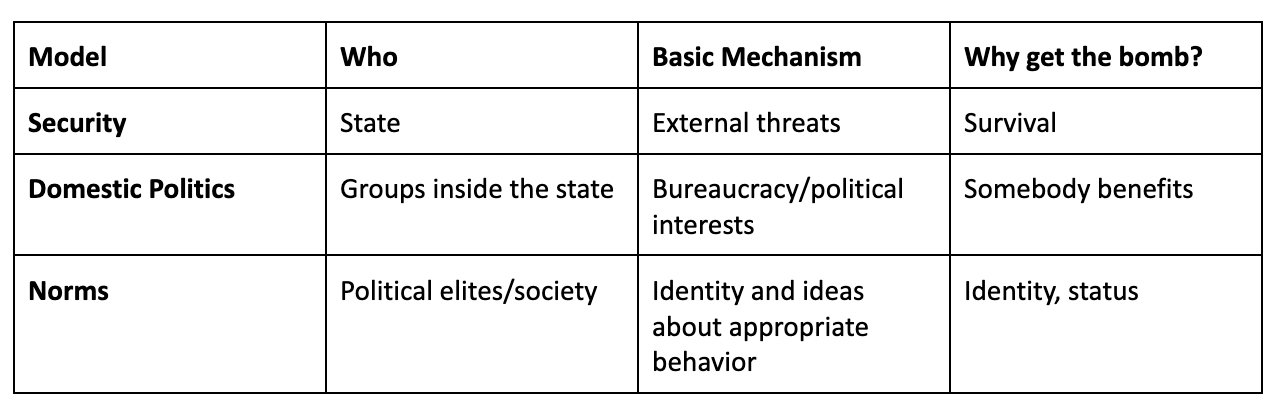
What 3 models explain the causes of proliferation (Sagan)
Security
Domestic Politics
Norms
Sagan Belief:
Common solution to puzzle: States will seek to develop nuclear weapons when they face a significant military threat to their security that cannot be met through alternative means
Argument: National security being the cause of proliferation is an inadequate and incomplete argument for why states build nuclear weapons
REVIEW SAGAN NOTES
Security model of proliferation
Anarchy means states worry about their own survival
Nuclear weapons (powerful deterrent) can protect states from external security threats in anarchic world
Nuclear-armed adversary creates particularly strong incentives to get a nuclear weapon
Expect: Nuclear proliferation drive more nuclear proliferation (nuclear domino theory)
Ex: US → USSR → China → India → Pakistan got nuclear weapons
However: Nuclear pursuit = expensive, so states might get security in other ways
Ex: Why doesn’t SK get nuclear weapons if they are threatened by NK? What about Japan, having being threatened by China?
U.S. Nuclear Umbrella - extending a credible nuclear guarantee to alies to a powerful tool to limit nuclear proliferation
However: Nuclear pursuit = dangerous (Iraq, Syria, Iran)
Commitment problems - fear adversaries will strike against them before they are equipped to get a nuclear weapon
Arises when the thing you are bargaining over is itself a source of bargaining power
Strong incentive to bomb you now when you don’t have nukes
Security calculations might lead some states to conclude security costs outweigh security benefits of nuclear weapons
Ex: Israel bombing countries around them developing nuclear weapons, → maybe it would be better not to develop them at all so you have better security
Nuclear Domino Theory
When one state acquires nuclear weapons, other states inevitably follow
^ debunked
Domestic politics model of proliferation
Domestic Politics Model
Military, nuclear scientists/labs, defense industries, politicians who can use nuclear nationalism, bureaucracies who receive expanded budgets → benefit from nuclear weapons
Governments that do not benefit
Outward facing governments whose political survival depends on integration into the world economy face especially costs from proliferation
Governments that do benefit
Inward looking nationalist governments can more easily use nuclear programs as instruments of political mobilization (cementing own power at home)
Example: Iraq vs. Egypt 70s, 80s
Iraq - Nuclear power/modernization → political mobilization for Saddem Hussein
Pursues expensive nuclear weapons program
Egypt - open economy to the world, strengthening trade ties, → nuclear weapons become less appealing
Diplomacy with Israel, shifted toward U.S., embraced nuclear restraint
Norms model of proliferation
Sagan uses the “international norms” he means states treat nuclear weapons as a symbol
What normative power does a state having nuclear weapons have?
Power, great power status, technological progress, modernity, independence, sovereignty,
Nuclear restraint carries normative power too
Peacefulness, responsible international citizenship, membership in the international community, moral leadership
Ex: Why did France get nuclear weapons and not Japan?
France “no great power can voluntarily accept status which would leave it in permanently inferior position” - nuclear weapons gives it a global, great power status
“Japan believes it is her moral responsibility to take non-nuclear path as the only country to have suffered from atomic bombings” - moral authority
Both are normative explanations
Nuclear Assistance/Comparative Cases
Israel and Egypt
Egypt would have no choice than protective/preventive war if Israel developed a nuclear weapon
Why does Israel develop a serious nuclear option while Egypt does not?
Israel assisted by France
Access to nuclear assistance changes states calculations when it comes to pursuing nuclear weapons (Something Sagan does not address)
Israel had a nuclear-sharing agreement with France, France gave nuclear supply
Both Israel and Egypt wanted nukes but only Israel was confident it could get them
Demand-side drivers of proliferation
(motive, willingness)
Security, alliances, interests/domestic politics, status/prestige may drive you towards getting a nuclear weapon
Supply-side drivers of proliferation
(means, opportunities)
resources, ability to get opportunities, assistance (civilian and sensitive), procurement networks may drive you to get/not to get a nuclear weapon (proliferation v. restraint)
Institutions
Others: Regime type, psychology, bureaucracy
Institutional drivers of proliferation
The treaty on the Non-Proliferation of Nuclear Weapons (NPT) - prevents countries from seeking weapons??
Nuclear Umbrella
extending a credible nuclear guarantee to allies to a powerful tool to limit nuclear proliferation
Ex: South Korea doesn’t have a nuclear weapon even though it’s adversary right next to them does…SK can hide under the U.S.’s nuclear umbrella
Nuclear Latency
have a latent capability to turn a civilian nuclear technology to a nuclear weapon (can have high or low latency)
Nuclear Hedging
Build up civilian facilities that bring them close to having a weapon and wait. Building nuclear latency
Nuclear Breakout
if they feel threatened they can get weapons
the time it takes a state to accumulate a "significant quantity" (roughly 25 kg) of weapons-grade uranium (90% U-235) needed to build a nuclear device
??
Nuclear nonproliferation regime
(NPT) an international framework designed to stop the spread of nuclear weapons, promote peaceful nuclear energy, and work toward global disarmament
read this in the Why Do States Build Nuclear Weapons article
Mutual assured destruction (MAD)
full-scale use of nuclear weapons by two opposing sides would cause complete annihilation of both
Some say there’s been no WWIII because of nuclear weapons
War between nuclear states → would become so costly we wouldn’t do it
First-strike advantage
Ex: Imagine Kaplow reduce/eliminates nuclear arsenal by launching before I do but if I know this, I might want to strike first, and if you know I know you might strike sooner
Thomas Schelling - “the reciprocal fear of surprise attack”
Secure Second Strike
(solution to first strike advantage)
We want “survivable” nuclear forces
Missile silos, subs, launch on warning, airborne alert, launch on warning (can’t destroy all of them)
If we can absorb a nuclear first strike and still be able to retaliate with nuclear weapons
We want the other side’s forces to be survivable too
Suggests we do not want to protect our population from a nuclear strike
No ballistic missile defense, maybe no fall out shelters
Conventional weapons make you safer but nuclear weapons better defense can make both sides less safe because deterrence is built on mutual vulnerability
Limited War/Stability-Instability Paradox
A nuclear would be costly but what if we agreed to have a conventional war with no nukes
BUT - always the risk of escalation
Difficult to know the other side’s red lines (what would cause them to use nuclear weapons)
Each side thinks their red line is abundantly clear to their adversary but its not
Possibly can make all out war less likely, limited war more likely
Would be willing to fight a conventional war elsewhere and take a loss as long as their nuclear arsenal is safe
Stability-instability paradox
Brinksmanship
Incredible Threats
For MAD to work, one side needs to be able to credibly threaten to engage in a retaliatory nuclear strike
But so many innocent people would die…it’s really hard to make that threat credible
If you can’t make that threat credible, there’s a high chance of nuclear war
First strike advantage etc.
Solution - Brinkmanship “threats that leave something to chance”
Edge of cliff, tied together on a rope, asking for sandwich, say no, kaplow gets closer to the cliff
Run a risk of falling off a cliff
Like a game of chicken, whose willing to run the biggest risk closest to the edge
Competition in risk-taking and the winner is the party with the most resolve (willingness) not necessarily the most power
All you need is to bring a risk to the brink of disaster - you don’t need any more than that to be credible