Week 4- Grief, Palliative Care, End-of- Life Care & Loss
 Call Kai
 Learn
 Practice Test
 Spaced Repetition
 Match
 Flashcards
 Knowt Play
1/36

There's no tags or description
Looks like no tags are added yet.
37 Terms
What implicit expectations exist in nursing culture regarding emotional strength or stoicism?
nothing gets to you
youve seen it before
expect a lot from us
we dont have our own feelings (seen as hero, angels, etc)
How might unresolved grief impact a nurse’s empathy, clinical judgement, or risk of burnout?
can trigger something in you based on your own experience
Anticipatory grief
perceived loss before it actually happens (dementia), belongings (car, home), losing a body part
Stages of anticipatory grief
shock, denial, acceptance of the loss
Anticipatory grief feelings
sadness, uncertainty, anger, irritable, hostile, impatient purgatory
Acute grief
the immediate, intense psychobiological response to the death of a loved one or a major loss
comes in waves
Grief
Individual's response to loss
Persistent/complicated grief
grief is chronic
avoid reminders of loss
others cant understand what you're going through
numb
can lead to major depressive episodes
can recommend professional assistance
Disenfranchised grief
experience loss that you cannot openly grieve or mourn
nursing: don't have the right to grieve patients
closeted individuals
affair
someones hurt you
Nursing Role in Grief
Support those who are grieving
Understand the person's grief
Assess for signs of grief and loss (coping)
Listen
build therapeutic relationship
dk what to say: ask about the pt
religion, culture, beliefs
establish report
observe for functional disruptions
increased complicated grief chance
losing child
codependent relationship
unexpected/ violent relationship
older male widowers
Living-Dying Interval
crisis knowledge of death
wont live as long as they expected
living-dying phase
chronic phase: can be long
coded language
terminal phase: energy preservation

Asking the “question”
• “Would I be surprised if this patient died in the next 6-12 months”
• Purpose: to get people thinking about palliative care approach earlier than later in illness
• Doesn’t determine prognosis
• If NO: initiate palliative care approach
• Review goals of care and manage symptoms
Palliative care is simply ______ care
good
Focus on illness trajectory and who could benefit from palliative care.
Palliative Performance Scale (PPS)
Validated clinical tool used to measure a patient's physical and functional decline over the course of an illness.
It adapts the older Karnofsky Performance Scale to better fit palliative and hospice care settings

Nursing Role
• Care
• Control
• Composure
• Communication
• Continuity
• Closure
• goal: appropriate care for yourself
Care
Expert symptom management
Pain: physical AND emotional
Emotional support
pain worse when anxious
Listening
Empathy
Allowing a person to express their thoughts
document what you assess
different, symptom focus assessment
medication not the only way to treat pain
ask what they want, dont want to over or under do it
Control
Collaborative care
Respect the patient's wishes on when,
where and how they want to receive care
loss of control, feel ashamed that they're a burden
be an active part of their care
dont want to be a burden
Composure
Emotional activity
Composure enables the person to modulate emotional experiences
Communication
The need to receive information to make decisions
The need to share information
Closed awareness
pt or family might not known
Suspected awareness
think its near but not discussed
Mutual Pretense
lets pretend, no one talks about it
Open awareness
openly acknowledge the death
should be able to communicate how they want to
not everyone comfortable to do that
Continuity
Maintaining a normal life as possible
Leaving a "legacy"
end of life can make someone feel lonely
Closure
closure not about grief ending
resolve conflict
say goodbye
come to term with spiritual self
get family and pt to talk about life
Advance Care Planning
Substitute Decision Maker (SDM)
Communicating personal wishes to the SDM
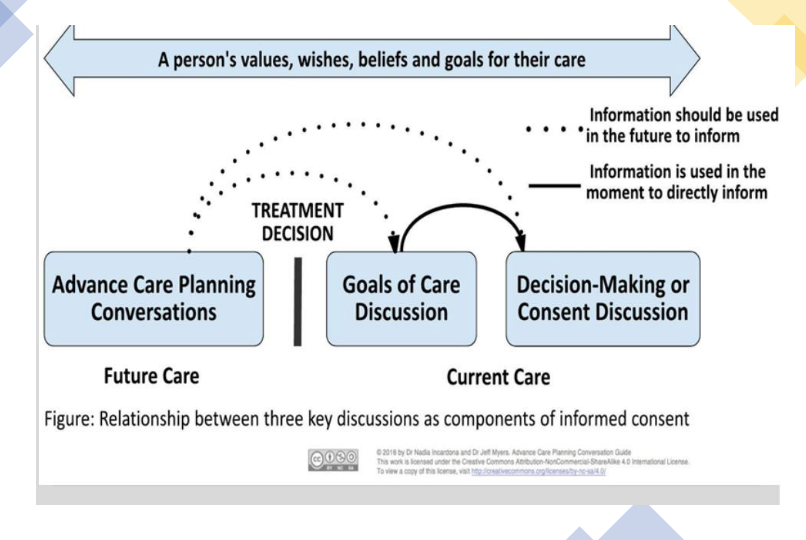
Substitute Decision Maker (SDM)
is a person authorized by law to make personal care, medical, and healthcare decisions on behalf of someone who is found mentally incapable of making those choices themselves
What is the difference between palliative care and end-of-life care?
Palliative care is specialized medical care for anyone living with a serious or life-limiting illness (such as cancer, heart failure, or dementia). It can begin at the time of diagnosis and continue for months or years, and patients can receive it at the same time as active, curative treatments.
End-of-life care is a specific phase within palliative care that is provided when a person is in the final stages of a terminal illness—typically during the last weeks, months, or final year of life. At this stage, curative or life-prolonging treatments are usually stopped or scaled back, and the focus shifts entirely to comfort, dignity, and a peaceful death.
End-of-life care
Can be in a variety of different areas/settings
Focus on comfort, goals of care, family support
Manage pain
Good mouth care
Repositioning (avoiding pain)
Manage delirium
Manage anxiety
Manage families expectations (education)
Hospice Palliative Care
Multidisciplinary coordinated care for those with living with terminal illness
a specialized medical and holistic approach that improves the quality of life for individuals and families facing life-limiting or advanced illnesses
Can happen in multiple settings
Action Plan on Palliative Care in Canada
Awareness of importance of end-of-life care through public education
Developing tools and resources to support community and home-based end of life care
Enhancing health system quality improvement through enhanced data collection and research
Fostering improved access to palliative care for underserved populations
Improving access to culturally sensitive palliative care for Indigenous communities
why stop vitals at end of life care
were not treating it
different goals for the patient
only asses things that were gonna treat
Support the family
were not treating it
different goals for the patient
only asses things that were gonna treat
Nursing Considerations
Listen – full body
Symptom assessments
Psychological/social/spiritual assessment
Follow up after provider conversations
Apply the above to family too
End-of-life issues
Personal and sensitive topic, nurse comfort level caries
Addition of assisted death and it can raise complex issues and emotions
Views on death and dying can be shaped by many factors
Suffering, autonomy, choice, person centered, quality of life, sanctity of life, dignity, stigma
MAiD issues
Ethical, legal and moral aspects
May involve moral distress for some health care providers
Uncertainty and opportunity
MAiD Eligibility
Persons who wish to receive MAiD must satisfy the following eligibility criteria:
Be 18 years of age or older and have decision-making capacity
Be eligible for publicly funded health care services
Make a voluntary request that is not the result of external pressure
Give informed consent to receive MAiD, meaning that the person has consented to receiving MAiD after they have received information to make this decision
Have a serious and incurable illness, disease or disability (excluded mental illness for now)
Originally set to be including 2023, then deferred to 2024, now 2027
Be in an advanced state of irreversible decline in capability
Have enduring and intolerable physical or psychological suffering that cannot be alleviated under conditions the person considers acceptable
MAiD with mental health
Canadians whose only medical condition is a mental illness, and who otherwise meet all eligibility criteria, will not be eligible for MAiD until March 17, 2027.
Guidelines and safeguards will be developed in the next two years. Likely to exclude neurocognitive and neurodevelopmental disorders, or other conditions that may affect cognitive abilities
Two-track approach for MAiD
To ensure that sufficient time and expertise are spent assessing MAiD requests from persons who natural death is not reasonably foreseeable
To ease procedural safeguards in those cases where natural death is reasonably foreseeable
MAiD Procedural Safeguards
When natural death is reasonably foreseeable:
Request for MAiD must be made in writing: a written request must be signed by one independent witness, and it must be made after the person is informed that they have a “grievous and irremediable medical condition.” (a paid professional personal or health care worker can be an independent witness)
The requirement for a minimum 10-day reflection period between approval and MAiD is now removed
Two independent doctors or nurse practitioners must provide an assessment and confirm that all of the eligibility requirements are met
The person must be informed that they can withdraw their request at any time, in any manner
The person must also be given an opportunity to withdraw consent and must expressly confirm their consent immediately before receiving MAiD
Final consent waiver
Request for MAiD must be in made in writing; a written request must be signed by one independent witness and it must be made after the person is informed that they have a “grievous and irremediable medical condition” (a paid professional personal or health care worker can be an independent witness)
Two independent doctors or nurse practitioners must provide an assessment and confirm that all of the eligibility requirements are met
If neither of the two practitioners who assesses eligibility has expertise in the medical condition that is causing the person’s suffering, they may consult a practitioner with such experience
The person must be informed that they can withdraw their request at any time, in any manner
The person must be informed of available and appropriate means to relieve their suffering, including counselling services, mental health and disability support services, community services, and palliative care, and must be offered consultations with professionals who provide these services
The person and the practitioners must have discussed reasonable and available means to relieve the person’s suffering and agree that the person has seriously considered those means
The eligibility assessments must take at least 90 days, but this period can be shortened if the person is about to lose the capacity to make health care decisions, as long as both assessments have been completed
Immediately before MAiD is provided, the practitioner must give the person an opportunity to withdraw their request and ensure that they give express consent
RN Role
Communication with family
Know employer policy
Acknowledge patient requests for information and provide accurate, objective information on MAiD or refer to someone who can
Listen to patient and family concerns, feelings, unmet needs and responds with empathy, respect and compassion
Continue to provide high-quality nursing care and ensure all care areaddressed
Alleviate pain and suffering through symptom and pain management
Ensure patient is aware of all available supports and desire for MAiD is not connected to lack of supports or services
Document care provided
Knowledge Based Practice
RNs are responsible for understanding and complying with MAiD legislation and understanding how it applies to their nursing practice, setting and role
The must also consult and follow employer policies and ensure that they have the competence to do the required interventions (ex: providing education or starting an intravenous line). If RN’s elect to aid a NP or physician in the provision of MAiD they need to review and understand:
The principles of the Criminal Code provisions
Any provincial legislation and/or direction;
Any guiding documents from their regulatory body;
The employer’s policy regarding MAiD in the employment setting and any applicable policies, guidelines, procedures and/or processes in place; and
Any professional or employer legal advice
The Criminal Code allows RNs to aid in MAiD under the direction of a NP or
physician, but this does not include the assessment of patient eligibility or
administration of any substance that causes death. This could include
interventions such as initiating an IV access but does not include administering
the substance causing death pursuant to an order or prescription.
- RNs can aid a NP or physician in the lawful provision of MAiD by performing
activities such as patient education, provide support or comfort care to patients
and family, or insert an IV line (always refer to employer policies before aiding a
NP or physician);
RN Role
- RNs have a duty to:
- Ensure that they are aware of eligibility criteria, safeguards and
requirements to support that they are acting appropriately with respect
to a patient who is requesting MAiD
- Review the patient’s chart and signed written request for MAiD
- Review or discuss the assessment of eligibility and safeguards with the NP
or physician
- RNs must refrain from activities:
- That may be viewed as the actual administration of the substance, such as
placing the oral substance in patient’s mouth or inserting the substance
into the IV or feeding tube or preparing or altering the substance to ease
ingestion such as mixing the substance with food or liquid
- That may be viewed as preparing, dispensing, retrieving, administering or
returning any of the lethal substances prescribed and administered by the
NP and/pr physician for MAiD
Conscientious Objection
- The amendments to the Criminal Code do not
impose any obligation for RNs to aid in MAiD. RNs
are not obligated to aid a NP or physician in MAiD.
RNs who are asked to aid in any aspect and lawful
MAiD and chose not to participate at any time due
to personal moral beliefs and values, lack of skill or
other reasons must immediately:
- Assure the patient that they will not be
abandoned and continue to provide care that
is not related to activities associated with
MAiD; and
- Notify their employer so that alternative care
arrangements can be arranged
Independent Witness
- The Criminal Code requires that a person’s request for
MAiD be made in writing. This request must be signed and
dated before one independent witness. The role of the
independent witness is to confirm to the signing and dating
of the request by the person requesting MAiD and that
they understand what they are signing.
RN Role
- Must be at least 18 years of age and understand what it
means to request MAiD, and can be a paid of professional
personal or health care worker
- Cannot benefit from the persons’ death, cannot be an
owner or operator of a health-care facility where the
person making the request is being treated and cannot be
an unpaid caregiver
- According to current legislation, RNs can act as
independent witnesses. However, it is recommended that
they contact the Canadian Nurses Protective Society before
accepting such a role for their patients.