Medieval Art History | Exam #2 | Dr. Bevin Butler
 Call Kai
 Learn
 Practice Test
 Spaced Repetition
 Match
 Flashcards
 Knowt Play
1/92

There's no tags or description
Looks like no tags are added yet.
93 Terms
graticule
network of parallels (latitude) and meridians (longitude); essentially a grid
projection
way of flattening the round Earth onto a flat surface
kerning
stretches text
done by hand at the time
emphasizes going on a journey
Chronica maiora
provides mental journey for monks
page turning as a metaphor for travel, progressing on journey
flaps in book, can be unfolded
interactive elements, dynamic reading, multiple ways of reading
architectural drawings are accurate to actual sites
Medieval maps
all East oriented
sun rises in east: sunrise, heaven, Jerusalem
Hereford World Map
1000+ inscriptions
Jerusalem in center of composition
thought to be most holy cite; “portal to heaven”
antisemitic and racist depictions
may have been displayed in North Transept in its cathedral
parchment
animal skin - flesh and hair sides
stretched, washed, and cleaned
lapis lazuli is
more valuable than gold!
quires
modern day: signatures
bundle of pages
pens and brushes
quills, animal hair brush bristles
ink and paints
ground pigment (minerals, variety of other things) + egg tempera
palimpsest
upcycled parchment
copying text
scored paper, calligraphy
mostly done by nuns and monks
decoration
optional
illustrations, marginalia
gold leaf
book binding
sewing together quires
cover = leather covered plate (metal, wood, etc.)
Gospel Books
passed down orally before being written and standardized
The Evangelists
authors of gospels
sometimes depicted in art as divinely inspired authors
also represented by symbolic or beastly forms
Man
image of creator
Mark
Lion
king of beasts
Mark
Ox/bull
king of domestic animals
Luke
Eagle
king of birds
John
insular
art of the British Isles
scriptorium
place where manuscripts are written
Book of Durrow
oldest surviving insular Gospel
illuminations: beastly evangelist portraits, carpet pages, incipit pages
carpet page
art history term
typically a page of rectangular, intricate artwork
looks like the name says
incipit page
first page of a Gospel
order in manuscript
evangelist portrait → carpet page → incipit page → gospel text
Lindisfarne Gospels
colophon: written and illuminated by Eadfrith (Bishop of [term], 698-721)
famously intricate: interlaced scrollwork; linear and anthropomorphic
Book of Kells
started by scribe Connachtach (killed at Iona in 802 by vikings)
at least 4 monks helped finish in monastery at [term]
one of the most famous insular gospel books
virgin and child page may suggest Byzantine influence
Carolingian Period
c. 780-900
Charlemagne
Holy Roman Empire
Charlemagne
credited with uniting most of western Europe
crowned Holy Roman Emperor in 800
regarded as saint in HRE - later middle ages, but never officially canonized
created “court schools”
Godescale Gospels
made in court school
Christ in Majesty influenced by Byzantine and Roman painting, as well as intricate insular arts
court schools
standardized writing and scripts taught during Carolingian Period
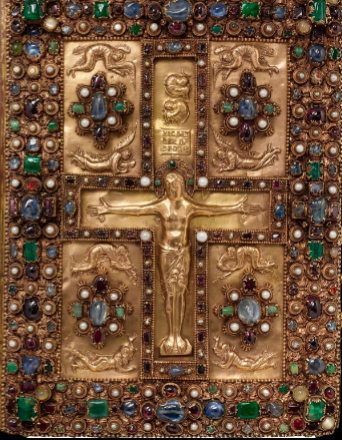
Lindau Gospels
Front cover: east France c 870-880; repousse
Inside cover: pastedown; woven silk from Byzantium
Text and illuminations: Monastery of St Gall
Back cover: Salzburg, Austria, late 8th cen
recto
right
verso
left
Lindau Front Cover
repousse cold Crucifixion
heavily jeweled
3D, sculptural, architectural
reliquary for word of God and the life of Christ
Lindau Pastedown Inside Cover
exotic, valuable textiles in book bindings throughout Europe
likely recycled from older/earlier
Lindau Text and Illuminations
example of Charlemagne standardized script/text
Lindau Back Cover
gold, silver, gemstones, enamel
Ottonian Dynasty
c. 900-1000 CE
3 guys, all HRE emperors
Gospel Book of Otto III
c 1000, German
personifications of 4 chief provinces of HRE paying homage to [guy]
gestures and wide eyes, harsh colors, gold lead backgrounds, stylized drapery & figures → narrative & iconic/symbolic
Otto III Luke Portrait
winged ox above [guy], King David above ox
not shown writing, but with stack of books and receiving divine inspiration
frenetic energy
big on Byzantine influence
Moralized Bible (Bible Moralisee)
elaborately illuminated and biblical manusripts
popular in France and Spain in 13th cen
owned mostly by wealthy & nobility; among most expensive
thousands of images; some only illuminated on flesh sides (hair side left blank if bleed-through = RICH)
7 medieval copies exist with medallion framework
typological pairing
typological pairing
old testament and new testament stories paired to explain one another (metaphor, foreshadowing, etc)
Birth of Eve vs. Birth/Creation of Church
Sacrificing Lamb vs. Crucifixion
Ecclesia
female depiction of Church
Bible of St. Louis
dedication page: Blanche of Castille & [guy] with scribes
Blanche commissioned manuscript
Book of Hours
often form of Breviary
psalms and other prayers
not really for monks of nuns; for regular but wealthy people
devotional text
Hours of Liturgy
Breviary
monastic book with Divine Offices, prayers, and songs for specific times
Hours of Liturgy
times to pause in order to pray and/or sing for an hour, typically in ~3 hour increments
Book of Hours of Jeann d’Evreux
for Queen of France (Charles IV), commissioned by Charles between 1325-1328
20 full-page illuminations by Jean Pucelle
grisalle technique - grayscale figures
small size, probably girdle book
images of Life of Christ to illustrate Hours of Virgin
scenes from life of Louis IX (her great-grandfather)
bas-de-page
bottom of the page
Mozarabs
Christians living in Islamic Spain
Mudejar
Muslim or Muslim-trained artists working for Christian or Jewish patrons
apocalypse theory
awareness of Islam as indicator of end times
manicule
hands drawn to indicate important sections of text
Beatus Manuscripts
copies of Commentary on the Apocalypse
34 surviving medieval ones
heavily illuminated, mostly consumed by wealthy & nobility
Beatus of Liebana
c. 730-800
Spanish monk, theologian, geographer
wrote Commentary on the Apocalypse in 776
The Morgan Beatus
Maius - Spanish monk, scribe, and iluminator
best known for this work, copied and illuminated for monks at San Miguel de Escalada
300 leaves; includes 64 full-page and 48 smaller illustrations
elaborate colophon
Book of Revelations
final book of New Testament
apocalyptic visions of St John the Evangelist (received while in exile)
metaphor of Christianity triumphing over heresy and enemies (Muslims and Islam at the time)
The Vision of the Lamb - Morgan Beatus
great multitude (some with palms) representing all the people of the world
Lamb of God in top center
angels and four beasts (evangelists) bowing
St John receiving visions of the apocalypse
Leon Bible of 960
“Mozarabic Bible of St. Isidore”
copied and illuminated by Florencios and Sancho (scribes) in Monastery of Valeranica in Tordomar
tables showing Christ’s descent from Adam; Heavily decorated Old Testament (80 illuminations)
less illuminations through New Testament
Medieval Bestiary
observation of animal behavior + science + history + Christianity
info compiled from other ancient and medieval texts
more commonly illuminated than other types of manuscripts
often begins with Creation in Genesis
bestiary illuminations
inspired by descriptions of animal appearances and behaviors
bestiary animal classifications
beasts
livestock
small animals
birds
snakes and reptiles
worms
fish
sometimes also includes trees, plants, and stones
Natural History
Pliny the Elder, ca 78 CE
Physiologus
2nd century CE
Etymologiae
Isidore of Seville, ca 630 CE
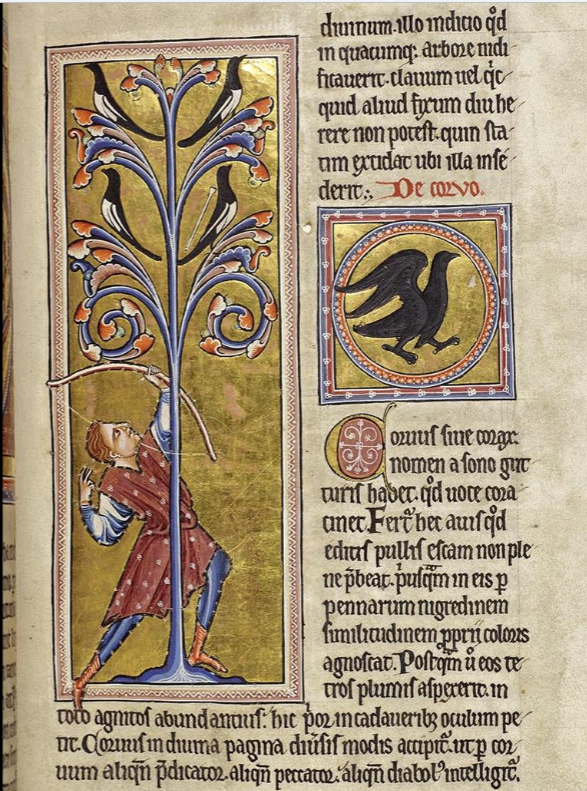
Magpie & Raven, Aberdeen Bestiary, fol. 37r.
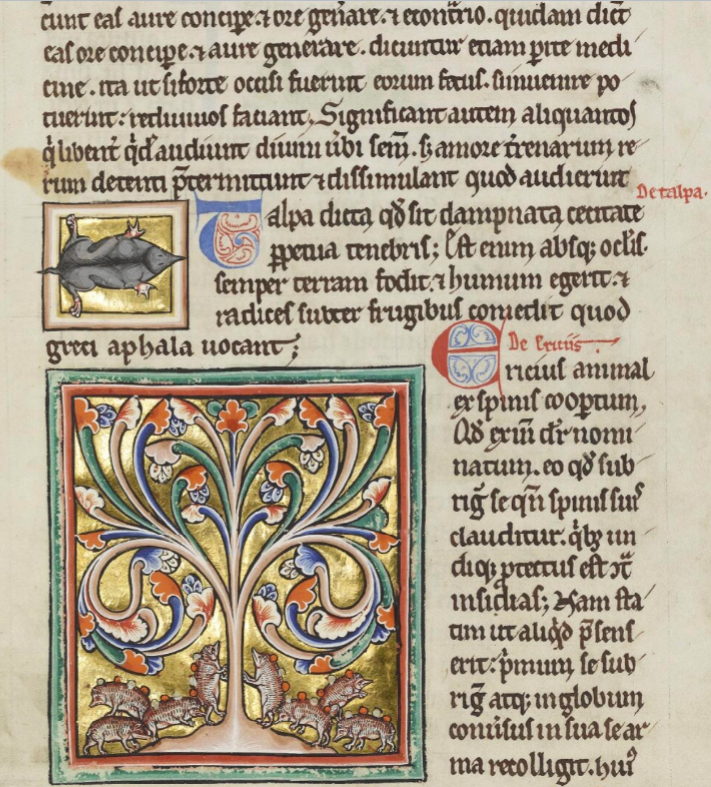
Mole & Hedgehog, Ashmole Bestiary, fol. 36r.
Sirens, Northumberland Bestiary, fol. 14

Phoenix
bird of Arabia (“exotic” + unseen = from East)
lives 500+ years
willingly gathers items for death, lights self on fire, reborn from ashes
metaphor for Crucifixion, Resurrection, & Eucharist
Pelican
very common in medieval art
Egyptian, lives in Nile River
Kills its babies, grieves for 3 days, uses blood to revive them
metaphor for Crucifixion, Resurrection, and Eucharist
Lion
erase their tracks with their tail so hunters cannot follow
cub is thought to sleep for three days and nights after birth
waken by roar of father
metaphor for Crucifixion and Resurrection
Lion illumination. Ashmole Bestiary, fol 10v

Pelican, Northumberland Bestiary, fol 41r

Unicorn, Northumberland Bestiary, fol 11r

Unicorn
four-footed beast with a single horn on its forehead
strong and pierces anything it attacks
cannot be caught unless a virgin girl exposes her breast to it
metaphor: Persecution/execution of Jesus; importance of virginity; courtship and romantic pursuit
Creation of Eve from Adam’s rib + Creation of Church from Christ’s side wound
“Vienna 2554” Moralized Bible, French, c 1220,
Austrian National Library, 13 ½ X 10 ¼ in

Louis IX Feeding the Sick and
Washing the Feet of the Poor

Death of King Louis IX
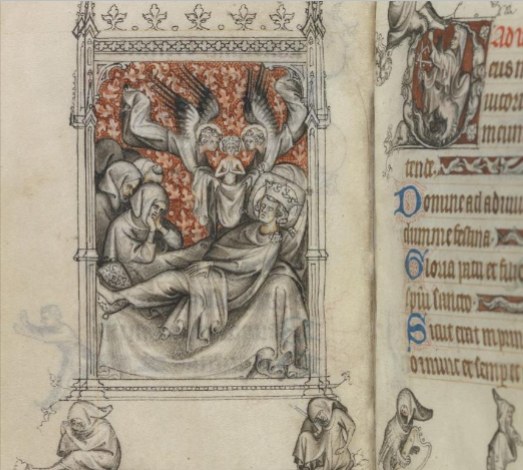
Sext (Noon)
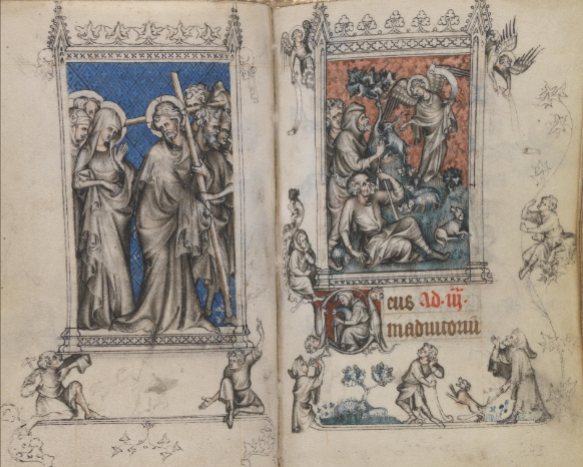
Crucifixion & Adoration of the Magi

Terce (Mid-Morning)
Christ Carrying the Cross & Annunciation to Shepards
Godescalc Gospels, Aachen, 781-783,
12 X 8 ½ in, BNF NALat. 1203, fol. 3r

The Lindau Gospels
Front Cover: Eastern France;
c 870-880, 12 ½ X 10in
Gospel Book of Otto III, Illuminated Manuscript,
c 1000. German (Reichenau?), 13 X 9 ½ in.
Munich: Bayerische Staatsbibliothek, Clm. 4453, fol. 24r

Transfiguration – Christ appears (with Moses & Elijah)
to James, John, and Peter; God speaks to themGospel Book of Otto III, Illuminated Manuscript,
c 1000. German (Reichenau?), 13 X 9 ½ in.

Wh0re of Babylon, Beatus’ Commentary on
the Apocalypse (“The Silos Apocalypse”),
1091-1109, 12 ½ X 17 in.
London: British Library, Add. 11695, fol. 183v

Adoration of the Lamb, The Morgan Beatus,
Leon (Spain), c 940-945, 15 X 11 in.
New York: The Morgan Library, MS M.644, fol. 87r.

Woman Clothed with the Sun, The Morgan
Beatus, Leon (Spain), c 940-945, 15 X 11 in.
New York: The Morgan Library,
MS M.644, fol. 152v-153r.

Evangelists, Book of Kells, c. 800.
Trinity College (Dublin) IE TCD MS 58, fol. 27v.

Matthew, Lindisfarne Gospels, c 715-720
British Library Cotton MS Nero D.IV, fol. 25v

ohn, Book of Durrow, 248 folios, 9 ½ X 5 ¾ in.
Trinity College (Dublin) TCD MS 57, fol. 84v.
