bio lab exam 3
 Call Kai
 Learn
 Practice Test
 Spaced Repetition
 Match
 Flashcards
 Knowt Play
1/194

There's no tags or description
Looks like no tags are added yet.
195 Terms

Epidermis
Stratified squamous epithelium
surface layer
avascular

Dermis
areolar and dense irregular connective tissue
deeper layer
two layers

Hypodermis ( Subcutaneous Layer)
not actually a part of the integumentary system
under dermis
mostly adipose tissue
Stratum Basale of Epidermis
Single layer of cells capable of mitosis
Stratum Spinosum
Several cell layers thick of non-dividing keratinocytes
Stratum Granulosum
three to five layers of fully dead keratinocytes
Stratum Corneum
most superficial layer of dead keratinocytes
Stratum Luciderm
two to three layers thick (only in hands and feet)
Thick Skin
Contains all five layers of the epidermis
found in the palms of hands and soles of the feet
Thin skin
covers most of the body
lacks a stratum lucidum
What makes thick skin thick in comparison with thin
The presence of elidin creates a thicker stratum corneum
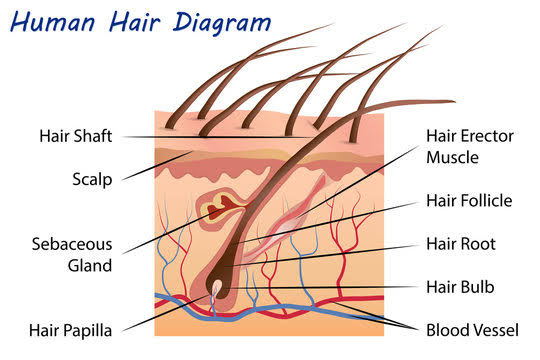
Hair
Columns of Keratinocytes growing from follicles deep in the dermis or hypodermis
Functions of hair
sensory reception
visual identification
heat retention
protection
Hair bulb
Swelling of epithelial cells where the hair originates
Hair root
Portion deep to the skin surface
Hair shaft
portion extending beyond the skins surface
Hair follicle
surrounds each hair
Arrector pili muscles
attach to hair shaft
Sweat glands (sudoriferous glands)
produce water solutions
2 main types
What are the two main types of sweat glands
Merocrine
Apocrine
Merocrine gland (also called eecrine)
Release secretions into a duct with a pore on skins surface
(palms of hands, soles of feet and forehead)
Apocrine glands
Release secretions into hair follicles (armpits, nipples, groin)
Sebaceous glands
produce oily secretions
Antagonist effect
oppose eachother
Skeletal Muscle
striated
voluntary
attached to bone
Cardiac Muscle
striated
involuntary
heart
do not need independent variability
Smooth Muscle
non striated
involuntary
walls of viscera and blood vessels
Agonist
Produces a specific movement when it contracts
Antagonist
A muscle whose action opposes that of an agonist
Synergist
A muscle that assists the agonist in performing its action
Neuromuscular junction
The region where the motor neuron comes into close proximity to the muscle fiber
subscapularis
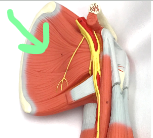
supraspinatus

infraspinatus
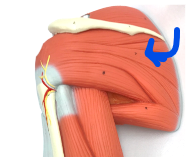
teres minor

teres major

deltoid

coracobrachialis

biceps brachii
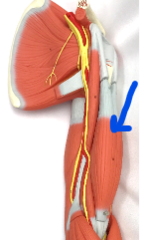
triceps brachii

brachialis

brachioradialis
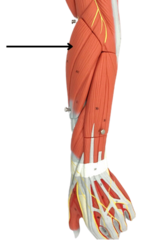
extensor carpi radialis longus
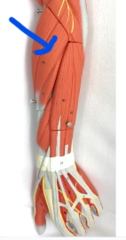
extensor carpi radialis brevis

extensor digitorum

extensor digiti minimi

extensor carpi ulnaris

gluteus medius

gluteus minimus
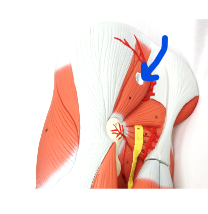
piriformis

sciatic nerve
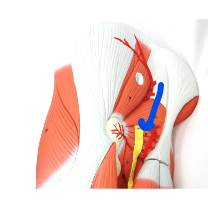
gluteus maximus

biceps femoris

vastus lateralis
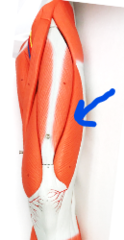
vastus medialis

rectus femoris

semitendinosus
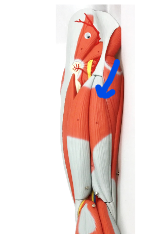
semimembranosus

extensor digitorum longus

gastrocnemius
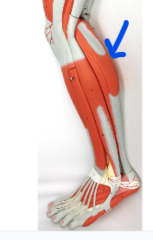
soleus

fibularis longus

fibularis brevis
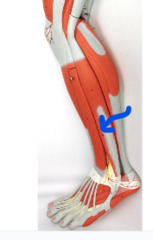
tibialis anterior

patellar tendon
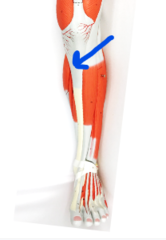
tendocalcaneus

sartorius
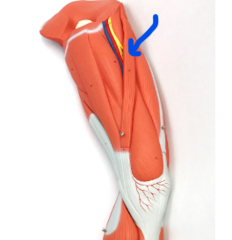
gracilis

adductor magnus
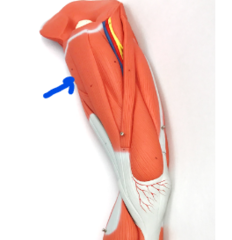
adductor longus

Flexor carpi ulnaris

Brachioradialis

Palmaris longus

Flexor carpi radialis

Pronator teres

humerus and glenoid cavity; femur and acetabulum
What is an example of a ball and socket joint?
electromyogram
What does EMG stand for?
It measures the action potentials (electrical activity) in skeletal muscle fibers that cause muscle contraction.
What does an EMG measure?
It measures force generated during muscle contraction.
What does a dynamometer measure?
dynamometer
What instrument is used to test grip strength?
a single action potential leading to a muscle contraction
What is a muscle twitch?
all of the muscle fibers innervated by a single motor neuron
What is a motor unit?
by recruiting additional motor units
how can we increase the force of muscle contraction?
Muscle fatigue occurs when muscles use ATP faster than they produce new ATP.
What causes muscle fatigue?
muscle fatigue
What does this graph illustrate?

The foot moves a little or not at all.
Define hyporeflexic. What does it look like when the patellar reflex is hyporeflexic?
The foot moves extensively.
Define hyperreflexic. What does it look like when the patellar reflex is hyperreflexic?
an involuntary movement in response to a stimulus
What is a reflex?
patellar reflex
What reflex did you test in lab by tapping below the knee?
All muscle cells have been recruited and stimulated. No further motor units can be recruited.
What is happening at maximum contraction?
thick skin - has stratum lucidum, no hair follicles, no sebaceous (oil) glands
thin skin- no stratum lucidum, has hair, has sebaceous glands
Describe the differences between thick and thin skin.
the ability to differentiate 2 different points on the skin
What does the 2 point discrimination test test for?
The size of the receptive fields are associated with the density of the sensory receptors.
(increased size of receptive field= decreased density of sensory receptors;
decreased size of receptive field= increased density of sensory receptors
What is the relationship between the size of receptive fields and the density of sensory receptors?
tip of finger
You're doing the two point discrimination test. Are you more likely to feel 2 points first on the tip of your finger or your forearm?
The initial pressure or sensation of something on your skin becomes the new set point for receptor feeling. The weight "goes away" after awhile. Repeated stimuli causes temporary desensitization.
What is sensory adaptation?
wearing glasses/clothes and no longer feeling the sensation of wearing them
What is a real world example of sensory adaption?
capsaicin
What is the chemical responsible for causing spiciness?
Capsaicin binds to special nociceptors on the tongue which send painful signal to brain
How is "spicy" different from the taste sensations?
bitter, sour, salty, sweet, umami
What are the 5 taste sensations?
Where do we get the tastes sweet, savory and bitter?
from G protein coupled receptors on taste buds