Mammalogy Exam 2
 Call Kai
 Learn
Learn Practice Test
 Spaced Repetition
 Match
Match Flashcards
 Knowt Play
1/182

Earn XP
Description and Tags
Discuss with Peers: -Describe characteristics of different hair types -Functions or occurence of the different types of molt - Be familiar with the current theory on the origin of mammary glands
Name | Mastery | Learn | Test | Matching | Spaced | Call with Kai | Chat |
|---|
No analytics yet
Send a link to your students to track their progress
183 Terms
Which of the following is NOT an accurate statement about most phylogenies?
Phylogenies represent the known relationship between species
Which of the following variables reduces the probability that two populations of the same species will diverge and form 2 species?
gene flow
Which of the following is NOT a family that is represented in the transition from Artiodactyla to Cetacea?
Cetacetidae

Based on the skull characteristics, what do you predict that this animal eats?
animal material
Which of the following is likely to have the longest digestive tract relative to its size?
a rabbit (herbivore)
Young animals are often much softer than adults. This loss of fur between weaning and adulthood is referred to as the ______ molt.
post-juvenile
Non-cetacean Cetartiodactyla and Perissodactyla vary in their adaptations to unguligrade locomotion. How do they differ?
The feet of Cetartiodactyla have reduced to 2 digits (digits 3 and 4) and the feet of Perissodactyls have reduced to 1 digit (digit 3)
The naming of organisms and the placement of organisms into a hierarchical scheme
Taxonomy
The field of science concerned with resolving the historical or phylogenetic relationships of organisms.
Systematics
Change in gene frequency (and consequentially characteristics of organisms) over time
Evolution
The three most common mechanisms of evolution are:
Drift
Gene flow
Natural selection
Genetic drift arises through _____ and _______
chance events; sampling error
Gene flow arises when there is ____
exchange of genes between populations
Natural selection arises when___
Individuals have heritable variation in their genes
Individuals with certain attributes survive/ reproduce better than others
Increasing representation of more fit genotypes =
Evolution by natural selection
New traits/ genomic variation arise from modifications of genes that code for old traits. These modifications include:
mutations
change in gene expression
gene silencing
gene duplication
For new traits/ genomic variation to be passed down, the changes must be expressed in the ___
germline
The two outcomes of evolution by natural selection are:
Adaptation (attunement to the environment)
Speciation (new species arise)
Change within a lineage over time
Anagenesis
Adaptation relates to Anagenesis because____
Multiple adaptations over time lead to anagenesis in a species
Lineage splitting
Cladogenesis
Speciation relates to Cladogenesis because___
Cladogenesis is a pattern of speciation where one ancestor branches into multiple distinct, independent descendant species
A phylogenetic group comprised of an ancestor and all descendants
Clade
A complete clade that contains all descendants and includes no taxa that are not descendants
Monophyletic group
A hypothesis of the evolutionary relationships of a group of organisms
Phylogeny
An old approach to constructing phylogenies based on the overall similarity of the organisms
Phenetics
A more current approach for constructing phylogenies based on shared derived characters
Cladistics
If a trait is ancestral, it ___
existed in a common ancestor and was passed down to descendant species
If a trait is derived, it ___
evolved in a lineage after it split from a common ancestor; the ancestor did not have it
Types of data used to build phylogenies include:
Morphology
Fossils
Embryological development
Vestigial structures
DNA sequence
To build phylogenies with a phenetic approach, different types of data must be used to ___
Quantify similarity
Trees developed using phenetic methods are a __
Phenogram
A problem with phenetics where two species have similar characteristics due to inheriting them from a common ancestor
Homology
A problem with phenetics that confounds quantified relatedness where two species have characteristics similar in form but evolved independently.
Homoplasy
The goal of cladistic approaches is to use____
homologous traits to describe relatedness
The method used when building phylogenies using a cladistic approach is to ___
identify homology using hypotheses about evolutionary patterns
What is the principle of parsimony?
The simplest phylogeny is the correct phylogeny (aka tree with fewest reversals and incidences of convergence)
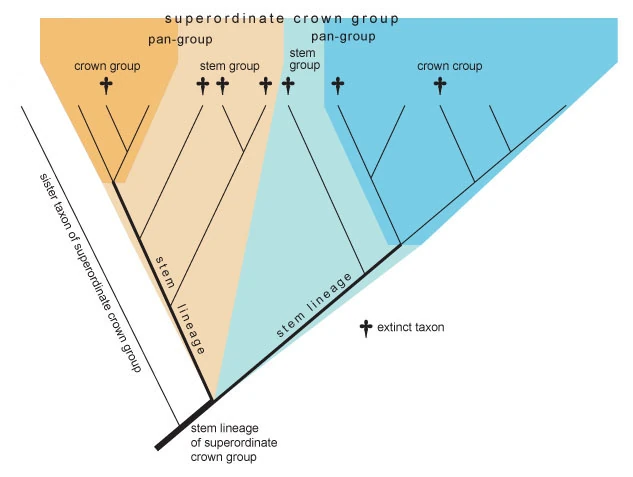
A collection of species on a clade that includes all living (extant) members of a linage, their most recent common ancestor, and all the descendants (living or extinct) of that common ancestor
Crown group

A group of extinct organisms that are more closely related to a specific living group (crown group) than to any other living group, but are not part of that living group themselves.
Stem group
The process of disrupting gene flow between populations
Speciation
The transfer of genes between populations; works against speciation
Gene Flow
Anagenesis leads to cladogenesis if ____
gene flow between groups is stopped
Complete mixing of genotypes across a population
Panmixia
Unequal distribution of genetic variation across a population
Genetic structure
A gradual change in phenotype across a species’ range
Clinal Variation
Speciation arising from divergence of populations that are physically separated in time and space
Allopatric speciation
Speciation arises within a population that is not separated in time and space
Sympatric Speciation
How long before there is greater than 2% genetic divergence in the species-level differences?
1 million years
How long before there is a fixed genetic difference and the possibility of a slight divergence in appearance?
10,000 years
How long before you can start to get major divergence in ecology, body plan, etc.?
10 million years
How long before there is mammalian diversity in a population?
Approx. 225 million years
How long until there is eukaryotic diversity?
Approx. 2 billion years
If the hybrid of two species does not survive to reproductive age, has low fitness, or is sterile, it is considered a ____
Post- zygotic barrier
What is the most common form of speciation in mammals and other animals?
Allopatry
The species concept where species are reproductive units and defines a species as any interbreeding population reproductively isolated from all other populations.
Biological Species Concept
In the Biological Species Concept, the basis for discriminating species is ____
Hybrid breakdown
The species concept that defines a species as any group of organisms with a unique evolutionary history, as diagnosed by one or more traits
Phylogenetic Species Concept
In the Phylogenetic Species Concept, hybridization is ____
irrelevant
The species concept that defines a species as any group of organisms that is genetically isolated from other such groups or any diagnosable (differentiable) group as a species if there’s <2% divergence
Genetic Species Concept
The Genetic Species Concept requires hybrid breakdown, meaning interbreeding cannot___
contribute to substantial gene flow
The species concept that defines a species as a genetically isolated population from other by incompatibilities in uniquely coadapted mitochondrial and nuclear genes
Mitonuclear Compatibility Species Concept
In the Mitonuclear Compatability Species Concept, _____ _____ is key.
hybrid fitness
The coordination of function by the products of the mitochondrial genome and the nuclear genome to achieve oxidative phosphorylation
Mitonuclear Coadaptation
Mitonuclear coadaptation is maintained by ___
Coevolution
Was the dominant land animal for 70 mya until the rise of the dinosaurs; would diversify again in the Cenozoic; origin was 320 mya and would give rise to mammalian lineage ~200 mya later
Synapsida
Put the following in order from mose ancestral to most recent:
a) First birds
b) First dinosaurs
c) First true mammals
d) The vertebrate lineage that gave rise to mammals
e) Lost non-avian dinosaurs
d, b, c, a, e
Origin of the earth was ___
4.54 billion years ago
First organisms/ bacteria arose around ____
4.1-3.5 billion years ago
First vertebrates arose around ___
525 million years
First tetrapods arose around ___
375 millions years ago
The members that would become the lineage to mammals arose in the ___ period or ____ mya.
Pennsylvanian; 320
The first dinosaurs arose in the ____ period, or ___ mya.
Triassic; 250
The first mammals arose in the ____ period, or ____ mya.
Triassic; 200
The first birds arose in the ___ period, or ____ mya.
Jurassic; 150
Early amniotes gave rise to the 2 major lineages:
Diapsids
Synapsids
The first amniotes arose ____ mya, while the first synapsids arose ___ mya
330; 320
Was the dominant land animal for 70 mya until the rise of dinosaurs, and would diversify again in the Cenozoic period, also had the distinguishing trait of a single temporal fenestra
Synapsids
Early Synapsids diverged into 2 major taxa:
Pelycosauria
Therapsida
The following traits describe the _____ taxa that Synapsids diverge into:
Small single temporal fenestra
Do not have reptilian scales
Some osteoderms and dermal scutes
May have had glandular skin
Canine-like teeth develop in derived taxa
Pelycosauria
Name (abbreviated) characteristics of Pelycosauria:
Small temporal fenestra
No scales
Osteoderms and dermal scutes
Possible glandular skin
Canine-like teeth
The following traits describe the _____ taxa that Synapsids diverge into:
Mammalian gait
Larger temporal fenestra
Heterodont teeth
No growth rings in bone (determinate growth)
Nasal turbinates
Hair in some based on coprolites
Therapsida
Name (abbreviated) characteristics of Therapsida:
Mammalian gait
Large temporal fenestra
Heterodont teeth
Determinate growth
Nasal turbinated
Possible hair
There would be a dramatic reduction in Synapsid diversity due to the ________, 252 mya.
End Permian extinction
Abundant animals in the Triassic period, derived from a Therapsid group; had mammal-like characters such as:
Distinct premolars and molars
Tricuspid molars
Double-rooted cheek teeth
Enlarged dentary bone; reduction in size of post-dentary bones
Atlas and axis differentiate
Secondary palate
Earliest mammary glands
Cynodontia
Name (abbreviated) characteristics of Cynodontia:
Enlarged dentary bone
Reduced post-dentary bones
Postcanine teeth well developed
Complete secondary molars
Earliest monotreme fossil dates to ____ mya.
100
A group of organisms descended from a common evolutionary ancestor
Monophyletic group
Groups of organisms derived from more than one common evolutionary ancestor
Polyphyletic group
Fossil that comes from Yunnan Province, China and dates back to ~195 mya; has larger brain than conspecifics and has nearly complete mammalian dentary and ear ossicles
Hadrocodium wui
The Hadrocodium wui fossil has great importance because is serves as a crucial _____
reference point for determining how major mammalian lineages branched off and which ancestral traits appeared first.
Using the change in the number of mutations in regions of the genome that mutate at a relatively constant rate for dating
Molecular dating
If there’s an average of 1 base change per 25 million years, and molecular dating tells you that a fossil varies by 8 base changes compared to the living species, how old is the fossil?
200 million years old
The evolutionary splitting and divergence between different biological orders, and involves deeper, older phylogenetic nodes. Under the long-fuse model, this type of diversification is linked to the diversification of angiosperms in the Cretaceous period
Interordinal Diversification
The evolutionary diversification of families, genera, and species within the order, and involves shallower, more recent phylogenetic crown branching. Under the long fuse model, majority of this form of diversification accelerated after the K-Pg extinction left ecological niches vacant by dinosaurs for early mammals to fill
Intraordinal Diversification
Evolutionary timing model that says all diversification occurred within about 10 million years after the K-Pg boundary; supported by fossils
Explosive model

Evolutionary timing model that says interordinal diversification arose in the Cretaceous, order and most intraordinal diversification happened just after the KP-g boundary; supported by DNA
Long fuse model

Evolutionary timing model that says order and families originated in the Cretaceous prior to the KP-g extinctions
Short fuse model

In the Simmons et al. paper, they observe the bat fossil Onychonycteris displays the characteristics of:
small cochlea in its basicranial region
keeled sternum
robust clavicle
no unambiguous evidence of the ability to laryngeally echolocate
Based on this, did flight or echolocation evolve first in Chiroptera?
Flight
Intermediate species from 55-45 mya in the evolution of Artiodactyla to Cetacea that had the Artiodactyl traits of hooves on toes and 2 trochleae on the astragalus, and the Cetacean traits of a thick inner ectotympanic wall, thick cortex in long bones, and teeth that have oxygen isotope ratio that suggests it lived in water.
Raoellidae
First cetacean species from 50-41 mya that had the Artiodactyl traits of eyes high on the skull and a present astragalus, and the cetacean traits of tooth wear matching a piscivorous diet, and a narrow mandibular joint
Pakicetidae