WAM Exam 2
 Call Kai
 Learn
 Practice Test
 Spaced Repetition
 Match
 Flashcards
 Knowt Play
1/194

There's no tags or description
Looks like no tags are added yet.
195 Terms
French Grand Opera
Broad appeal, music spectacle, romantic elements
Syncopation, heterogenous scoring, dynamic contrast, huge forces (Theatricality), coloratura
Plot is usually historical/high class
Rossini
1792-1868
Il barbiere di Siviglia
Wrote 40 operas in less than 20 years then disappeared from opera on his 40th birthday
Could only get paid from opera when he participated in performances (No copyright)
Last 40 years of life were filled with illness but comfy
Irrepressible melody, animated rhythms, clear phrase structure, well-shaped/unconventional periods, sparse texture, orchestration supports voice, simple but unique harmonic schemes
Vincenzo Bellini
1810-1835
Norma
Rose to prominence after Rossini retired
Long, sweeping, embellished, emotional melodies, flexibility of form
18th c. Opera Seria
Romantics didn’t like it
Characters weren’t regular people
Castrati were weird and unnatural
Unrealistic and convoluted stories (nobles, gods magnimity (forgiveness))
Reflected absolutist fictions
Arias imprede the drama too much coloratura), exit arias sucked, too long and predictable, da capo aria is too strict and creates circular stories
Aria
Lyrical, melismatic, reflection on action, text repetition, orchestra plus Basso Continuo
Earlier attempts to reform opera
Comic opera (Opera comique, opera buffa)—Enlightenment attack on Absolutism, low-born characters, vocal ensembles, simpler arias, eliminated castrati, 1720s on
Serious Opera—Some of Comic Opera’s reforms, close recititave/aria gap via orch acc., smoother transitions, 1760s on
REFORM OPERA does NOT count
Romantic Strategies for Opera Reform
Adapt 18th c. opera buffa ensembles, causing actors to interact with each other
Rossini crescendo—repeat passage of music and words, crescendo to create humor and the the illusion of action
Streamline arias to better reflect the drama (da capo becomes double aria—ABA→A(Slower, primo tempo) B( (caballetta)
No more castrati
Fewer exit arias
More flexible singing in recitative (recit, arioso, parlante)
Better transition between recitative and aria
More realistic stories
Opera Ensemble
Anything that isn’t an aria—duo, trio, chorus, etc
Giuseppe Verdi
1813-1901
La Traviata, Rigoletto, Otello
Born in northern Italy—life was hard, oppressed by French and Austrians
Didn’t know counterpoint and was denied entry into Milan Conservatory
Lifelong partnership/marriage with soprano for Nabucco, Giusppena
Early period: 19 operas in 15 years, culminated in 1853-intimate personal tragedy, french culture
Late period: 6 operas in 16 years (1855-1871)—publisher convinced him to return and write Otello and Fallstaff-continuous action, freely combined solos/ensembles/chorus, orchestra treated with originality, reshaped traditional forms to fit drama, Grand Opera influence, return to historical subjects with political ramafications to parallel Italy unification, wrote comic roles, composed for imperial Russian Opera
Last period: After retirement, responsive to new trends, unbroken flow of music—act opera
Helped cultivate national identity (supported Risorgimento/italy liberation movement) though music was rarely overtly nationalistic
Opera as human drama/passion, not romantic nature and mythology—chose stories himself
Librettos with fast action, contrast, unusual characters, strong emotional situations
Weakest connection to bel canto opera compared to Bellini and Rossini
Typical Double Aria Structure
Scena Recitative (before aria starts-instrumental intro and recitative)
Primo Tempo (Slow, andante, cantible)
Tempo di mezzi (ensemble, chorus, transitioon)
Cabaletta (fast)
Typical Duet Structure
Scena Recitative (Action—instrumental intro and recitative)
Tempo d’attacco (opening movement-action)
Slow movement (Stasis)
Tempo di mezzo (action)
Cabaletta (fast-stasis)
French Lyric Opera
Between comique and grand—melodic appeal, romantic drama or fantasy
Turn the dialogue in opera comique into recitative
Parlante
Orchestra has the tune while the voice is declamatory
Aspects retained from opera seria in italian opera reform
Singers rule-excessive coloratura and improvisation (slows drama)
Recitatives and arias are still a thing
Stories are still sometimes focused on highborn characters
Orchestral ritornello at start of sections
Still number opera
Number Opera
Series of selections
Opera=plural of opus
Buhenfestspielen
Festival stage plays—acts of music made visible (music drama—Wagner)
Giacomo Meyerbeer
1791-1864
Los Huguenots
German but wrote French Grand Opera
Opera Comique
Used spoken dialogue instead of recitative and had less contentious plot, contrasting with grand opera
Straightforward comedy or semiserious drama
George Bizet
1835-1875
French
Carmen
Local Color
Subject matter stands out due to regional location—picturesque
Often utilizes folk music and simple tunes/songs, repetition
Paired Phrases and Non-Developing Modules
More exoticism than nationalism
Non-Developing Modules/Paired Phrases
AA BB AA (It’s the same as the first time)
Exoticism/Orientalism
Glorification (also villification) of foreign places
Ex. count of monte cristo reading
The East/Exotic is unknowable and incomprehensible—both alluring and terrifying to the European (male) imagination
Sensual Gratification theme of Exoticism
Luxury/Hedonism: Personal comfort, indolence and freedom from work, promise of sexual fulfillment
Aesthetic delight: Visual (Jewels, precious objects), sensual (taste, smell, exotic foods/odors/coffees), general appreciation of the voluptuous/over-ripe/excessive
Enchantment (Fantasy, Imagination): Drugs (Hashish, tobacco), sensual and aesthetic overload
Self-Indulgence theme of Exoticism
Violence/Brutality: Never far away, could happen anytime
Authoritarianism (Absolute power wielded by one man): Master and devoted slaves, arbitrary punishment (no proper judicial process), luxury/enchantment made possible by fabulous wealth
Irrationality: A world of outsized desires and seemingly random/illogical whims
Musical consequences of exoticism
Stylistic innovation—unusual scales (like the Seguidilla), repetitive figures and unusual harmonic rhythm (Habanera)
German Romantic Opera
Developed in 18th century (Strong opera tradition already in France and Italy)—less rooted in tradition so they can make more dramatic changes
Use german subject matter/culture
Put in german language
Use traits of traditional german music (Symphony, leid, chamber music)
Philosophical/ethical/spiritual subtexts
Orchestral commentary and extramusical depiction
Less vocal lyricism and text repetition
Fewer numbers in opera
Fewer starts and stops (for aria/recit/applause)
Increased dramatic opportunity
Thematic integration, cyclicism
Large scale tonal organization
Richard Wagner
1813-1883 (German)
Tristan und Isolde, Das Rheingold
Political Revolutionary and German Nationalist
Radical reformer of opera
Music style: Orch. comments on action and more important than voice, heftentenor (hero tenor—to cut through orchestra), voices are less lyrical and more syllabic, Leitmotifs, prose libretto w/o repetition, extended harmonies
No number opera, music drama instead (For better dramatic continuity)
Womanizer, asshole, borrowed money and never paid it back, egotistical (called his work the music of the future)
Leitmotifs may be varied or transformed as the plot develops
Leitmotifs
Small musical idea with extramusical associations
Stabriem
German medieval literary technique of alliteration—Wagner used it (nationalism)
Gesamtkunst
Total work of art
Like how Wagner did libretto and composition and set design (total control)
Jean Sibelius
1865-1957 (Finnish)
Finlandia
Incorporated themes of national identity into music even after Finland gained independence from Russia in Revolution of 1917
Finland’s leading composer by 1890s, supported by gov’t from 1897-death
Turned toward international audience around 1900 (difficult to balance)
Modal melodies, simple rhythms, insistent repetition of brief motives, pedal points, strong contrasts or orchestral timbres/colors
Piotr Il’yich Tchaikovsky
1840-1893 (Russian)
Symphony 4 (Finale), Symphony 6 (3rd mvmt)
Reconciled international and national styles
Memorable tunes and folk melody/rhythms
Born in distant providence of Russia, moved with family to St. Petersburg, graduated law school at 19
4 years as civil servant before enrolling in new St. Petersburg Conservatory
Taught at Moscow Conservatory for 10 years
Gay, depressed, attempted suicide multiple times
Died 9 days after premiere of 6th symphony (called Pathetique as harbinger of death)
Anton Rubenstein
1829-1894, Russian
Westernizer virtuoso pianist and composer who founded St. Petersberg conservatory in 1862 on western model
Brother to Nikolay Rubenstein
Raised Russian Musical standards
Nikolay Rubenstein
1835-1881
Pianist who founded Moscow Conservatory in 1866
Brother of Anton Rubenstein
Raised Russian Musical standards
Career in Navy
Bedrich Smetana
1824-1884 (Czech/Bohemia)
Nationalist composer
Antonin Dvorak
1841-1904
Slavonic Dances, Piano Quintet in A major
“Friendship” with Brahms, sometimes called Bohemian Brahms
Heroism and communal feeling were good for communicating nationalism
Truly nationalistic music derives from folk traditions
Many pieces are international style—Spent time in America, England, Russia
Peasant background, prof of comp at Conservatory of prague
Inspired by Smetana—Dance rhythms, melodic inflections of rustic popular/village music (Bohemian fairy tales, slavic history)
Modest Musorgsky
1839-1881 (Russian)
Within Four Walls, Boris Godunov (these works do not use thematic transformation)
Most Original of Mighty Handful
Imitated russian speech, lifelike musical depiction of gestures
Realism plus nationalism and individuality
Syllabic, accents/higher/louder notes on strong beats
Vocal music tends to lack lyrical melodic lines, symmetrical recitative w/o falling into its conventions—attempt to capture rhythms of everyday speech
Melodies like russian folk song—Narrow range, rise at beginning of phrases and sink to cadences, often repeat 1-2 melodic/rhythmic motives
Tonal/modal/non-functional harmony, rarely used actual folk melodies, repeat and accumulate large blocks of material rather than continuous development
Unusual timbres
Worked in mainstream (french/german) genres
Mighty Handful
Nationalistic—anti-traditional music education
“Moguchaya Kuchka”
Mily Balakirev (1837-1910)-leader and informal teacher, only one with conventional music training
Aleksander Borodin (1833-87)
Cesar Cui (1835-1918)
Modest Musorgsky (1839-81)
Nikolay Rimsky-Korsakov (1844-1908)
Nikolay Rimsky-Korsakov
1844-1908, Russian
Prof at st pete conservatory in 1871-abandon anti-music-ed view
Championed russian music, incorporated folk tunes and their melodic characteristics
Completed orchestral works by Glinka and Musorgosky to ensure their survivall
Taught next-gen composers—Stravinsky
Programatic works
Giacomo Puccini
1858-1924 (Italian)
Madama Butterfly
Italian trad: Vocal lyricism above all, hidden numbers (verdi), plots about human passion
Influenced by Wagner (more prominent orchestra, thematic integration, extended harmony, prose libretto)
Surrealism
Comes out of the modernist movement, based off of Freud’s “dream world”—abstract
Claude Debussy
1862-1918 (French)
En sourdine, Reflets dans l’eau, Nuages
Took Wagnerian harmony w/o resolution (Loved Tristan)
Impressionist/symbolist
Exotic and symmetrical scales, extended rich harmony
Defies conventional tonal relationships between chords
Inspired by javanese gamelan
Maurice Ravel
1875-1937
Soupir, Rapsodie espagnole mvts 1 and 2
More assimilator than impressionist—variety of influences
Traditional forms, diatonic melodies, complex harmonies with tonal language
Spanish idioms but also French and Russian, international popular music
19th century musical nationalism
A search for a distinctive national musical style that’s different from the mainstream
Achieved via use of national language (lyrics, score indications), national subject matter, national musical traits and traditions (vernacular materials)
Often in service of a national political cause (strengthen society, internal reform/unification, independence)
Must overlap to some extent with mainstream in order to compete
Europe’s musical leaders
Before 1860-Italy and France in Opera, Germany in Instrumental music
After: Austro-German Tradition
Vernacular materials
Used in nationalist music
Common culture—hymns, dances (middle class), folk music (lower class)
Traits common to nationalistic music (From folksong)
Take from folk tradition
Sounds awkward/crude/unusual
Paired phrases/Non-Developing Modules, repetition
Modal or unusual scales
Rhythmic color (snap, hemiola, syncopation)
Harmonic or timbral color
Diverge from traditional forms
Awkward leaps
Strange performing styles
Unusual phrase lengths
Narrow melodic range
Russian Internationalists
Rubenstein Brothers and Tchaikovsky
Dramatic realism/organic continuity in 19th-century opera
Stories were more centered in contemporary times and had more realistic plotlines
Verdi strove for this via his reforms
Coloratura
Virtuosic runs/embellishments by opera singers
It became less frequent/more controlled
Castrato
Boys who had the snip snip :(
They can sing really high—opera
Also had large torso, small head, were too tall (broken growth plate)
Romantics thought they were weird and unnatural
Da capo aria
ABA’ (results in circular plot, too much coloratura in A’')
Cadenza
Improvisatory section for singer to show off virtuosity/show emotional processes that reflect character’s mindset in opera
1) its occurring near the conclusion (i.e. “cadence”)
of a movement where 2) the orchestral accompaniment drops out and 3) the soloist is heard alone in a free improvisatory style where 4) the meter and rhythm are very flexible, begin on a I 6/4 chord, the elaborate melisma (since this is a vocal cadenza), and the word repetition at the end
Ritornello
Orchestral introduction section at beginning of pieces such as concertos and arias
Themes are introduced here
Often started to be cut in opera reform
Opera Buffa
Italian comedic opera
Bel Canto Opera (Characteristics)
Italian for “Beautiful Singing”
Sounds easy, good tone, wide pitch range, embellished/florid melodies
Voice most important
Affected other genres, such as Chopin’s Nocturne in Db
Term created in retrospect to contrast with older, heavier dramatic singing styles
Ex. Il barbiere di Siviglia, Act I, Una voce poco fa
Recitative
Declamatory style of singing, not lyrical
In contrast with the aria, used to develop plot/action
Scena=orchestral introduction+recitative
Rapid-fire declamation, syllabic, action takes place, no text accompaniment, Basso Continuo accompaniment
Arioso
Lyricism of aria but in freer form
Unsustained melodic and accompanimental patterns—short, aria-like passage
Finale
Often involving many characters and chorus
Scena (Instrumental intro and recitative
Lyric Dialogue
Concertato (slow)
More lyrical dialogue
Stretta
Rossini Crescendo
Repeat passage of music and words, crescendo to create humor and the the illusion of action
Spoken dialogue/melodrama
Happened more with reformed Romantic opera
Melodrama is spoken dialogue over orchestra
Ex. Der Freischutz
Ostinato
A small figure repeated over and over again
Often used in modernist music to undermine sense of meter
Ex. stravinsky’s rite of spring
Pitch class analysis
Writing down all the pitches in a section to figure out the key/scale
Parallelism
Use of consecutive parallel 5ths and octaves, becomes more prevalent in modernist music
Non-functional/directional harmony
Showed up in modernism to break standard harmony tradition
Idea is to disrupt normal syntax
Take pleasure in here-and-now rather than yearning for resolution
Musical Symbolism
Like extramusical significance—the music is saying something
Music Drama
Wagner invented it because he had too many issues with Opera—primarily, this new form focused more on the orchestra and music’s power of narrative rather than libretto/vocals
Poetic vs. prose libretto
Poetic: Text repetition, melodic/lyrical, end rhyme
Prose: Little/no repetition and rhyme, more spoken than lyrical
Music of the Future
The end goal for the progressives/new german school—Wagner said he was writing it
New German School
-Most progressive side of Austro-German tradition
-Most progressive of progressives
-Liszt, Strauss, Mahler, Bruckner, Wagner
Led us to the modern era
Wandering Tonality
Ex. Prelude to Tristan and Isolde
Constantly modulating so that it’s hard to pinpoint the key
Most associated with Wagner
Harmonic/timbral/rhythmic color
Qualities present in lots of nationalistic music for its resemblance to folk music
Thematic integration (4 techniques)
Permeation of motivic or thematic material throughout a theme/mvmt/work for purposes of formal/structural unity
Organic thematic/motivic development (Theme develops in an open-ended fashion—asymmetrical themes)
Cyclicism (Material from 1 mvmt reappears in different mvmt)
Thematic transformation (Where a melody is altered via [] to have a different mood)
Developing variation (Brahms) (theme that is symmetrical but developing simultaneously, can influence accompaniment—structural technique that links to later themes, philosophically shows underlying unity in universe)
Honorable mention to leitmotifs
Brindisi
Drinking song, common opera form
ex. the section from Verdi’s Otello
(sounds like Brandy (drink))
Subject matter
The difference between nationalism and exoticism (both used similar musical traits)
What the music’s talking about
Dumka
Ex. Dvorak’s Piano Quintet (2nd movement), Slavic dances
Slavic dance style—thoughtful/melancholic suddenly switching with exuberance
Duple rhythm, triple meter
Kuchka
Another name for the Mighty Handful/5
Modal scales
Common trait of exotic or nationalistic music
Helped push style away from diatonic scale and into symmetrical scales of the Modernist era
Ex. Phrygian in Carmen, Lydian in Halling
Russian realism
Focus on working class life (connections to democracy)
Identification with the poor
Ex. Boris Gudonov’s hero was NOT the Czar
Mosaic form
Non-developmental juxtaposition of sections (Not organically developing)
Also an example of primitivism
Ex. Ravel’s Rapsodie Espagnole
Modernism
The rejection of traditional processes in the arts
Gradual process originating in late Romantic period, goes until late 20th c.
Shows up in all arts, but shows in music as rejection of common practice period
Implicit critique of mass culture
Past is still model—continue developing tradition
Common practice period
1600-1900
Traditional expectations in regards to basically every musical quality
Symmetrical vs asymmetrical scales
Symmetrical: Octatonic, whole tone, chromatic
Asymmetrical: Diatonic, pentatonic
Octatonic scale
8 notes in scale: WHWH pattern or HWHW
Allows for 4 different leading tones
Whole tone scale
1 note less than the usual scale, it’s made completely of whole steps (no leading tones)
Chromatic scale
All half steps
Pentatonic scale
5 note scale
Major: 123 56
Minor: 1 345 7
Asymmetrical
Ex. Madama Butterfly (sounds Asian), B section of Nuages
Symbolism vs impressionism
Turn of the century french art
Symbolism: Sensual and bodily pleasure, synesthetis, personal fantasy—broken grammar, unclear syntax, ambiguous meaning, melodie—literature/poetry
Impressionism: Moody and elusive images—create a mood picture to evoke emotions and senses at a glance, program music—visual arts
Both: Transcend petty concerns and focus on here and now—indirection, soft dynamics, slow tempos, extended harmonies, metrical ambiguity, static harmony, fragmentary/non-lyrical harmony, discouraged tonal center/functions, SOCIAL CRITICISM
Rhythmic/metric ambiguity
Created by use of super slow tempos, ostinatos (flowing, repetitive)
Suspended/static harmony
Created via slow harmonic rhythm, inverted chords
Fin de siecle culture
“Turn of the century” culture—things are wild and changing fast
Wagnerism
Many composers were inspired by the works of Wagner, especially in Tristan and Isolde, and used his techniques—Debussy, Strauss, etc
Prose libretto, denial of functional harmony, etc
Cult
Synesthesia
Associated with Symbolism—one bodily sensation triggers another—combination of senses
Una corda
The first pedal on a piano—only strikes 1 of 3 strings of a note, creates a muted sound
Unusual timbres like this evoked new states (Modernism)
As seen in Duparc’s Extase
NOT an extended technique
Melodie
French art song—text set to music—symbolism
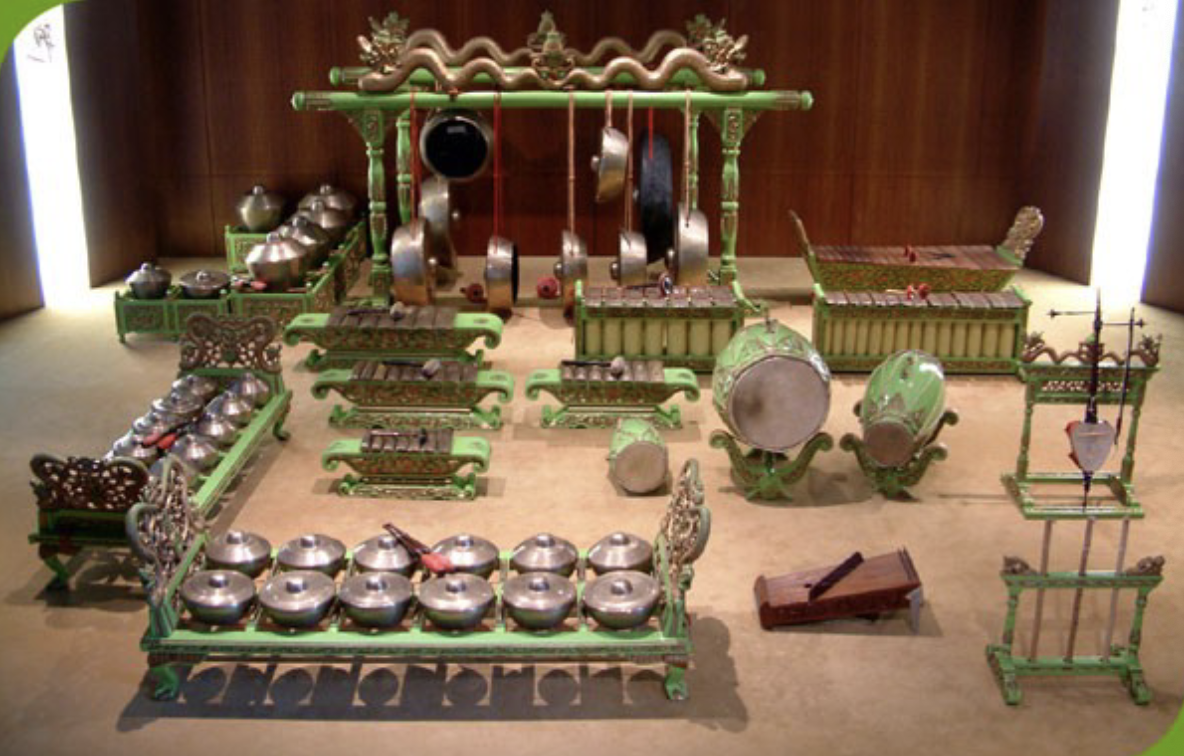
Javanese gamelan
Debussy was fascinated by it after hearing a piece at the world fair
Ensemble of mostly percussive instruments
Uses unusual scales, heterophony
Origins in temples/courts—local rulers
Heterophony
2 voices play 1 melody slightly differently from each other
Ex. Javanese gamelan
Primitivism
The deliberate incorporation of the unsophisticated, elementary, naive art for purposes of stylistic innoation and social criticism
Parallels Romantic elements (folk)
Ballets Russes
The Russian Ballet (Performed in Paris)
Polychord
2+ chords on top of one another (Combine simple chords)