MATH-C2210: CH 2 - LIMITS
 Call Kai
 Learn
Learn Practice Test
 Spaced Repetition
 Match
Match Flashcards
 Knowt Play
1/22

There's no tags or description
Looks like no tags are added yet.
Name | Mastery | Learn | Test | Matching | Spaced | Call with Kai | Chat |
|---|
No analytics yet
Send a link to your students to track their progress
23 Terms
What is the definition of a limit?
If f(x) is defined when x is a number a, then the limit of f(x) as x approaches a will equal L.
When the limit of f(x) as x approaches a, will x ever equal a?
NEVER!!!!!!!!!!!!!
What are one-sided limits?
Limits in which x approach a number a, from either the right or left side of a.
When would the limit of f(x) as x approaches a number a, exist?
Both sides of the limit of f(x) as x approaches a from the left and right side are equal.
How are infinite limits defined?
When the limit of f(x) as x approaches a (from the left / right), equals ± infinity, it means the values of f(x) can be as large or small by taking x to be as sufficiently close to a from the left / right, but will never equal a.
What are vertical asymptotes?
Dashed vertical lines that come as close to the intended value, but never equal to its intended value.
How are vertical asymptotes related to limits?
VAs are produced for every infinite limit; limit of f(x) as x approaches a = ± infinity
What is the sum & difference limit law?
If f(x) and g(x) are grouped with a ±, then they can be written as separate limits for f(x) and g(x).

What is the constant multiple limit law?
Constants in front of f(x) can be taken outside the limit. (especially -1!!!)

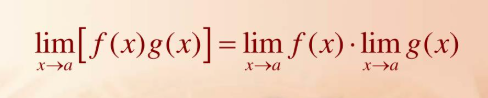
What is the product limit law?
If f(x) and g(x) are grouped, then they can be written as separate limits for f(x) and g(x) with a multiplication sign.
What is the quotient limit law?
If f(x) and g(x) are grouped, then they can be written as separate limits for f(x) and g(x) with a division sign.

What is the power limit law?
If n is an exponent applied to f(x), n can be expanded and applied to the entire limit of f(x).

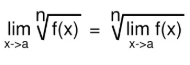
What is the root limit law?
If n is a root of f(x), n can be applied to the entire limit of f(x).
When do you apply direct substitution property?
If f is a polynomial or rational function defined at a (a is in the domain of f), then a can be directly substituted.
What is the Squeeze Theorem?
Suppose f(x) < (or equal to) g(x) < (or equal to) h(x). If the limit of f(x) as x approaches a and the limit of h(x) as x approaches a are both equivalent to L, then g(x) must equal to L.
When do you apply the Squeeze Theorem?
When computing the limit of a trig function, because you are given the domain to set the bounds of the function. (???)
Why are we able to cancel out holes in a rational function?
x will never approach a number a (???)
What is continuity?
The property in which a function experiences no interruptions in its graph (discontinuities)
What are the three criteria that makes a function continous?
+f(a) is defined, or a is in the domain of f
the limit of f(x) as x approaches a exists
the limit of f(x) as x approaches a = f(a)
When is a one-sided limit continous?
When the limit of f(x) as x approaches a from the left/right = f(a).
What seven functions are continuous at every point in their domain?
Polynomials
Rational functions
Root functions
Trigonometric functions
Inverse trig functions
Exponential functions
Log functions
What does the intermediate value theorem state?
If f is continuous on [a, b] and f(a) & f(b) have opposite signs, then there is a number c in (a, b) such that f(c) = 0 (crosses the x-axis)