Application of ABO Discrepancies
 Call Kai
 Learn
Learn Practice Test
 Spaced Repetition
 Match
Match Flashcards
 Knowt Play
1/28

There's no tags or description
Looks like no tags are added yet.
Name | Mastery | Learn | Test | Matching | Spaced | Call with Kai | Chat |
|---|
No analytics yet
Send a link to your students to track their progress
29 Terms
Camelia Caldwell is a 25 year old pregnant female who is in her 28th week of pregnancy. Ms. Caldwell received 2 FFP 3 years ago. She has sickle cell disease but she is not experiencing a sickle crisis and has been doing well for the past 3 years. Her antibody screening was performed 3 years ago and her antibody screen was negative at that time.
She is ordered for a Type and Screen. Her results are below.
What is the interpretation of her forward and reverse types as shown without additional testing results?
Fill in the blanks with one of these: A or B or AB or O as written (upper case)
Anti-A | Anti-B | Anti-A,B | Forward ABO type interp. | |
Patient RBCs | 4+ | 4+ | 4+ | |
A1 Cells | B Cells | Reverse type interp. | ||
Patient Plasma | 1+ | 0 |
Forward Type: AB
Reverse Type: B
Ms. Caldwell has additional testing performed as shown below. Which of the following is the most likely explanation for all of her testing results so far including her original forward and reverse ABO type results?
Anti-A1 lectin | |
Patient RBCs | 4+ |
A2 Cells | |
Patient Plasma | 0 |
cell | D | C | c | E | e | K | k | Fya | Fyb | Lea | Leb | IS | 37C | IgG | Check Cells |
I | + | + | 0 | 0 | + | 0 | + | + | 0 | + | 0 | 0 | 0 | 0 | 3+ |
II | + | + | + | + | 0 | + | + | 0 | + | 0 | + | 1+ | 0 | 0 | 3+ |
III | 0 | 0 | + | 0 | + | 0 | + | + | + | 0 | + | 1+ | 0 | 0 | 3+ |
She is an A2B pateint with an anti-A1 antibody.
She has an acquired B antigen.
She has an unexpected warm-reacting IgG antibody.
She has an unexpected cold-reacting IgM antibody (not anti-A1).
She has an unexpected cold-reacting IgM antibody (not A1)
Based on all of the results and information included so far, what is the most likely antibody causing Ms. Caldwell's positive antibody screening results and ABO discrepancy?
Anti-c
Anti-Le(b)
Anti-Le(a)
Anti-Fy(b)
Anti-Le(b)
How is this antibody from #3 interfering with her ABO typing results?
The reagent B cells are most likely positive for the corresponding antigen (to the antibody selected in #3, example if you said anti-c then the B cells are c pos).
There is no problem with her ABO forward and reverse types; they match.
The reagent Anti-A antisera is contaminated with this additional antibody (the one you selected in #3).
The reagent A1 cells are most likely positive for the corresponding antigen (to the antibody you selected in #3 - example if you said anti-c then the A1 cells are c pos)
The reagent A1 cells are most likely positive for the corresponding antigen (to the antibody you selected in #3 - example if you said anti-c then the A1 cells are c pos)
Remember Ms. Caldwell's history:
Camelia Caldwell is a 25 year old pregnant female who is in her 28th week of pregnancy. Ms. Caldwell received 2 FFP 3 years ago. She has sickle cell disease but she is not experiencing a sickle crisis and has been doing well for the past 3 years. Her antibody screening was performed 3 years ago and her antibody screen was negative at that time.
Based on her history, which of the following most likely explains the results being seen currently:
Pregnancy
Sickle cell disease history
FFP transfused 3 years ago
Pregnancy
For Questions 6 and 7: Mr. Barney Jones is an 88 year old patient presenting to the emergency department of Blue Hen Medical Center experiencing severe shortness of breath and anemia. His ABO typing results are below. What is most likely his true ABO type?
Anti-A | Anti-B | Anti-A,B | |
Patient RBCs | 4+ | 0 | 4+ |
A1 Cells | B Cells | ||
Patient Plasma | 0 | 0 |
Type AB
Type O
Type B
Type A
Type A
Which of the following is the MOST LIKELY explanation for Mr. Jones' ABO results?
He has reduced antigen expression due to his age.
He has acquired B antigen.
He has reduced antibody expression due to his age.
His sample was mislabeled; it is actually a newborn's sample.
he has reduced antigen expression due to his age
Questions 8, 9, 10: A 26 year old trauma patient is transferred from Beebe Health in Lewes, DE to Christiana Care in Newark, DE. Upon arrival, a Type and Crossmatch sample is sent to the Transfusion Service Lab - it was collected at Christiana Care after he arrived.
The patient is named Trauma M, 12345 at this point (not yet identified). The only thing we know is that he was transfused 6 RBCs, 4 FFP, and 2 apheresed platelet products prior to transfer. His results are as follows.
What is MOST LIKELY this patient's blood type?
Anti-A | Anti-B | Anti-A,B | Anti-D | Rh Control | |
Patient Cells | 3+ MF | 3+ MF | 3+ MF | 3+ MF | 0 |
A1 Cells | B Cells | |
Patient Plasma | 0 | w+ |
AB Pos
What is the MOST LIKELY explanation for the FORWARD TYPE results for Trauma M, 12345?
Both the FFP and the Apheresed Platelets were type AB.
He received emergency transfusion of Type A FFP.
He received uncrossmatched O NEG RBCs.
He received emergency type AB apheresed platelets.
He received uncrossmatched O NEG RBCs
What is the most likely explanation for his REVERSE ABO TYPING results?
Both the FFP and the Apheresed Platelets were type AB.
He received uncrossmatched O NEG RBCs.
He received emergency transfusion of Type A FFP.
He received emergency transfusion of Type AB Apheresed Platelets.
He received emergency transfusion of Type A FFP
Ms. Goldie Sunshine is a 24 year old patient who is ordered for a Type and Screen for an emergency caesarian section (C-section) to deliver twins. Previous records indicate that Ms. Sunshine is O POS. Everything goes smoothly, and the babies are delivered. Three days post delivery a new sample is sent to the Transfusion Service Lab after her hemoglobin is tested and the result is 6.5 g/dL.
Her new sample test results are below. Which of the following is an example of a preanalytical error that could have caused these results?
Anti-A | Anti-B | Anti-A,B | Anti-D | Rh Control | |
Patient Cells | 0 | 0 | 0 | 3+ | 0 |
A1 Cells | B Cells | ||||
Patient Plasma | 0 | 0 |
The sample is actually from one of the babies, mislabeled with her label.
The sample was collected too soon after delivery.
The MLS forgot to add reagents to the reverse typing.
The MLS forgot to add plasma to the reverse typing.
The sample is actually from one of the babies, mislabeled with her label
What blood type does this indicate?
Forward
Anti-A: +
Anti-B: 0
Anti-A,B: +
Reverse
A1: 0
B: +
Type A
What blood type does this indicate?
Forward
Anti-A: 0
Anti-B: +
Anti-A,B: +
Reverse
A1: +
B: 0
Type B
What blood type does this indicate?
Forward
Anti-A: +
Anti-B: +
Anti-A,B: +
Reverse
A1: 0
B: 0
Type AB
What blood type does this indicate?
Forward
Anti-A: 0
Anti-B: 0
Anti-A,B: 0
Reverse
A1: +
B: +
Type O
What are the most common causes of unexpected reactions in reverse grouping?
some patients have decreased or inability to produce antibodies
newborns do not begin production till 4-6 m age
elderly patients
pt with leukemias and/or lymphomas with hypo / agammaglobulinemia
patients on immunosuppressive drug therapy
congenital hypo/ agammaglobulinemia
BM transplant recipients
Why can A2 cause an ABO discrepancy?
some A2 individuals produce anti-A1
anti-A1 will react with A1 cells during reverse typing
creates unexpected positive reaction
What are the expected results for an A2 person who produces anti-A1?
Pt RBC with anti-A: pos
Pt RBC with ANti-A,B: pos
Pt RBC with anti-A1 lectin: 0
Pt plasma with A2 cells: may be positive
Pt plasma with A2 cells: - for anti-A1 reaction
T/F: A2 cells do NOT react with lectin wheras A1 cells do?
True
What does this mean?
Anti-A = 4+
Anti-B = 0
A1 cells = positive
B cells = 4+
Anti-A1 lectin = 0
A2 with anti-A1

What is the most likely explanation of the discrepancy?
anti-A1 subgroup

How would you resolve it?
anti-A1 lectin

What do you suspect her true blood type to be?
A2 +
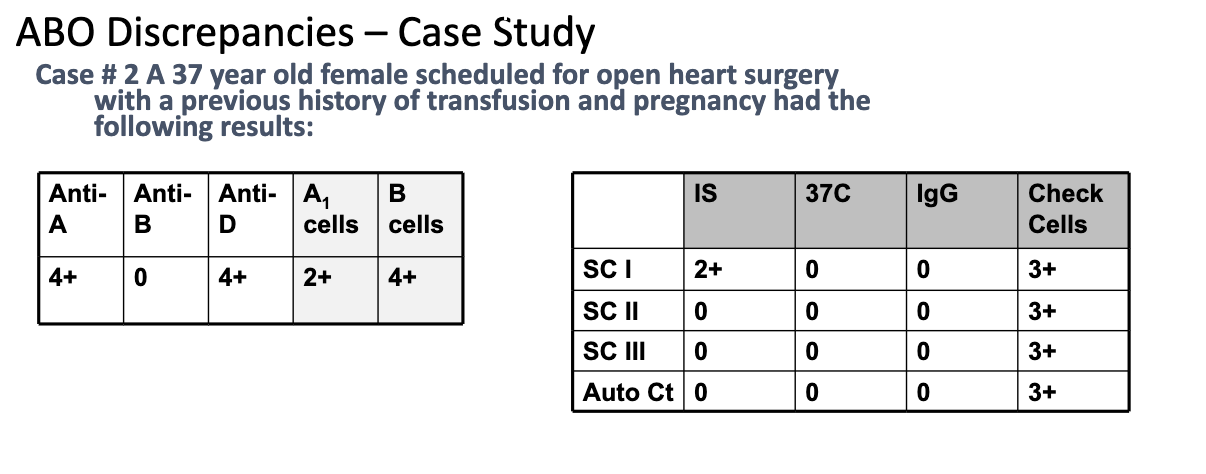
What is the most likely explanation for the discrepancy?
cold reactive alloantibody

How would you resolve it?
Repeat the ABO typing, then follow with anti-A1 lectin testing

What do you suspect her true blood type to be?
A pos

What is the most likely explanation for the discrepancy?
weak or missing ABO antibodies due to old age

How would you resolve this?
repeat forward and reverse typing
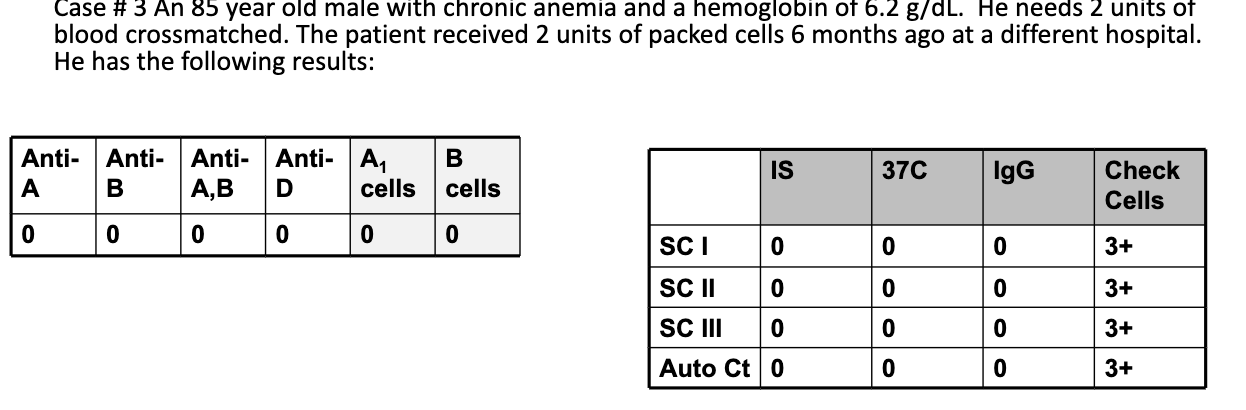
What do you suspect his true blood type to be?
O negative