Digital Divide Week 9
 Call Kai
 Learn
 Practice Test
 Spaced Repetition
 Match
 Flashcards
 Knowt Play
1/33

There's no tags or description
Looks like no tags are added yet.
34 Terms
What is the difference between the traditional definiton of privacy and the current one?
traditionally: hiding your information/personal matters from others (until 1960s), the “right to be alone”
now: not about hiding facts but controlling information flows (who can collect, share, interpret your data)
What is “contextual integrity”?
appropriate information flow depends on social context + expectations, e.g. showing physical address to a food delivery service but not to a marketing agency
What does contextual integrity look like in the medical context?
telling doctors about medical history, allergies, medication you take, height/weight for diagnosis/treatment > strict regulatory frameworks
What does contextual integrity look like in the retail context?
complete contrary to medical context (sharing data for recommendations & order processing)
What does it mean when people say the issue has moved “from concealment to exposure”?
Digital technologies constantly record and track your behavior (you are being observed all the time and you become predictable), even anonymous data can be re-identified
privacy concerns is about information we share but also how it is being collected and used
What does it mean to say that privacy has become a market commodity?
“If you’re not paying for the product, you are the product”.
free online services trade convenience for data
YouTube: watching ads or completing surverys "which of these brands did you get an ad about", you don't have to do that if you pay for YouTube Plus
new services, that sell privacy back to consumers (VPN) > only accessible for people who can pay for that
How does privacy as market commodity enable and reinforce inequality?
higher-income users can afford premium/ad-free services (Youtube Plus) and their data is therefore less exposed, they are better at protecting data because of their digital skills + knowledge (e.g. cookies)
lower-income users cannot afford these premium services and therefore depend on free services, their data is more exposed and they are worse at protecting data (limited literacy)
THEREFORE: lower-income users are exposed to more surveillance + behavioral profiling
So, low-income users are more likely to experience a surveillance risk. What does that mean?
higher risk of being targeted by discriminatory algorithms (+ loan sharks, predatory loans, political messaging)
new form of capital: awareness of data practices + privacy tools
What is surveillance capitalism?
=human experiences as raw material for commercial data extraction and prediction (to predict and influence future human behavior for profit) > data is used even without your agreement
What are the 4 core mechanisms of surveillance capitalism?
data extraction
data processing
commercialization
behavior modification
What is data extraction about (core mechanisms of surveillance capitalism)?
collecting data about consumer behavior beyond what is needed for a service (data =behavioral surplus) (e.g. GPS data from flashlight app) for algorithms that predict behavior
What is data processing about (core mechanisms of surveillance capitalism)?
creating predictive models based on past history with AI and analytics
What is commercialization about (core mechanisms of surveillance capitalism)?
commercialization: sale of prediction products in behavioral futures markets to clients
this person is 50% likely to buy this product > will be sold to other entities (advertisers, insurers, political campaigns) and commercialized, these entities will set up a feedback loop
consumers’ futures are traded as speculative assets
What is behavior modification about (core mechanisms of surveillance capitalism)?
feedback loops shape user actions
What is instrumentarian power (vs. totalitarian power)?
controlling not with force (totalitarian power) but through nudging & automation, algorithms shape possible choices + choice architecture
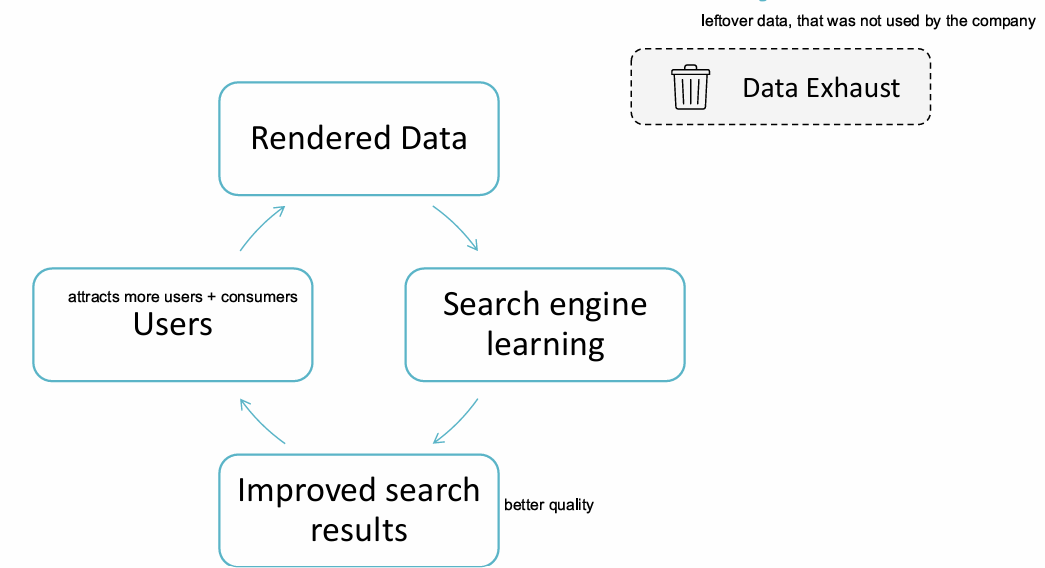
What’s the behavioral value reinvestment cycle about?
use of rendered data → search engine learns → improved quality of search results → attracts more users + consumers (KREISLAUF)
Name three inequality mechanisms that come with surveillance capitalism!
Free-model trap: you pay for the service with your own data (data extraction) instead of money
regulatory asymmetry: stronger data-protection laws mainly protect citizens of wealthy economies (EU vs. Africa)
knowledge gap: understanding algorithms, cookies and consent forms is not something everyone can do
What is consumer autonomy?
ability to govern your own choices and actions in accordance with your own reasons and preferences (consumer protection!)
What are the three relevant dimensions to digital consumer autonomy?
authenticity
competence
independence

Explain authenticity (3 dimensions digital consumer autonomy)!
capacity to act according to your authentic, stable + reflective preferences (not externally imposed ones)
Explain competence (3 dimensions digital consumer autonomy)!
enough cognitive/practical ability to act on your reasons
Explain independence (3 dimensions digital consumer autonomy)!
ability to make decisions free from external pressure/manipulation/structural dependency
What are the differences between persuasion, coercion and manipulation? Refer to key mechanisms and effect on autonomy!
Persuasion: reasons, arguments, can preserve autonomy
Coercion: threats/irresistible pressure, usually undermines autonomy
Manipulation: hidden/undue influence that influences decision-making, can undermine autonomy
What are the 4 mechanisms of manipulation?
Deception
Temptation: e.g. buy matcha/energy drinks because you crave it rather than realizing that it’s expensive for you long term
Emotional steering
framing & context design (3 options: low, medium, high > consumers use medium option)

What is the “dataification of life”?
everyday activities are turned into data to be collected, processed, exchanged + monetized, datafication + data commodification turns human experience into an economic asset

What is Marx’s perspective on data exploitation?
exploitation = appropriation of surplus value produced by labor without equivalent compensation

What is Foucalt’s perspective on data exploitation?
modern power = managing life (health, habits, productivity) through norms + statistics rather than force

What pattern does data extraction usually follow?
core-periphery pattern: core economies own algorithms/analytics/profits, peripheral regions supply data (users, labor, training content)
e.g. image-labelling work outsourced to low-wage regions
What is the paradox of participation?
users think participation = empowerment but participation increases dependency on platform infrastructure (value goes upward not outward)
→ data exploitation reflects class + regional hierarchies
What is predatory inclusion?
marginalized groups are included in markets on exploitative terms (e.g. users who often search “cash advance” or “debt consolidation” get digital ads from sketchy lenders)
What is the EU General Data Protection Regulation?
principles: lawfulness and fairness, purpose limitation, data minimization, accuracy, storage limitation, confidentiality, accountability
data-subject rights: access, erasure, protection from automated decisions
What are the disadvantages of the EU regulation?
consent fatigue (not really practical in daily life)
costs high for small companies
uneven enforcement across EU member states
Compared to the EU, how does the US govern personal data? What are the advantages and disadvantages of that?
no overall privacy law, protection depends on each state, firms rely on notice-and-choice (privacy policy, opt-out possibility)
+flexibility for start ups + AI development
-weak baseline rights -> bigger risk for vulnerable users
How does Korea govern personal data? What are the advantages and disadvantages of that?
Personal Information Protection Act similar to EU regulations, though it allows broader data use for legitimate interests
MyData initiative should give consumers portability + control over their financial data
+more fintech innovation + personalized consumer service
-low data literacy + complex consent structures increase privacy risks