lecture 9 - Mental Health and Neurological Conditions
 Call Kai
 Learn
 Practice Test
 Spaced Repetition
 Match
 Flashcards
 Knowt Play
1/109

There's no tags or description
Looks like no tags are added yet.
110 Terms
Brain based conditions charcteristics
• Can be long-lasting, recurrent or progressive causing major consequences for daily functioning.
• Contributing to disability, premature mortality, reduced quality of life, and social and economic costs.
• Psychiatric conditions can coexist with cardiovascular disease, diabetes and other chronic diseases.
• Effective prevention and management require more than clinical treatment; social, environmental and structural conditions matter.
Brain based conditions examples
Mood and Anxiety Disorders
Schizophrenia
PTSD
Suicide
Migraine
Dementia
Life course approach
exposures and experiences accumulate across the life course
Early-life conditions can influence later health
Opportunities for prevention exist at every stage
Life course approach to brain-based conditions
Childhood:Anxiety symptoms and disorders; migraine onset; early adversities
Adolescence: Depression, anxiety, self-harm, migraine
Young Adulthood: Schizophrenia onset and other mental health conditions
Mid-Life: Mental-physical multimorbidity
Older Adulthood: Dementia, cognitive decline
Global burden of mental health conditions

Determinants of mental health conditions - biological
Genetics / family history
Neurodevelopment
Neurobiology
Determinants of mental health conditions - psychological
Stress response
Coping
Experience of trauma
Determinants of mental health conditions - social and env
Family relationships
Education
Poverty
Discrimination, violence
Employment
Housing
Social determinants of mental health conditions
Demographic
Economic
Neighbourhood
Environmental events
Social and cultural
Social determinants are not simply risk factors they also represent potential targets for prevention and policy action.
Demographic: : Examples of determinants & Potential interventions
Examples of determinants: Gender inequalities, discrimination, adverse childhood experiences
Potential interventions: Violence prevention, antidiscrimination policies
Economic: Examples of determinants & Potential interventions
Examples of determinants: Poverty, unemployment, food insecurity, financial strain
Potential interventions: Cash transfers, income security, employment supports
Neighbourhood: Examples of determinants & Potential interventions
Examples of determinants: Unsafe housing, deprivation, community violence
Potential interventions: Improved housing, safer neighbourhoods
Environmental events: Examples of determinants & Potential interventions
Examples of determinants: War, forced migration, disasters
Potential interventions: Violence prevention, disaster preparedness and response
Social and cultural: Examples of determinants & Potential interventions
Examples of determinants: Education, social support, social exclusion
Potential interventions: Educational opportunities, strengthening social networks
Interpreting Lund et al. framework

Mental ⇄ Physical Connection:Chronic stress
Chronic stress and associated physiological pathways.
Prolonged activation of stress responses → increased blood pressure and inflammation → greater CVD risk.
Mental ⇄ Physical Connection: health behaviours
Sleep, physical activity, smoking and other health behaviours.
→ increased risk of obesity, hypertension, type 2 diabetes and CVD
Mental ⇄ Physical Connection:accessing or maintaining medical treatment.
Difficulties accessing or maintaining medical treatment.
Missed screening, delayed care → poorly controlled chronic diseases (e.g., diabetes) → preventable complications.
Mental ⇄ Physical Connection: metabolic effects
Adverse metabolic effects of some psychiatric medications
Some antipsychotics → weight gain, insulin resistance and dyslipidemia → increased risk of type 2 diabetes and CVD
Mental ⇄ Physical Connection: Pain, disability and functional limitations
Pain, disability and functional limitations
→ disrupted sleep, loss of enjoyable activities and reduced sense of control → increased risk of depression and anxiety
Mental ⇄ Physical Connection: Psychological distress
Psychological distress associated with diagnosis and treatment.
→ fear about the future, uncertainty and ongoing stress → increased risk of anxiety and depressive symptoms
Mental ⇄ Physical Connection: Financial strain, reduced independence and social isolation.
Financial strain, reduced independence and social isolation.
→ illness-related expenses, difficulty working and barriers to social participation → increased risk of depression and anxiety
Depression
• Characterized by persistent low mood and/or loss of interest or pleasure.
• May involve changes in sleep, appetite, concentration, energy and daily functioning.
• Can be episodic, recurrent or persistent.
Biology of Depression
• Changes in brain circuits involved in mood, motivation and reward.
• Altered neurotransmitter signalling (e.g., serotonin, dopamine) and stress-response systems may contribute.
• Genetic susceptibility interacts with stress and life experiences.
Anxiety
• Characterized by excessive fear, worry or anxiety that interferes with everyday functioning.
• Include generalized anxiety disorder, social anxiety disorder, panic disorder and others.
• Symptoms may begin during childhood or adolescence and continue into adulthood.
Biology of Anxiety
• Increased reactivity in brain circuits involved in detecting and responding to threats (e.g., amygdala).
• Activation of the fight-or-flight response can cause rapid heartbeat, muscle tension and heightened alertness.
• Genetic susceptibility, learning and repeated stress can shape these responses.
Global burden of depression and anxiety
• Anxiety and depressive disorders are the most common categories of mental health conditions worldwide.
• They contribute substantially to years lived with disability.
• A large number of people do not receive effective treatment.
• Burden reflects both the number of people affected and the severity and duration of symptoms.
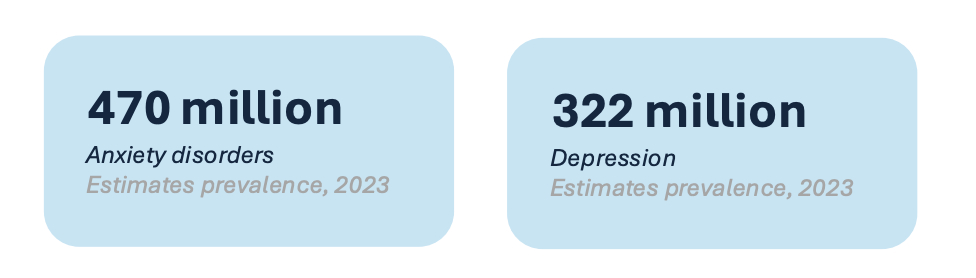
Canadian burden of depression and anxiety: person
• The burden is not evenly distributed across sex/gender and age
• Among young people (15–24 years):
• Major depressive episode: 18.4% of young women+ vs 8.8% of young men+
• Generalized anxiety disorder: 11.9% of young women+ vs 4.8% of young men+
Canadian burden of depression and anxiety: place
• Mood disorders (2023): Higher reported prevalence in Newfoundland and Labrador (17.4%), New Brunswick (16.8%) and Nova Scotia (16.3%), compared with 9.4% in Quebec.
• Anxiety disorders (2021): Higher reported prevalence in New Brunswick (15.1%) and Nova Scotia (14.8%), compared with 8.5% in Quebec.
• Geographic differences likely reflect differences in social, economic, and service contexts
Canadian burden of depression and anxiety: time
• The burden of depression and anxiety has increased in Canada between 2012 and 2022.
• Major depressive episode: 4.7% → 7.6%
• Generalized anxiety disorder: 2.6% → 5.2%
Why has the prevalence of depression and anxiety increased?
Changing in underlying risk
Changes in reporting and measurement
Why has the prevalence of depression and anxiety increased?: Changing in underlying risk
Economic and social conditions
• Financial insecurity, housing instability, discrimination and chronic stress.
Major societal events
• COVID-19 disruptions, social isolation and interruptions to education, employment and support systems.
Changing exposures among young people
• Social pressures, online experiences, sleep disruption and other potentially evolving risk factors.
Why has the prevalence of depression and anxiety increased?: Changes in reporting and measurement
Greater awareness and recognition
• People may be more likely to recognize and disclose mental-health symptoms.
Reduced stigma
• Changing attitudes may influence willingness to report experiences.
Survey methodology
• Differences in collection methods, response patterns and sample composition may affect estimates.
Population Health Interventions
Universal prevention
Economic policy
Early Intervention
Accessible treatment
Universal prevention: example, Prevention level/strategy, Mechanism
Example: School-based socialemotional learning and coping-skills programs
Prevention level/strategy:Primary prevention/Population
Mechanism: Prevent onset of mood and anxiety disorders
Economic policy
Example - Cash transfers, income security and employment supports
Prevention level/strategy - Primary prevention/population or targeted/high-risk
Mechanism - Reduce social and economic risk factors
Early Intervention
Example - CBT-based programs for people with emerging symptoms
Prevention level/strategy - Primary or secondary depending on diagnostic status
Mechanism - Prevent progression of emerging symptoms
Accessible treatment
Example -Publicly funded psychotherapy and stepped care
Prevention level/strategy -Secondary/tertiary depending on who the treatment is targeted to
Mechanism -Reduce symptoms, recurrence and disability
Intervention 1: Income-support to improve mental health
Policy intervention:
Proposed mechanism:
Results:
Policy intervention:Provide cash transfers or income supports to populations experiencing poverty.
Proposed mechanism:Financial support → reduced financial strain and material deprivation → reduced chronic stress → improved mental health.
Results:
• A 2023 systematic review included 17 studies involving 26,794 participants in low- and middle-income countries.
• Cash transfers were associated with a small reduction in depression and anxiety symptoms.
• Improvements were not clearly sustained several years after programs ended.
Economic and social policies can influence mental health without being delivered as clinical health interventions
Financial insecurity → stress and deprivation → depression/anxiety → cash transfers
Schizophrenia overview
• A severe mental disorder affecting perception, thinking, behaviour and cognition.
• Symptoms may include hallucinations, delusions, disorganized thinking and reduced motivation.
• Typically begins in late adolescence or young adulthood.
• Symptoms and long-term outcomes vary; treatment and support can improve functioning and quality of life.
Schizophrenia biology
• Associated with differences in brain development and communication between brain regions.
• Altered dopamine signalling is implicated in psychotic symptoms; other neurotransmitter systems are also involved.
• Genetic susceptibility interacts with environmental and developmental exposures
Schizophrenia – Burden
• Less prevalent than depression and anxiety, but associated with substantial disability and unmet support needs.
• Onset most commonly occurs during late adolescence and the twenties.
• Onset tends to occur earlier among men than women.
• Educational and employment transitions may coincide with the onset of symptoms.

Schizophrenia Life-course implication:
Schizophrenia can emerge during a period when young adults are establishing independence, relationships, education and careers.
Schizophrenia – Premature Mortality
Factors contributing to excess mortality include:
• Cardiovascular and metabolic diseases.
• Infectious diseases and other physical health conditions.
• Barriers to obtaining timely and coordinated health care.
• Social disadvantage and other intersecting risk factors.

Schizophrenia Public-health implication:
Preventing premature morality requires addressing physical health and social conditions, not only psychiatric symptoms.
Schizophrenia – social exclusion and structural barriers
Housing instability and homelessness
Employment and educational discrimination
Stigma and social exclusion
Fragmented health-care services
Social disadvantage can both influence and result from serious mental illness, creating cycles of exclusion and poorer health outcomes.
Schizophrenia : Housing instability and homelessness Potential consequence
Insecure living conditions and difficulty accessing continuous care
Schizophrenia Employment and educational discrimination Potential consequence
Reduced economic security and opportunities for participation
Schizophrenia : Stigma and social exclusion Potential consequence
Isolation, discrimination and reduced social support
Schizophrenia: Fragmented health-care services Potential consequence
Unmet mental and physical health needs and preventable complications
Population health strategies for schizophrenia
Early psychosis intervention
Supportive housing (Housing First)
Supported employment and education
Integrated physical and mental health care
schizophrenia strategy:Early psychosis intervention
What does it involve?
Outcome
Prevention framing
What does it involve: Coordinated teams providing psychiatric care, family support and education/employment assistance
Outcome : Earlier treatment, improved functioning and recovery
Prevention framing: Early treatment and prevention of progression/complications
schizophrenia strategy: Supportive housing (Housing First)
What does it involve?
Outcome
Prevention framing
What does it involve: Stable housing combined with individualized community supports
Outcome :Improved housing stability and quality of life
Prevention framing:Reducing social and health consequences among people with existing illness
schizophrenia strategy: Supported employment and education
What does it involve?
Outcome
Prevention framing
What does it involve: Job placement, workplace accommodations and educational supports
Outcome : Greater participation and economic security
Prevention framing: Rehabilitation, social participation and reduction of disability-related disadvantage
schizophrenia strategy: Integrated physical and mental health care
What does it involve?
Outcome
Prevention framing
What does it involve: Cardiometabolic screening, chronic disease management and coordinated primary care
Outcome :Reduced physical comorbidities and preventable complications
Prevention framing:Prevention and management of physical chronic diseases
Intervention 2: Housing First and Coordinated Care
Policy approach: Address housing and social needs alongside mental-health treatment.
At Home/Chez Soi (Housing First)
• Randomized trial involving people experiencing homelessness and mental illness.
• Participants received housing assistance and community-based supports.
• In the Toronto high-needs group, Housing First participants spent 73.6% of follow-up time stably housed, compared with 27.8% under usual services.
Housing instability, employment and social exclusion → supportive housing and employment programs
PTSD overview
• A mental disorder that may develop following exposure to a traumatic event.
• Symptoms include intrusive memories, avoidance, heightened alertness, and changes in mood or thinking.
• Can cause significant distress and interfere with daily functioning.
• Not everyone exposed to trauma develops PTSD; individual responses and recovery vary.
PTSD biology
• Altered activity in brain circuits involved in fear, threat detection and emotional regulation (e.g., amygdala).
• Changes in stress-response systems (e.g., sympathetic nervous system and cortisol regulation) may contribute to persistent hyperarousal.
• Altered processing of traumatic memories may contribute to intrusive memories and difficulty distinguishing past danger from present safety.
Trauma exposure and subsequent disorder
• PTSD risk varies by the nature and context of traumatic exposure.
• Women experience PTSD more frequently than men.
• Social support after trauma can be protective.
• Exposure to war, conflict and violence is associated with particularly high risk.

Trauma is not randomly distributed
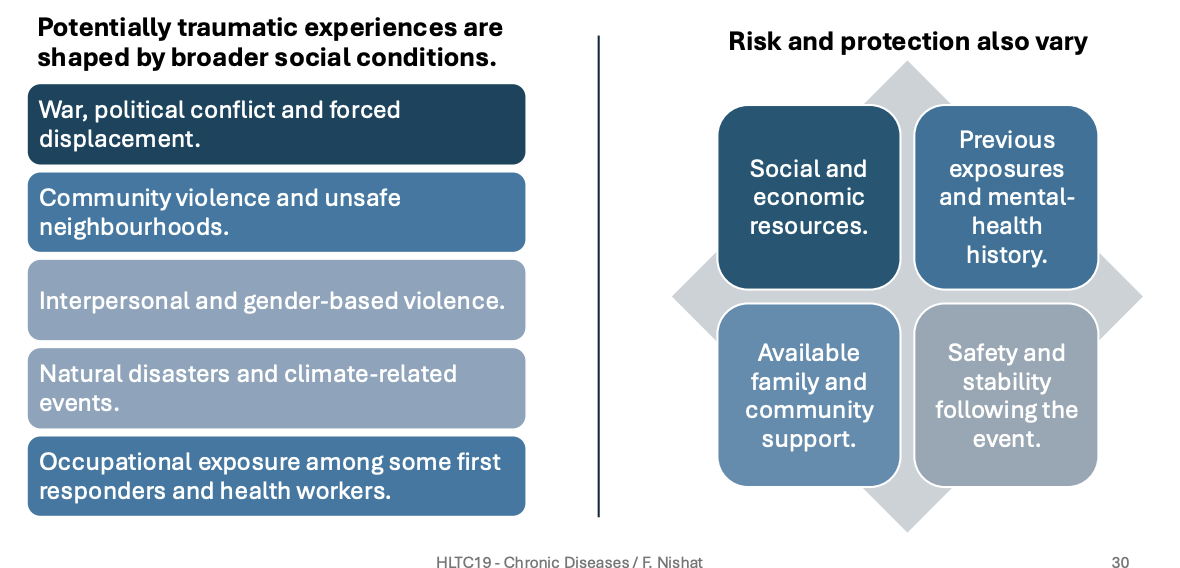
PTSD – Forced Displacement
• Protective factors: Stable housing, family reunification, social support, safety and accessible health services.
• Mental-health outcomes following trauma are affected by both the event itself and the conditions that follow.

PTSD – Opportunities for prevention
Before trauma exposure
Immediately following trauma
Emerging symptoms
Established PTSD
Conflict and displacement → trauma and loss of social supports → PTSD → prevention and post-trauma support
ptsd prvention oppurtunity: Before trauma exposure
intervention
outcome
When: Before trauma exposure
Intervention: Violence prevention, safer communities, protection from abuse
Outcome: Reduce exposure to potentially traumatic events
ptsd prvention oppurtunity:Immediately following trauma
intervention
outcome
When: Immediately following trauma
Intervention: Safe housing, practical assistance, social support and follow-up
Outcome: Reduce ongoing adversity and support recovery
ptsd prvention oppurtunity:Emerging symptoms
intervention
outcome
When: Emerging symptoms
Intervention: Active monitoring and targeted trauma-focused CBT when indicated
Outcome: Prevent persistent PTSD symptoms and functional impairment
ptsd prvention oppurtunity:Established PTSD
intervention
outcome
When:Established PTSD
Intervention: Trauma-focused cognitive behavioural therapy, eye movement desensitization and reprocessing, and ongoing psychosocial support
Outcome:Reduce symptoms, disability and improve functioning
Suicide
Major preventable cause of mortality
• Suicide is a cause of premature mortality with profound effects on families and communities.
• Suicidal thoughts, suicide attempts and suicide deaths represent related but distinct outcomes. '
• Suicide is associated with mental disorders but cannot be explained by psychiatric diagnoses alone.
• Risk reflects interacting psychological, biological, social, cultural and environmental factors.
• Prevention requires coordinated action across health care, education, social services and government.
Global burden of suicide
• Suicide was the third leading cause of death among people aged 15-29 globally in 2021.
• The global age-standardized suicide mortality rate declined by approximately 39.5% between 1990 and 2021.
• But hundreds of thousands of people continue to die by suicide annually.

Canadian burden of suicide - person
• Men account for approximately 75% of suicide deaths, with mortality rates nearly three times those of women.
• Highest rates are generally observed among men ages 45-64 and women ages 20- 24.
• Suicide is the 2nd leading cause of death among Canadians aged 15-29, after accidents.
Canadian burden of suicide - plcae
• Suicide mortality rates varies across Canada.
• Higher rates in Manitoba, Saskatchewan and the territories.
• Lower rates in Ontario.
• Differences may reflect varying social circumstances, access to services and other factors, although the geographical pattern alone does not establish causation.
Canadian burden of suicide - time
• Approximately 4,500-5,000 suicide deaths annually in Canada during 2020–2023.
• Age-standardized mortality rate: 11.8 deaths per 100,000 in 2023.
Contributors to suicide risk - Individual/Clinical
Previous suicidal behaviour
Mental disorders and substance use
Chronic pain or other serious health conditions
Acute psychological distress
Contributors to suicide risk - Social and structural
Poverty and economic insecurity
Discrimination, social exclusion and interpersonal violence
Adverse life events, isolation and inadequate support
Exposure to environments with readily accessible lethal means
Contributors to suicide risk - Protective factors
Connectedness and social support
Accessible and culturally appropriate care
Supportive school, workplace and community environments
Suicide - Opportunities for prevention
Individual/high risk approach
Identify people experiencing suicidal crises
Provide safety planning and follow-up
Treat mental-health conditions and address cooccurring needs
Coordinate crisis and ongoing care
Suicide - Opportunities for prevention
Population approach
Reduce access to highly lethal means
Promote responsible media reporting
Implement universal school-based suicideprevention programs
Improve housing and income security; prevent violence
Revisiting Geoffrey Rose, Sick Individuals and Sick Populations
• High-risk strategies provide intensive support to people at greatest identified risk.
• Population strategies change conditions influencing risk across a whole population.
• A comprehensive suicide-prevention strategy requires both.
Suicide prevention – WHO approach

Intervention 3: Means restriction as a public health intervention
• Policy approach: Sri Lanka implemented phased bans on several highly hazardous agricultural pesticides during 2008-2011.
• This reduced access to products associated with high fatality rates when involved in poisoning.
• Results
• The restrictions were associated with substantial reductions in suicide mortality (age standardized mortality 18.3 → 14.3 per 100,000).
• Specifically, pesticide related suicide rates dropped dramatically (8.5 → 4.2 per 100,000)
• A relatively small increase occurred in suicide deaths involving other methods.
What are ACEs
• Potentially traumatic experiences occurring during childhood and adolescence (0–17 years).
• Examples include abuse, neglect, exposure to violence, and household instability.
• Associated with increased risk of depression, anxiety, PTSD, substance use and suicidal behaviour later in life.
• Repeated or prolonged adversity can affect stress regulation, emotional development and long-term health.
Adverse Childhood Experiences: A Life-Course Prevention Opportunity
• Strengthen economic security: Income supports, paid parental leave and affordable childcare.
• Support families: Evidence-based parenting programs and early-childhood home visiting. '
• Create safe environments: Violence prevention, safe schools and supportive community spaces.
• Respond to adversity: Trauma-informed services, early support and access to mental-health care.
Migraine overview
• A recurrent neurological disorder characterized by attacks of moderate to severe headache, often accompanied by nausea and sensitivity to light or sound.
• Some people experience aura temporary visual or sensory disturbances.
• Attacks vary in frequency, severity and duration.
• Can substantially affect school, employment and daily activities, contributing to nonfatal disability
Migraine biology
• Altered sensory processing and activation of pain pathways involving the trigeminal nerve.
• Release of signalling molecules, particularly CGRP, contributes to migraine pain.
• In migraine with aura, a spreading wave of altered electrical activity in the brain produces temporary neurological symptoms.
• Genetic susceptibility and factors such as hormonal changes, stress and sleep disruption can influence attacks.
Global burden of migraine
• Tension-type headache was more prevalent than migraine.
• However, migraine accounted for approximately 90% of YLDs attributed to headache disorders

Patters of migraine
• Migraine frequently begins in childhood, adolescence or early adulthood.
• Prevalence is higher among females than males.
• Social and economic disadvantage may influence migraine occurrence,
recognition, management and associated disability.
• Depression, anxiety, sleep difficulties and stress can coexist with migraine.
Migraine frequently overlooked
Despite its substantial disability burden:
• Many people with headache disorders are not appropriately diagnosed or treated.
• Symptoms may be minimized or normalized.
• Access to primary-care expertise, specialist services and preventive treatments can vary.
• Recurrent attacks may affect school attendance and work productivity.
• Frequent use of acute headache medication can contribute to medication-overuse headache.
Reducing the disability burden of migraine
Prevent migraine attacks
Prevent frequent or chronic migraine
Prevent medication-overuse headache
Reduce migraine-related disability
migraine prevention: Prevent migraine attacks
Potential interventions & Intended outcome
Potential interventions:Regular sleep and activity schedules, stress-management programs, education about individual triggers
Intended outcome:Reduce frequency and severity of attacks
migraine prevention: Prevent frequent or chronic migraine
Potential interventions & Intended outcome
Potential interventions:Early identification, access to preventive medications (e.g., CGRP-targeting treatments), structured follow-up
Intended outcome: Reduce migraine days and associated disability
migraine prevention:Prevent medication-overuse headache
Potential interventions & Intended outcome
Potential interventions:Public and provider education on appropriate medication use; access to preventive treatment
Intended outcome:Reduce medication-overuse headache and worsening headache burden
migraine prevention: Reduce migraine-related disability
Potential interventions & Intended outcome
Potential interventions:School/workplace accommodations, accessible treatment and affordable medication coverage
Intended outcome:Improve daily functioning, education and employment participation
Dementia overview
• A syndrome involving decline in memory, thinking and other cognitive abilities that interferes with everyday functioning.
• Not a normal part of ageing, although risk increases substantially with age.
• Alzheimer's disease is the most common cause; other types include vascular dementia, Lewy body dementia and frontotemporal dementia.
• Can affect independence, social participation and quality of life, with implications for families and caregivers.
Dementia biologt
• Damage to brain cells (neurons) and their connections disrupts communication between brain regions.
• In Alzheimer's disease, accumulation of abnormal proteins (amyloid-beta and tau) is associated with neuronal damage and loss.
• Other forms involve different mechanisms, including vascular injury (reduced blood supply to the brain) or abnormal protein deposits (e.g., Lewy bodies).
• Ageing, genetic susceptibility and vascular health influence the risk of developing dementia.
Global and Canadian burden of dementia
Canadian epidemiological estimates, fiscal year 2023–24
• Age-standardized prevalence: 5.75% among adults aged 65+.
• Age-standardized incidence: 1,329 new diagnosed cases per
100,000 adults aged 65+.
• Prevalent case counts have increased over the past two decades.

Increasing burden of dementia
POPULATION AGEING
EPIDEMIOLOGICAL INTERPRETATION
POPULATION-HEALTH CONSEQUENCES
Increasing burden of dementia - POPULATION AGEING
• More people are surviving into older age groups, where dementia is more common.
• Even if dementia risk within each age group remains unchanged, the total number of cases can increase.
Increasing burden of dementia - EPIDEMIOLOGICAL INTERPRETATION
• Increasing case counts ≠ increasing age-standardized rates.
• Changes in survival, diagnosis and age-specific disease risk also influence observed trends.
Increasing burden of dementia -POPULATION-HEALTH CONSEQUENCES
• More people living with dementia increases demand for health and social supports.
• Including community care, long-term care, caregiver support and accessible environments.
Life course determinants of dementia: Early life
Education and cognitive development
Educational opportunities can influence cognitive reserve
Life course determinants of dementia: Adulthood
Vascular and behavioural exposures
Hypertension, smoking, diabetes, and physical inactivit