Perciformes and sculpins
 Call Kai
 Learn
 Practice Test
 Spaced Repetition
 Match
 Flashcards
 Knowt Play
1/59

There's no tags or description
Looks like no tags are added yet.
60 Terms
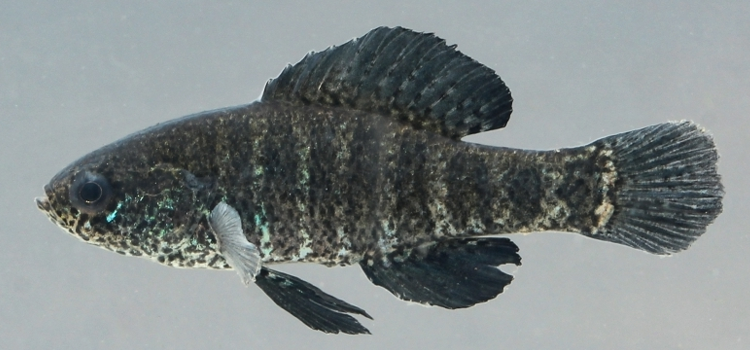
A tiny, darkly barred species of sloughs and swamps
Elassoma zonatum (male)

A tiny, darkly barred species of sloughs and swamps
Elassoma zonatum (female)

Dark and blotchy with 6 anal-fin spines.
Ambloplites rupestris

Note the dark suborbital bar running through the eye and 7-8 anal-fin spines
Centrarchus macropterus

Opercular flap soft, with round, dark spot; often spotted body; large preoperculomandibular pores; long gill rakers. This is a small sunfish, usually less than 100 mm SL.
Lepomis humilis (male)

Opercular flap soft, with round, dark spot; often spotted body; large preoperculomandibular pores; long gill rakers. This is a small sunfish, usually less than 100 mm SL.
Lepomis humilis (female)

Long pectoral fins; dark spot in soft dorsal fin; small mouth; long gill rakers.
Lepomis macrochirus

Short to moderate pectoral fin; small mouth; long opercular flap; wavy lines on face; short gill rakers.
Lepomis megalotis

Long pectoral fins; no dark spot in soft dorsal fin; red spot on posterior margin of operculum (pale in preserved specimens).
Lepomis microlophus

Only one in family without a big lateral stripe. Juveniles have a tricolored caudal fin.
Micropterus dolomieu

Best characters to use are 1) well- connected dorsal fins (nearly separate in M. nigricans); 2) patch of teeth on tongue (no teeth on tongue for M. nigricans from this area); 3) caudal fin tricolored in young-of-the-year (YOY) (bicolored in M. nigricans). The patterning of spots on the sides (see field guide) can be useful.
Micropterus punctulatus

Micropterus nigricans
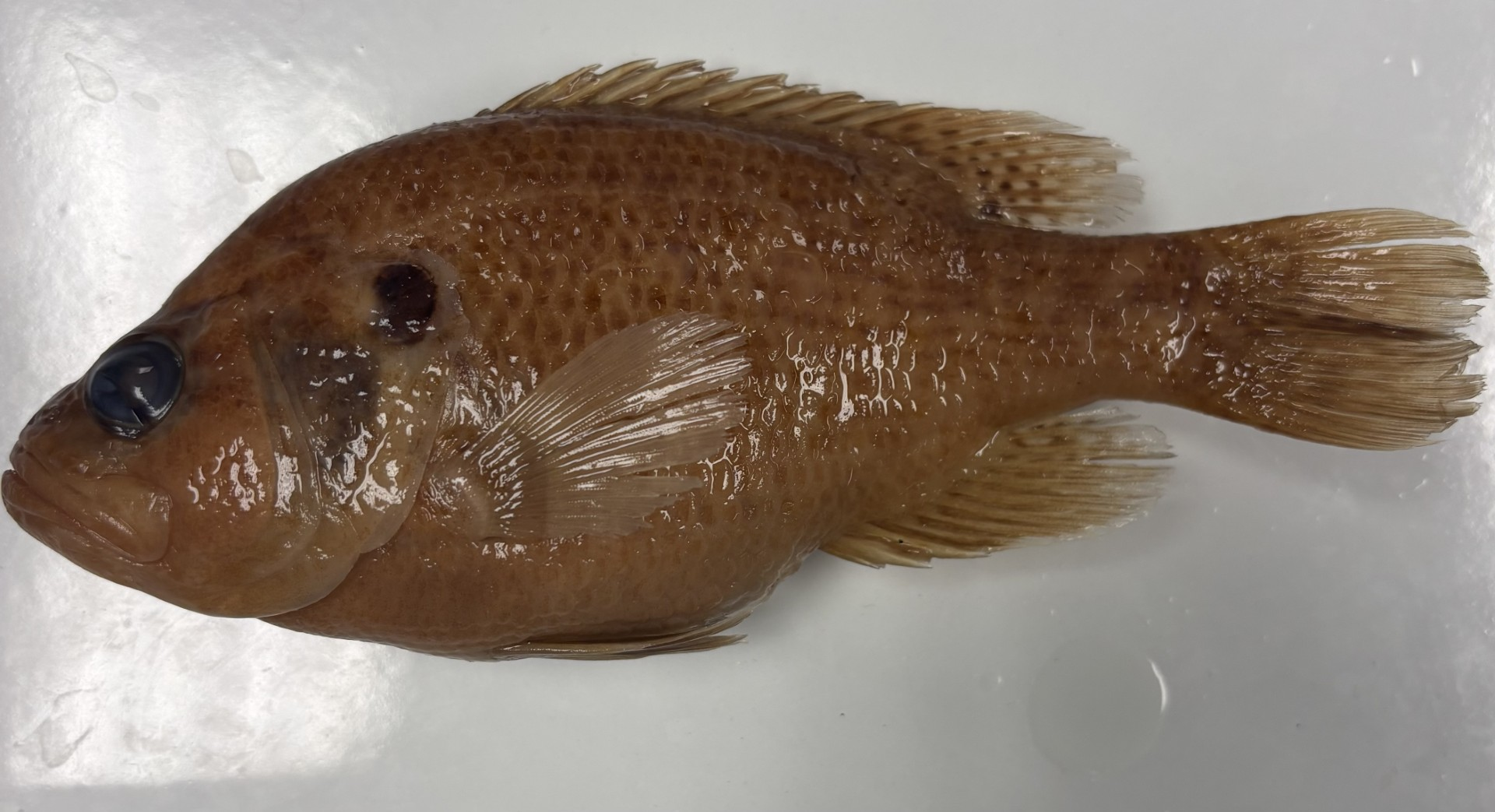
Darkly pigmented; large mouth; patch of teeth on tongue; short fins; 3-4 lines radiating from behind eye
Lepomis gulosus

Large mouth; slender, bass-like body; long gill rakers, short pectoral fin; often dark blotch in soft dorsal fin.
Lepomis cyanellus

Typically has 7-8 dorsal spines and a shorter predorsal region. Usually not as barred as P. annularis, but pigment is instead arranged as scatted spots or blotches
Pomoxis nigromaculatus

In addition to (usually) having only 6 dorsal spines and a relatively long predorsal region, it is vertically barred. All Pomoxis have characteristic large anal and dorsal fins and 6 anal fin spines.
Pomoxis annularis

Orange margin in dorsal fin (white in preservative)
Cottus bairdii

no distinct band in dorsal fin
Cottus carolinae

Stripes along lower side not broken and offset (one or two anteriodorsal stripes may be incomplete); deep body; short 2nd anal fin spine.
Morone chrysops

Stripes along lower side broken and offset; long 2nd anal fin spine.
Morone mississippiensis

Similar to M. chrysops but has more distinct stripes along its side and a more slender body. Compare the profiles and slope of the nape area. Also known as “stripers” or “rockfish” or “rocks.” Short 2nd anal spine.
Morone saxatilis

Large fish with a subterminal mouth, long but divided dorsal fin, and rounded caudal fin
Aplodinotus grunniens

Translucent in life. In preservation, white with a row of dark dashes. The most slender and most pale of all the darters on your list.
Ammocrypta pellucida
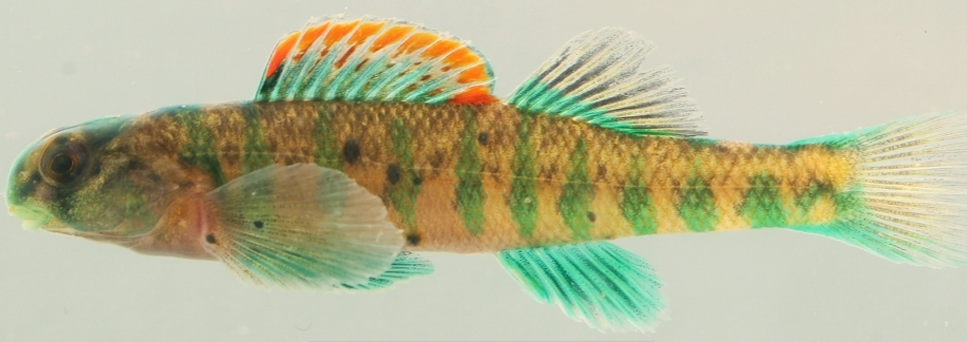
A small darter with a row of square blotches on sides, broadly connected gill membranes, and an extremely blunt snout.
Etheostoma baileyi

Characterized by U-shaped lateral blotches and a blunt snout.
Etheostoma blennioides (female)
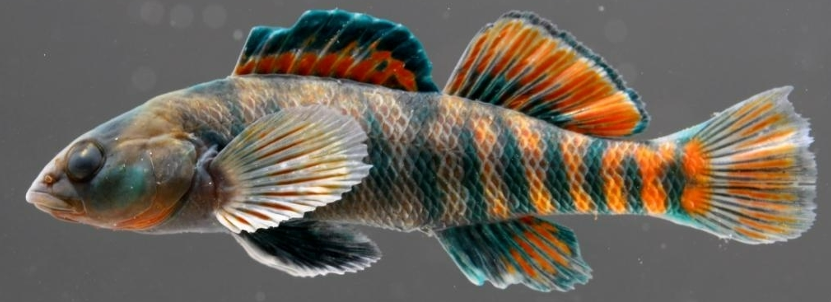
Relatively pointed snout; oblique bars on caudal peduncle; rainbow colors in life; gill membrane narrow
Etheostoma caeruleum (male)

Relatively pointed snout; oblique bars on caudal peduncle; rainbow colors in life; gill membrane narrow
Etheostoma caeruleum (female)

They have round caudal fins, flattened heads, and usually short dorsal fins. Note the pigment patterns
on the spiny dorsal fin, body, and caudal fin.
Etheostoma flabellare (male)

They have round caudal fins, flattened heads, and usually short dorsal fins. Note the pigment patterns
on the spiny dorsal fin, body, and caudal fin.
Etheostoma flabellare (female)

A small, pale darter with a few W-shaped markings on the side and hourglass-shaped saddles on the dorsum
Etheostoma gore (male)
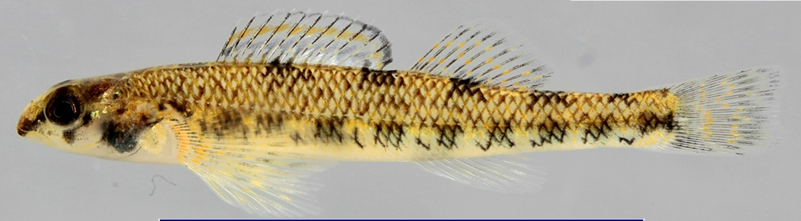
A small, pale darter with a few W-shaped markings on the side and hourglass-shaped saddles on the dorsum
Etheostoma gore (female)

Small darter with a humped back and an incomplete lateral line, which is arched sharply upward. Greenish vertical bars may still be present on some of our specimens.
Etheostoma gracile
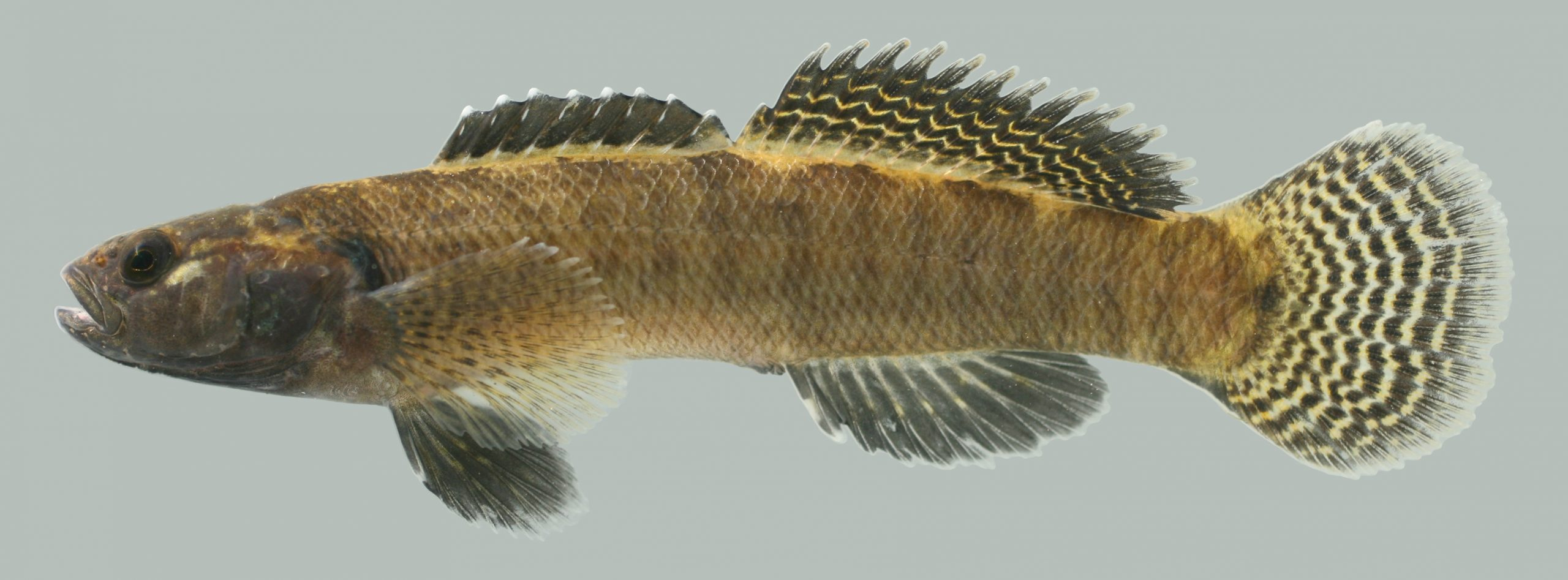
has a dark band in the spiny dorsal fin and a more prominently banded caudal fin.
Etheostoma kennicotti

This threatened species has a row of spots along the sides that are attached to pale, oblique bars. The appearance is of smeared blobs of ink. They also have red lips in life, which may still be present on some of our preserved specimens
Etheostoma maydeni

Small, plain fish with a series of X and Y-shaped markings.
Etheostoma nigrum

Slender, pointy-headed fishes with U-shaped markings on the sides
Etheostoma sagitta

differs from the similar E. caeruleum in having thin lines along the side (vs absent); 11-12 pectoral rays (vs 13); interrupted infraorbital canal (vs. complete infraorbital canal). In addition, — tends to be more humpbacked.
Etheostoma spectabile (male)
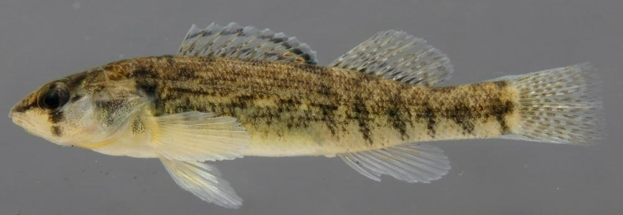
differs from the similar E. caeruleum in having thin lines along the side (vs absent); 11-12 pectoral rays (vs 13); interrupted infraorbital canal (vs. complete infraorbital canal). In addition, — tends to be more humpbacked.
Etheostoma spectabile (female)

three vertically arranged spots at the base of the caudal fin. Breeding males have ornate soft
dorsal fins.
Etheostoma squamiceps
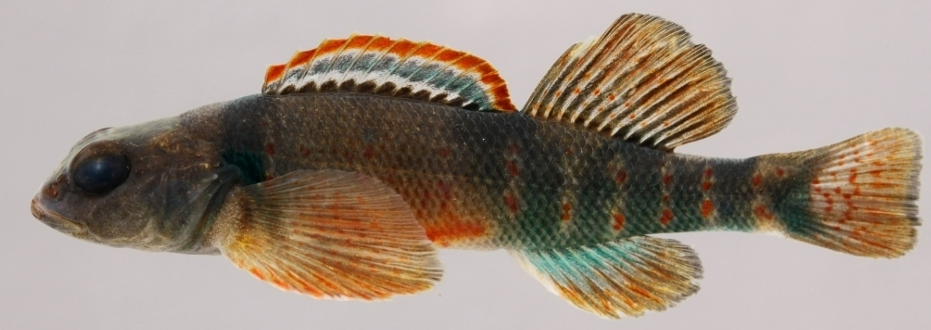
Large; blunt snout; four dark saddles (indistinct on large males); gill membranes broadly connected. Males are gaudily colored in the summer, and to some extent the rest of the year. Big, alien eyes
Etheostoma variatum

stripes on the side. Somewhat similar to Nothonotus species but has a rounded caudal fin and a distinctive head.
Etheostoma virgatum

Its only good character, green bars on the sides, fades in preservation. It has a distinct pattern on the side which is recognizable after seeing several hundred. We will see several hundred on the field trips. Most like E. baileyi, but the snout is not as blunt. Somewhat like E. caeruleum, but — has a blunter snout and has broad gill membranes and vertical bars on the caudal peduncle, not oblique bars.
Etheostoma zonale

is slab-sided with horizontal lines on the sides. Moderately blunt snout with pale submarginal bands in the median fins.
Nothonotus camurus
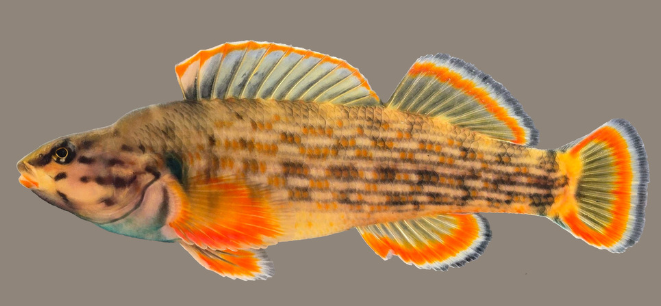
Like N. camurus but has a more pointed snout less distinct stripes. There are two white, vertically arranged spots just anterior to the caudal fin. Also, notice the horizontal markings on the cheek, unique to this species.
Nothonotus rufilineatus

Like N. camurus but has a more pointed snout less distinct stripes. There are two white, vertically arranged spots just anterior to the caudal fin. Also, notice the horizontal markings on the cheek, unique to this species.
Nothonotus rufilineatus

like N. camurus, but has a more pointed head and lacks the distinctive pale submarginal bands in the medial fins
Nothonotus sanguifluus (male)
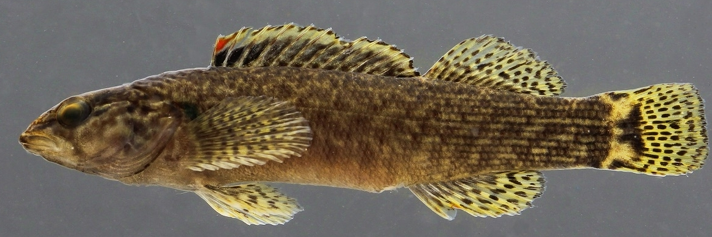
like N. camurus, but has a more pointed head and lacks the distinctive pale submarginal bands in the medial fins
Nothonotus sanguifluus (female)

This tiny species is orange with (usually) narrow, dark saddles and two pale spots at the base of the caudal fin. It does not have parallel horizontal stripes
Nothonotus tippecanoe (male)

This tiny species is orange with (usually) narrow, dark saddles and two pale spots at the base of the caudal fin. It does not have parallel horizontal stripes
Nothonotus tippecanoe (female)

Medium-sized, deep-bodied percid with 6-8 dark saddles
Perca flavescens

Pig-like snout and tiger-striped
Percina caprodes
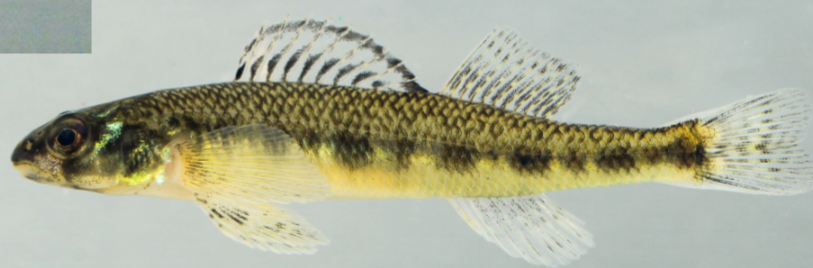
Small connected dashes and dots along sides, but much darker than A. pellucida. Unlike most darters, it lacks a frenum
Percina copelandi

Usually good teardrop; rectangular blotches that sometimes connect on the dorsum, as saddles
Percina evides
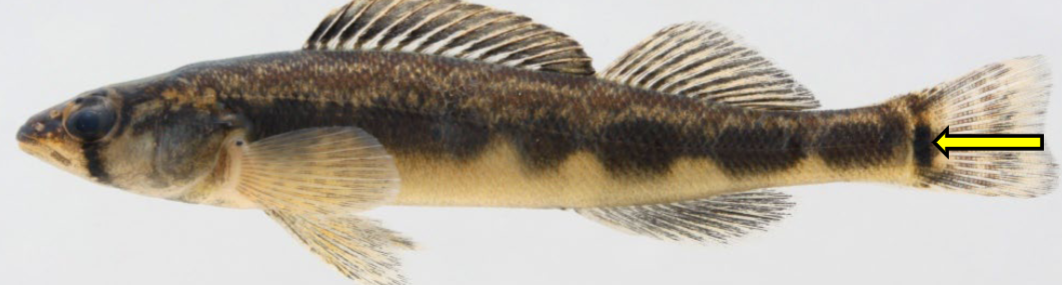
Rounded lateral blotches ending in a single basicaudal spot.
Percina maculata

Check out that pointed snout
Percina oxyrhynchus
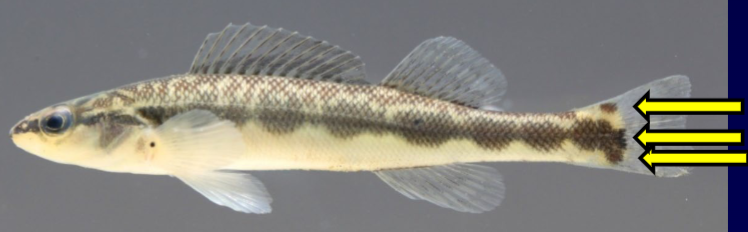
there are three vertically arranged basicaudal spots (the two lower ones often fused).
Percina sciera

Broad, scalloped-edged lateral stripe, spots on ventral half of the body.
Percina stictogaster

Spiny dorsal-fin pigmentation has several discreet, large black spots.
Sander canadensis

Spiny dorsal-fin pigmentation is finely sprinkled with melanophores, and a large vague dark spot may be present at the posterior base.
Sander vitreus