Module 4a: Cell Respiration to Fermentation
 Call Kai
 Learn
 Practice Test
 Spaced Repetition
 Match
 Flashcards
 Knowt Play
1/65

There's no tags or description
Looks like no tags are added yet.
Name | Mastery | Learn | Test | Matching | Spaced | Call with Kai | Chat |
|---|
No analytics yet
Send a link to your students to track their progress
66 Terms
What are the two fundamental tasks that all cells must accomplish to grow?
synthesize new parts and harvest energy to power reactions
The biochemical reactions in metabolism where the simple molecules combine to generate macromolecules is known as
Anabolism
Describes the conversion of energy from one form to another illustrated by a hydroelectric dam.
The potential energy of water stored behind the dam is converted to kinetic energy of moving water, which is converted to electrical current
Chemoorganotrophs oxidize _____ compounds such as glucose to obtain energy
organic
the set of chemical reactions that degrade compounds, releasing their energy
catabolism
Endergonic reaction
products have more free energy than the starting compounds
the reaction consumes energy
Starting compound —> intermediate a —> intermediate b —> end product
The first two reactions are catalyzed by enzymes A and B, respectively. If a mutant cell arose that was unable to produce enzyme B, what would be the impact on the other components of the pathway?
The cell could still produce intermediate a but would be unable to produce intermediate b or the end product
Three components needed by metabolic pathways
Terminal electron acceptor
ATP
Enzymes
Consider a cell converting glucose in CO2 and water with the release of energy. This is an example of _____ metabolism, and the reactions themselves are _____.
catabolism; exergonic
Which of the three central metabolic pathways generates the most reducing power?
Krebs cycle
Chemiosmotic Theory
It explains how the electron transport chain is linked to ATP synthesis
Example of activation energy
The energy of a small flame used to light the natural gas of a Bunsen burner

Fill in the blanks
ATP
energy released drives anabolic reactions
ADP
energy used comes from catabolic reactions
Processes that use an electron transport chain to set up a proton motive force used to generate ATP
Oxidative phosphorylation
photophosphorylation
What is needed in metabolic pathways?
ATP
Terminal electron acceptor
Enzymes
Electron carriers
Atoms that are more electronegative than others
have higher affinity for electrons
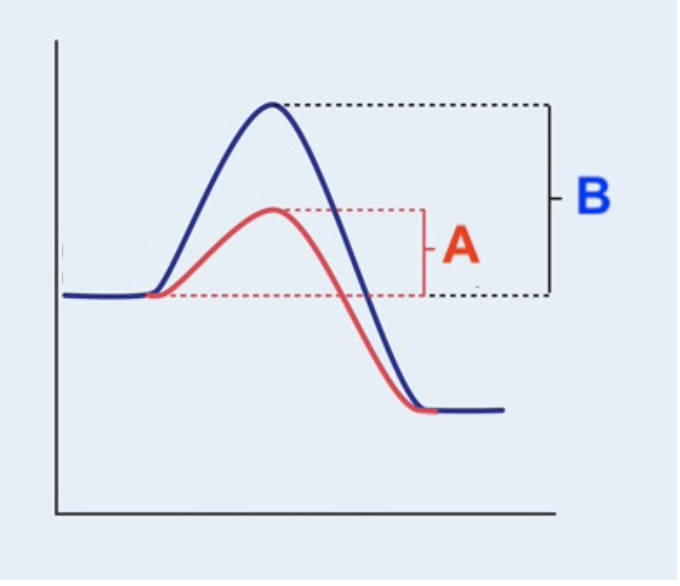
Which letter represents the activation energy of the reaction catalyzed by an enzyme?
A
The chemical that serves as the electron donor is the _______ and the one that ultimately accepts those electrons is the _____
energy source; terminal electron acceptor
Cells constantly produce ATP during ______ reactions of ______ and then use it to power ______ reactions of _______
exergonic; catabolism; endergonic; anabolism

Match the following three phosphorylation processes for ATP production.
energy released in an exergonic reaction is used to power the addition of P1 to ADP
Energy from exergonic reactions is used to create a proton motive force that drives the addition of P1 to ADP
The sun’s radiant energy and an electron transport chain create a proton motive force that drives the addition of P1 to ADP
A dehydrogenation reaction is ____ while a hydrogenation reaction is ____
oxidation; reduction
the tendency of an atom to accept one or more electrons and release energy in the process
electron affinity
Why do reduced electron carriers such as NADH, NADHP, and FADH2 represent reducing power?
they can easily transfer their electrons to another chemical that has a higher affinity for electrons
An organism that uses hydrogen sulfide as an energy source is called a _____ and is most likely _____.
chemolithotrophs; prokaryotic
Why are precursor metabolites important?
they serve as carbon skeletons from which subunits of macromolecules can be made
What are the reduced forms of NAD+ and FAD?
NADH, FADH2
Electrons carried by NADPH are
used to reduce compounds during biosynthetic reactions
What are the two key sets of processes included in catabolism?
oxidizing glucose molecules to generate ATP, reducing power, and precursor metabolites
transferring the electrons carried by NADH and FADH2 to the terminal electron acceptor
What are the end products of the three key central metabolic pathways?
ATP, precursor metabolites, reducing power
The central metabolic pathway that splits glucose and gradually oxidizes it to form two molecules of pyruvate
glycolysis
for aerobic respiration, which is the final electron acceptor?
O2
Compared to aerobic respiration, anaerobic respiration produces ____ ATP
less

A) does not use an electron transport chain; yields the least ATP of the three processes
B) uses an electron transport chain; yields more ATP than the other two processes
C) uses an electron transport chain; does not yield either the most or the least amount of ATP relative to the other two processes
Aerobic respiration: B
Anaerobic respiration: C
Fermentation: A
The metabolic pathway that oxidizes a 2-carbon acetyl group to release two molecules of CO2 and generates the most reducing power of all the central metabolic pathways
Krebs cycle
Fermentation
glucose is broken down via glycolysis
NAD+ is regenerated from NADH by the transfer of electrons to pyruvate or a derivative

Match according to its terminal electron acceptor.
A) Organic molecule (pyruvate or a derivative)
B) Molecule other than O2 such as nitrate, nitrite, or sulfate
C) O2
Aerobic respiration: C
Anaerobic respiration: B
Fermentation: A
Coenzymes are derived from
vitamins
environmental factors that affect proper enzyme function
temperature
pH
salt concentration
Critical site to which a substrate binds by weak forces
active site of an enzyme
A regulator binds at a secondary site, causing either increased or decreased binding to the active site
allosteric control of an enzyme
Enzyme specificity
The substrate must align spatially with the active site
hydrogen and ionic bonding occur to induce the correct fit between substrate and active site
a unique enzyme required to catalyze each reaction in a cell
In a biosynthetic pathway, what acts as the allosteric inhibitor?
End product
Describe the allosteric regulation of ATP and ADP
High levels of ATP inhibit
High levels of ADP stimulate
Until optimal temperature is reached, raising the temperature has what effect on the speed of enzymatic reactions?
increases their rate
A molecule that binds to a site othe3r than the active site of an enzyme and inhibits the enzyme’s function
allosteric inhibitor
The end product acting as an allosteric inhibitor of the pathway
feedback inhibition
When a compound binds to the active site of an enzyme, blocking access of the substrate to that site
competitive inhibition
What type of inhibitor is sulfanilamide?
competitive inhibitor
What happens in noncompetitive inhibition?
The inhibitor changes the enzyme shape so that it is no longer functional. The inhibitor “poisons” the enzyme

Match the type of enzyme inhibition on the left with the example of an inhibitor on the right
A. allosteric regulators
B. sulfa drugs
C. mercury
Competitive inhibition: B
Non-competitive inhibition by regulatory molecules: A
Non-competitive inhibition by enzyme poisons: C
In competitive inhibition, why is the inhibitor able to bind to the active site, thereby blocking access of the substrate?
The inhibitor has a chemical structure similar to the normal substrate

A. an inhibitor has a shape and structure similar to the substrate, so it competes with the substrate for the active site
B. An inhibitor binds to the enzyme but does not bind at the active site
Competitive inhibition: A
Noncompetitive inhibition: B i
If a bacterial cell had no ATP and was given glucose, what would happen with glycolysis?
The cell would be unable to perform glycolysis, since it would lack the initial investment of high-energy phosphate groups

Competitive inhibition: inhibitor binds to the active site of the enzyme, blocking access of the substrate
Non-competivtie inhibition by regulatory molecules: inhibition reversibly changes the shape of the enzyme so that the substrate can no longer bind to the active site
Non-competitive inhibition by enzyme poisons: inhibitor permanently changes the shape of the enzyme, making the enzyme non-functional
When a cell processes glucose or other organic molecules through its central metabolic pathways, it does so to generate what three critical things?
ATP, reducing power, precursor metabolites
Where are enzymes found in the Krebs cycle?
mitochondrial matrix
Where are enzymes found in prokaryotes?
cytoplasm
What is the total number of NADH and ATP molecules produced from a single glucose molecule?
2 NADH and 4 ATP
The transition step occurs twice for every molecule of glucose that enters glycolysis, oxidizing pyruvate to form acetyl-CoA. Together, these generate ______
2 NADH; 1 precursor metabolite (2 molecules of acetyl-Co-A)
For each glucose molecule, the pentose phosphate pathway yields ________
a variable amount of NADPH
2 precursor metabolites
The TCA cycle completes the ______ of glucose
oxidation
What are the reducing power products of the TCA cycle?
6 NADH
2 FADH2
Although the pentose phosphate pathway is used by cells to break down glucose, it is particularly important because of its contribution to ______
biosynthesis
What are the carriers of electrons that enter the electron transport chain?
NADH and FADH2
What happens to glucose inside a cell?
some glucose might be oxidized to CO2 generating the maximum amount of ATP
Some glucose might enter glycolysis, only to be siphoned off as a precursor metabolite for biosynthesis
Glucose can be used in catabolism to yield energy, or the precursor metabolites generated from its breakdown can be used in anabolism
Which of the three