Mod 4 - ENT 101
 Call Kai
 Learn
Learn Practice Test
 Spaced Repetition
 Match
Match Flashcards
 Knowt Play
1/35

There's no tags or description
Looks like no tags are added yet.
Name | Mastery | Learn | Test | Matching | Spaced | Call with Kai | Chat |
|---|
No analytics yet
Send a link to your students to track their progress
36 Terms
Passive Dispersal
Movement of an organism assisted by external sources.
Invasive Species
Organism that is not native to a specific location, and which causes damage in some way in its new range to the environment, the economy, or human health.
Phoresy
Movement of one organism that is being transported by another, without a parasitic relationship.
Active Dispersal
Movement of an organism powered by its own musculature, without the assistance of external sources.
Apodemes
Thick internal ridges of the exoskeleton that provide support for the internal organs and attachment points for muscles and tendons.
Resilin
Elastic protein which functions similarly to tendons in vertebrates.
Hydrostatic Skeleton
Structure supported by the pressure of fluid contained within it for insects that don’t have a rigid exoskeleton.

Parts of the Leg
Coxa, trochanter, femur, tibia, tarsus, and pretarsus.

Tripod Gait
3 legs remain in contact with the ground and centre of gravity remains balanced.
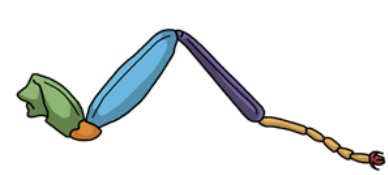
Cursorial Legs
Allow long strides and the leg segments are slim to reduce weight and increase stride frequency.

Raptorial Legs
Modified for grasping and holding, and the tibia and femur often feature spines to assist the grip.

Fossorial Legs
Forelegs modified for digging, with a flattened, enlarged, and hardened tibia that have tooth-like projections.

Saltatorial Legs
(Hind legs) have enlarged femurs and tibias to store energy to launch the insect.
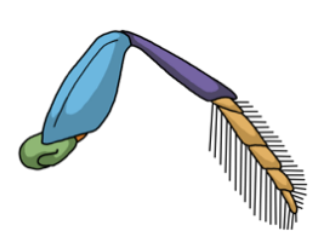
Natatorial Legs
(Mid or hind legs) segments are flattened with rows of setae or hairs to act like oars.

Proleg
Modified extensions of the body wall to improve grip on substrate. They are not “true legs” as they are not attached to the thorax and do not bear the six segments.
Paeloptera
“Old wing” and refers to the ancestral state of being unable to rotate the wings so they can be folded over the abdomen.
Neoptera
“New wings” in which they have flexion lines that allow them to be folded flat over the abdomen. Protected from physical damage and makes insect more compact.
Tegmina
Modified forewings used for protection, and asymmetry in the beats help steer the insect in flight.
Hemelytra
Half leathery, half membranous wings.
Elytra
Forewings that are completely sclerotized to form protective structures. They are unique to coleopterans.
Halteres
Reduced hindwings modified into small, knobbed stalks that help to improve stability.

Direct Flight Muscles
Flight muscles attach directly to the sclerites to power wing movement.

Indirect Flight Muscles
Flight muscles attach to anterior, posterior, dorsal, and ventral regions of the thorax, rather than directly to the wing bases.
Dorsoventral Muscles
Powers upstroke of wing.
Dorsal Longitudinal Muscles
Powers downstroke of wing.
Click Mechanism
Mechanism in insect flight that uses the elasticity of the thorax to store and release energy between wing strokes.
Synchronous Muscles
Muscles that produce one contraction cycle per nervous impulse. Less than 100 beats per minute.
Asynchronous Muscles
Muscles which produce multiple contraction cycles with a single nervous impulse. More than 100 beats per minute.
Migration
Direct and persistent movement of an animal towards a more suitable habitat driven by the animal's own efforts, during which the animal is unresponsive to to most stimuli.
Persistent movement away from home using animal’s locomotion.
Relatively direct movement toward a destination.
Generally unresponsive to stimuli.
Distinguishable pre- and post-migration behaviours.
Physiological changes in allocation of energy for biological processes.
Migratory Syndrome
Suite of pre-migratory behaviours and traits that predispose an organism to long-distance movement.
Oogenesis-Flight Syndrome
Delay of reproductive processes due to resource allocation to migratory traits over reproduction.
Locusts
Name given to the migratory form of some grasshopper species, which form under high population densities and poor environmental conditions, and have physiological, behavioural, and physical differences from the solitary form.
Swarm
Cluster of many insects.
Polyphenism
Phenomenon where two or more distinct phenotypes are produced by the same genotype.
Phenotypic Plasticity
Presence of multiple forms, or phenotypes, within a species or population dependent upon environmental conditions.
Citizen Science
Practice in which non-professional members of the public are guided by professional scientists to aid in experiments, data collection, or other aspects of scientific studies under standardized protocols.