Rotational Rotation 11/16

0.0(0)
Studied by 0 people
call kaiCall Kai
learnLearn
examPractice Test
spaced repetitionSpaced Repetition
heart puzzleMatch
flashcardsFlashcards
GameKnowt Play
Card Sorting

1/11

encourage image

There's no tags or description

Looks like no tags are added yet.

12 Terms

1
New cards
term image

To lift the heavy rock, the torque created by your force (τ=F×r\tau = F \times r) must overcome the torque exerted by the rock's weight. Moving the fulcrum closer to the large stone increases the distance between your hands and the pivot point, which gives you a longer input lever arm. This longer distance multiplies your applied force, generating a larger torque to successfully lift the rock.

<p><span>To lift the heavy rock, the torque created by your force ($\tau = F \times r$) must overcome the torque exerted by the rock's weight. Moving the fulcrum closer to the large stone increases the distance between your hands and the pivot point, which gives you a longer input lever arm. This longer distance multiplies your applied force, generating a larger torque to successfully lift the rock.</span></p>
2
New cards
term image

Throwing a football with a tight spin about its long axis generates angular momentum, which provides gyroscopic stability. This stability prevents aerodynamic forces from tumbling the ball, ensuring it maintains a single, consistent orientation during flight. Consequently, this predictable and streamlined trajectory makes it significantly easier for a receiver to track and catch the ball.

<p>Throwing a football with a tight spin about its long axis generates angular momentum, which provides gyroscopic stability. This stability prevents aerodynamic forces from tumbling the ball, ensuring it maintains a single, consistent orientation during flight. Consequently, this predictable and streamlined trajectory makes it significantly easier for a receiver to track and catch the ball.</p>
3
New cards
term image

When your toes are touching the wall, the axis around which you are free to rotate is positioned right up against the vertical surface. Because your center of mass is located near the center of your body rather than right against the wall, it does not align directly above this pivot point. As a result, the force of gravity acting on your center of mass creates a torque that tends to rotate you backwards about your toes.

<p>When your toes are touching the wall, the axis around which you are free to rotate is positioned right up against the vertical surface. Because your center of mass is located near the center of your body rather than right against the wall, it does not align directly above this pivot point. As a result, the force of gravity acting on your center of mass creates a torque that tends to rotate you backwards about your toes.</p>
4
New cards
term image

Rolling without slipping only requires an actual static friction force that matches the specific torque and linear acceleration demands of the motion. Doubling the coefficient of friction increases the maximum available friction threshold rather than altering the force needed to prevent slipping. Since the required frictional force remains unchanged and well below this new threshold, the object continues rolling without slipping with the exact same actual friction force.

<p>Rolling without slipping only requires an actual static friction force that matches the specific torque and linear acceleration demands of the motion. Doubling the coefficient of friction increases the maximum available friction threshold rather than altering the force needed to prevent slipping. Since the required frictional force remains unchanged and well below this new threshold, the object continues rolling without slipping with the exact same actual friction force.</p>
5
New cards
<p></p>


The wheel rims undergo both translational motion through space and rotational motion around their axis. Because their mass is concentrated far from the axis of rotation, reducing mass here has a massive impact on lowering rotational inertia. Consequently, choosing the rims saves a substantial amount of energy that would otherwise be required to accelerate both their rotation and translation.
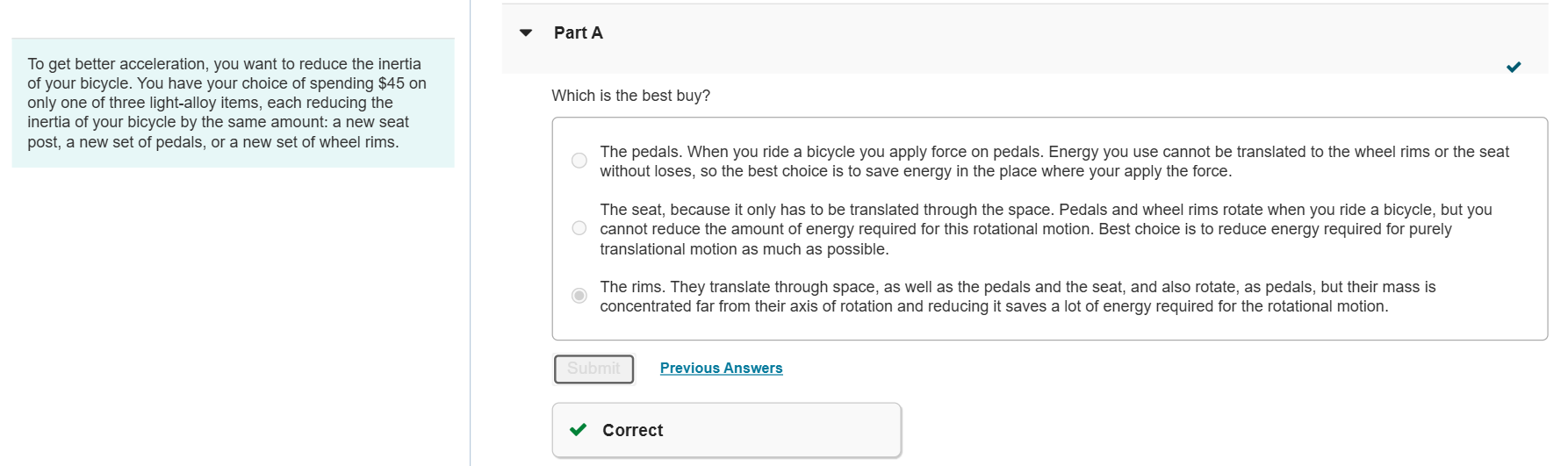
<p>The wheel rims undergo both translational motion through space and rotational motion around their axis. Because their mass is concentrated far from the axis of rotation, reducing mass here has a massive impact on lowering rotational inertia. Consequently, choosing the rims saves a substantial amount of energy that would otherwise be required to accelerate both their rotation and translation.</p>
6
New cards
term image

The acceleration of an object rolling down an incline depends on its mass and moment of inertia relative to its radius, but since both cans possess identical inertias, these dimensional differences cancel out. Because they convert gravitational potential energy into the same proportions of translational and rotational kinetic energy, their rates of acceleration are equal. Consequently, both cans travel down the ramp at the exact same speed and reach the ground at the same time.

<p>The acceleration of an object rolling down an incline depends on its mass and moment of inertia relative to its radius, but since both cans possess identical inertias, these dimensional differences cancel out. Because they convert gravitational potential energy into the same proportions of translational and rotational kinetic energy, their rates of acceleration are equal. Consequently, both cans travel down the ramp at the exact same speed and reach the ground at the same time.</p>
7
New cards
term image

As the rod rotates, both strings provide the centripetal force required for circular motion while the top string also helps support the downward force of gravity. Consequently, the tension components combine to make the total tension in the top string greater than in the bottom string at any given speed. As the rotational speed increases, the tension in the top string reaches its breaking limit first.

<p>As the rod rotates, both strings provide the centripetal force required for circular motion while the top string also helps support the downward force of gravity. Consequently, the tension components combine to make the total tension in the top string greater than in the bottom string at any given speed. As the rotational speed increases, the tension in the top string reaches its breaking limit first.</p>
8
New cards
term image

The ice cube converts all of its gravitational potential energy purely into linear kinetic energy because it slides without friction. In contrast, the rolling rubber ball must split its available energy between translational motion and rotational motion. Because no energy is diverted into rotation, the ice cube maintains a higher linear acceleration down the ramp and reaches the bottom first.

<p>The ice cube converts all of its gravitational potential energy purely into linear kinetic energy because it slides without friction. In contrast, the rolling rubber ball must split its available energy between translational motion and rotational motion. Because no energy is diverted into rotation, the ice cube maintains a higher linear acceleration down the ramp and reaches the bottom first.</p>
9
New cards
term image


<p></p>
10
New cards
11
New cards
12
New cards



